
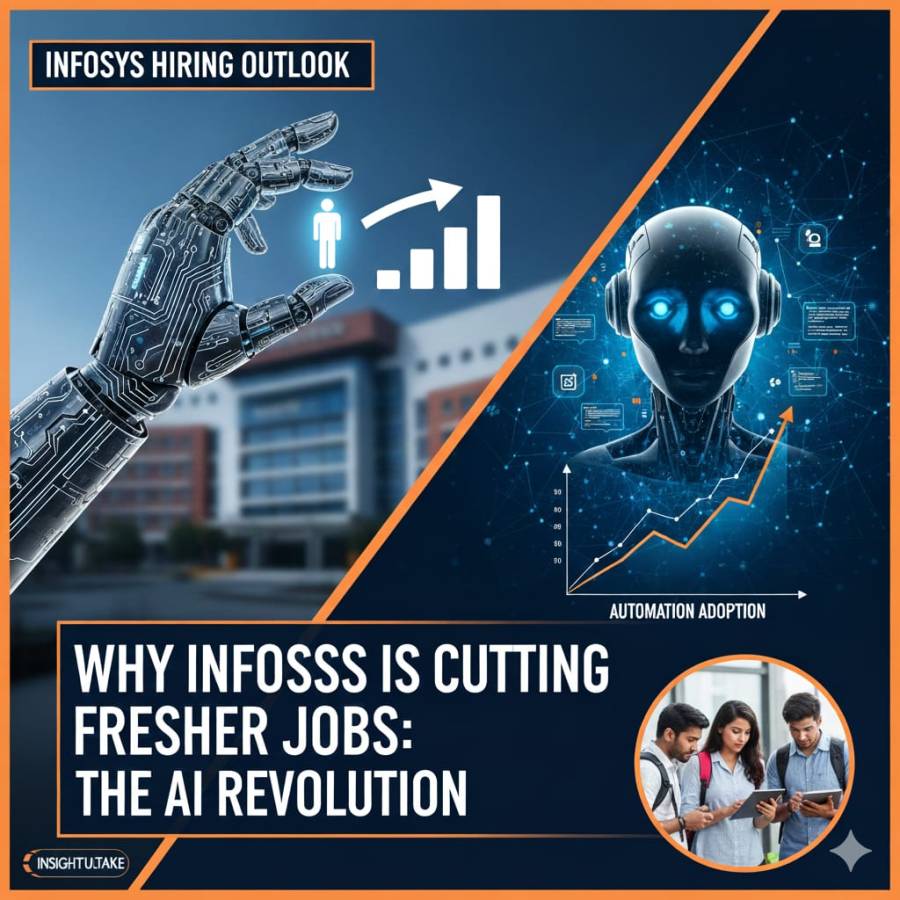
The landscape of the Indian IT sector is changing rapidly. For decades, landing a job at a major tech firm like Infosys right after college was the primary goal for millions of engineering students. However, recent news suggests that this path is becoming more narrow. Infosys, India’s second-largest software services provider, has announced plans to reduce its intake of fresh graduates in the coming years.
The main reason behind this shift is automation and artificial intelligence (AI). As technology becomes more advanced, the way IT companies operate is undergoing a massive transformation.
The Shift Toward Automation
According to recent reports, Infosys is explicitly forecasting a decline in entry-level job opportunities. In the past, IT companies followed a “linear growth model,” which meant that to increase revenue, they had to increase their headcount. If they wanted to make more money, they needed more people working on projects.
Today, that model is breaking. With the help of AI and automation, companies can now achieve “potential for revenue per headcount to increase.” This means fewer employees are needed to generate the same—or even more—amount of profit. Analysts from BMO Capital Markets have noted that higher productivity, enabled by automated tools, allows firms to do more with less.
Understanding the Numbers
To put this into perspective, let’s look at the hiring trends:
- Last Fiscal Year: Infosys hired 15,000 fresh graduates.
- Current Fiscal Year: The company expects to hire about 20,000 freshers (having already recruited over 12,000 in the first half).
- The Future: While the current numbers seem stable, the company's management expects future headcount to grow only “modestly.”
This change is a significant signal for the 1.3 million students graduating from thousands of engineering colleges across India. For the batch of 2026, the road to a “Big Tech” job may require more than just a degree.
Why Is This Happening Now?
Several factors are coming together to create this slowdown in fresher hiring:
- AI Disruption: Tasks that were previously given to entry-level engineers—such as basic coding, testing, and data entry—are now being handled by AI.
- Economic Uncertainty: Macroeconomic issues and a decrease in spending by international clients (especially in the US) have made companies more cautious.
- Visa Restrictions: Tighter visa rules in countries like the US make it harder for Indian IT firms to send employees abroad, leading to a change in how they manage their global workforce.
- Increased Productivity: As existing employees become more efficient using new digital tools, the need to hire large groups of new trainees decreases.
A Contrast in the Industry
Interestingly, not every company is following the same path. While Infosys is being vocal about a future decline in entry-level roles, its competitors like TCS (Tata Consultancy Services), Cognizant, and HCL Technologies have recently indicated a different outlook. These firms have guided for an increase in entry-level intake for the time being.
However, Infosys is often seen as a trendsetter. By being the first to explicitly forecast a decline due to automation, they may be signalling a long-term shift that the rest of the industry will eventually follow.
What Should Students Do?
For students graduating in 2026, skills will play a more important role in employability. Since machines are taking over basic tasks, human employees need to focus on high-value skills that AI cannot easily replicate.
Instead of focusing only on basic programming, students should look toward specialized fields like Cloud Computing, Cybersecurity, and AI Management. The era of “mass hiring” for simple roles is fading, replaced by a demand for “niche hiring” for complex roles.
While the news of fewer jobs might seem discouraging, it is actually a call to adapt. The IT industry is not shrinking but undergoing structural change.



























Leave a Comment