
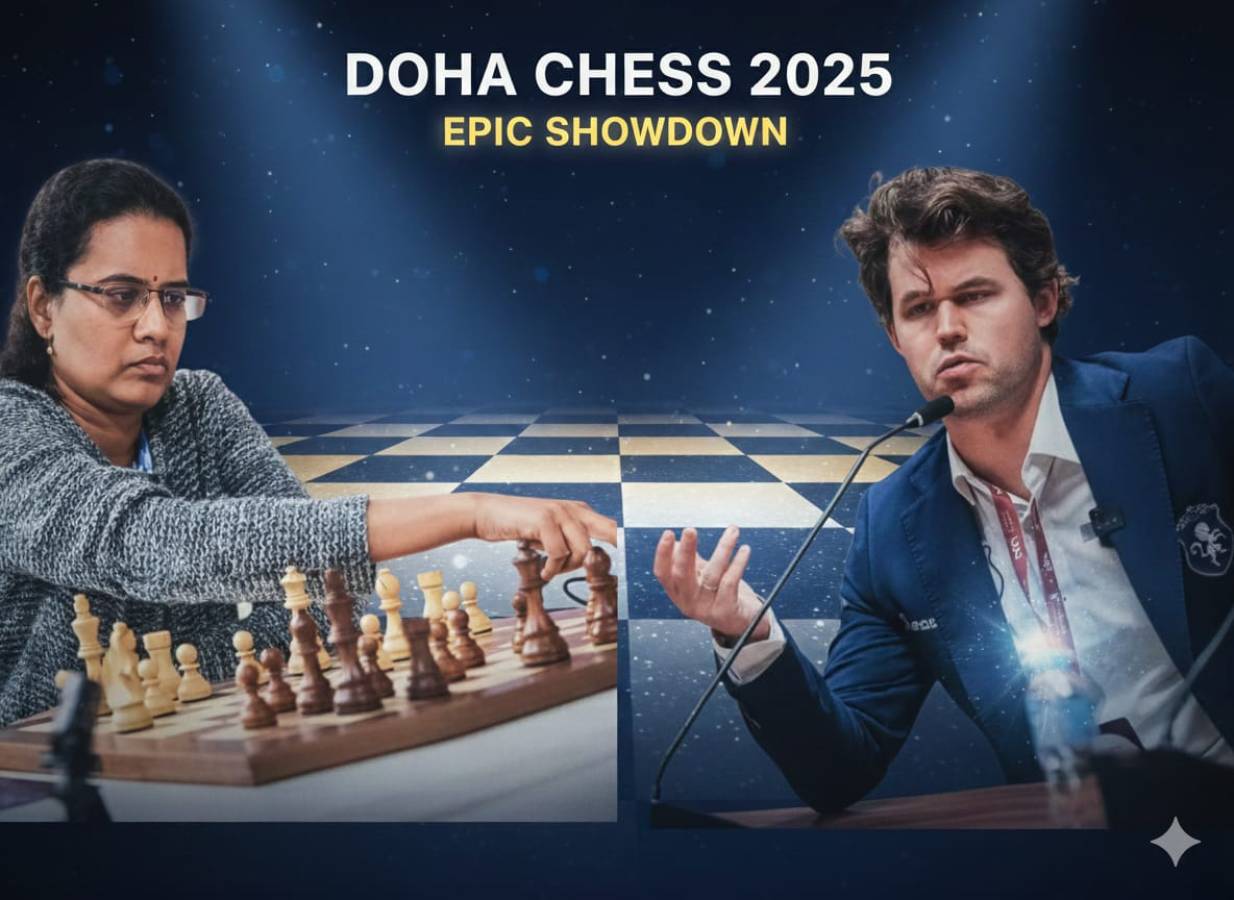
The chessboard in Doha was not just a battlefield of wood and ivory this week; it was a mirror reflecting the relentless evolution of professional sports. While the headlines will rightfully trumpet Magnus Carlsen’s sixth World Rapid crown and Koneru Humpy’s bittersweet bronze, the real story lies in the microscopic margins that separate a legacy-defining victory from a heartbreaking “what if”.
For the sports lover, Doha offered a masterclass in two of the most compelling narratives in competition: the terrifying, machine-like consistency of a GOAT (Greatest of All Time), and the poetic—often cruel—transition of power between generations.
The Carlsen Standard: Beyond Human Competition
Watching Magnus Carlsen navigate the Open section is becoming less like watching a sport and more like observing a natural law. By securing his sixth World Rapid title, Carlsen didn’t just win a tournament; he reinforced a psychological barrier that the rest of the world continues to struggle against.
What matters here isn’t merely the 10 points on the scoreboard or the trophy in his hands. It’s the way he responds to blips. A seventh-round loss to Vladislav Artemiev would derail most campaigns. For Carlsen, it became a catalyst.
He followed it with five consecutive victories—an unmistakable message to the field: his mistakes are temporary, his dominance is structural. For fans, Carlsen embodies the pinnacle of mental resilience. He isn’t playing the opponent across the table; he is playing against the limitations of the game itself.
The Changing Guard: A National Heartbreak
If Carlsen represents immovability, the Women’s section in Doha captured the irresistible force of change.
Koneru Humpy, the 38-year-old cornerstone of Indian chess, entered the final round not merely as a contender, but as an institution. For nearly two decades, she has been the North Star for generations of Asian players.
The heartbreak, however, wasn’t about missing gold. Humpy finished the tournament unbeaten. The deeper irony lay in how her title hopes slipped away—not at the hands of a foreign rival, but through an 18-year-old compatriot, Savitha Shri Baskar, a product of the very ecosystem Humpy helped build.
Humpy held a winning position. The title was within reach. But in a tense, oxygen-depleted 64-move scramble, the veteran blinked and the teenager held her nerve. It echoed an earlier moment this year against 19-year-old Divya Deshmukh.
For chess lovers, this is the bittersweet truth: the Humpy era isn’t fading because she has declined—it’s ending because the floor she constructed is now lifting others to higher ceilings.
The Cruelty of the Tie-Break
Doha also spotlighted a detail sports fans love to debate—the tie-break.
Humpy, Aleksandra Goryachkina, and Zhu Jiner all finished on 8.5 points, all undefeated. Yet Humpy walked away with bronze, edged out by the Buchholz system—a mathematical measure of opponent strength—without a playoff.
To the casual viewer, it feels unjust. To seasoned sports followers, it reinforces a harsher reality: context is everything. In Swiss-format tournaments, who you play matters almost as much as how you play. Every move in Round 1 casts a shadow on Round 11.
Humpy’s bronze stands as proof of excellence—and as a reminder that at the highest level, perfection is sometimes just the entry fee.
Why Doha Will Be Remembered
Years from now, Doha 2025 won’t be recalled only for medal tables. It will be remembered as the moment the gap between the established and the emerging visibly closed.
- For India: Three Indians—Humpy, Savitha, and Vaishali—in the women’s top five, along with Arjun Erigaisi’s bronze in the Open, signal that the Anand-Humpy era has matured into a nationwide movement.
- For the World: Magnus Carlsen remains the gravitational center of modern chess, even as new stars try to establish orbits of their own.
The Space Between Glory and a Draw
Ultimately, sport isn’t about winning alone. It is about the tension of the attempt—the fragile space where effort, nerve, and time collide.
Carlsen’s crown and Humpy’s heartbreak are two sides of the same coin, minted in pressure and decided by a single move. In that narrow, terrifying margin between victory and a draw, Doha revealed why chess—like all great sport—continues to matter far beyond the medals.
















Leave a Comment