
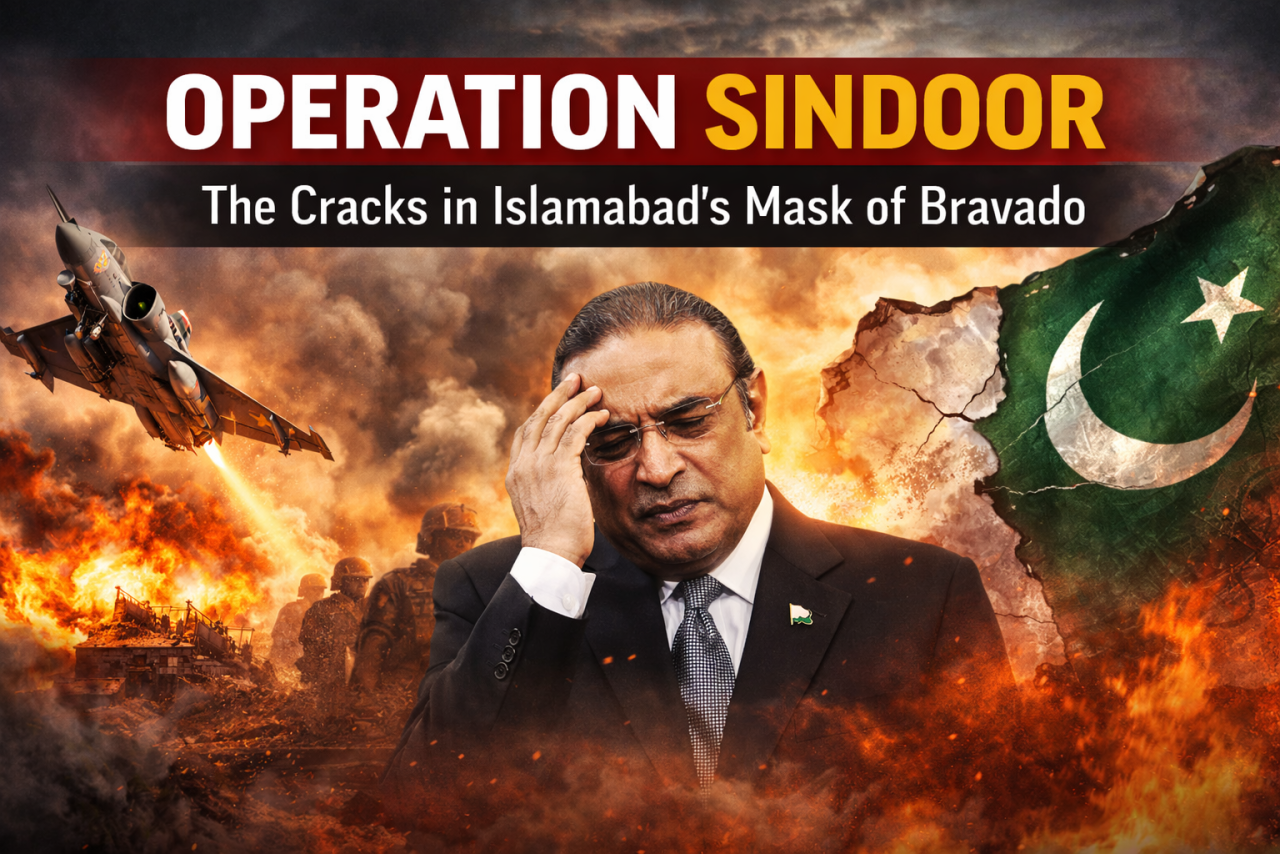
The long-standing myth of Pakistani "strategic defiance" finally crumbled under the weight of Indian precision during the events of May 2025. While the establishment in Islamabad has spent years perfecting a narrative of military parity, the aftermath of Operation Sindoor has forced a humiliating admission of vulnerability. For the first time, the world is seeing the stark contrast between Pakistan’s public posturing and the private panic that gripped its highest offices when Indian jets and missiles began neutralizing targets with surgical accuracy.
The "Bunker" Revelation: Panic at the Top
The most glaring evidence of this shift comes from President Asif Ali Zardari. In a recent public address that was likely intended to project strength, Zardari inadvertently exposed the sheer terror that permeated the government. He recounted a moment during the height of the Indian strikes when his Military Secretary (MS) rushed to him with an urgent plea: "Sir, the war has started... Let's go to a bunker."
While Zardari attempted to wrap this anecdote in a layer of heroism—claiming he refused to hide because "leaders don't die in bunkers"—the underlying message was unmistakable. The supreme commander of the Pakistani state was being ushered underground because his military could not guarantee his safety above it. This admission completely contradicts the initial Pakistani claims that the Indian operation was a failure or a mere "border skirmish." You do not scramble a head of state into a reinforced bunker over a failed operation; you do it because the "New India" has demonstrated it can strike whenever and wherever it chooses.
Rebutting the Double Standards of "Strategic Depth"
Pakistan’s history is defined by a double standard: sponsoring proxy terror while simultaneously playing the victim on the international stage. Operation Sindoor, launched in response to the Pahalgam terror attack, shattered this playbook.
Initially, the Pakistani military spokesperson dismissed the Indian strikes as "empty boasts." However, the truth began to leak through their own official channels. From the admission by Deputy PM Ishaq Dar regarding damages to the Nur Khan Air Base to the frantic deployment of anti-drone units along the Line of Control, the actions of the Pakistani state have consistently betrayed their words.
The most telling sign of their desperation was the request for a ceasefire initiated by the Pakistani DGMO just days into the operation. If Pakistan were as prepared and "unfazed" as their propaganda suggested, they would not have been the ones pleading for the guns to fall silent. They realized, far too late, that the era of "restraint" from New Delhi had been permanently replaced by a policy of "Strategic Clarity"—a policy that treats the source of terror as a legitimate military target.
The Anatomy of Terror in Islamabad
The terror felt in Islamabad was not just physical, but psychological. The Indian military didn't just strike terror camps; they struck the very idea that Pakistan could continue its proxy war without consequence.
- Tactical Helplessness: Despite Zardari’s claim that he "knew four days in advance" that a strike was coming, the Pakistani defense apparatus was unable to intercept or deter a single Indian asset.
- Leadership Disconnect: While the political elite discussed bunker protocols, the rank-and-file soldiers were left to face the brunt of an Indian military that had finally "taken the gloves off."
The End of the Bluff
Pakistan’s late acknowledgment of its fear is an admission that its decades-old bluff has been called. The double standard of projecting domestic strength while privately fearing total collapse is no longer sustainable. Operation Sindoor proved that the Indian military has the capability to bypass the traditional "escalation ladder" and strike at the heart of the provocateur.
By divulging how terrified they were, Pakistani leaders have unintentionally validated the effectiveness of India’s military resolve. The "Bunker Truth" is now out: Islamabad knows that in this new era, there is no corner deep enough to hide from the consequences of state-sponsored terror.
By Gautam Jha
Managing Editor





















Leave a Comment