
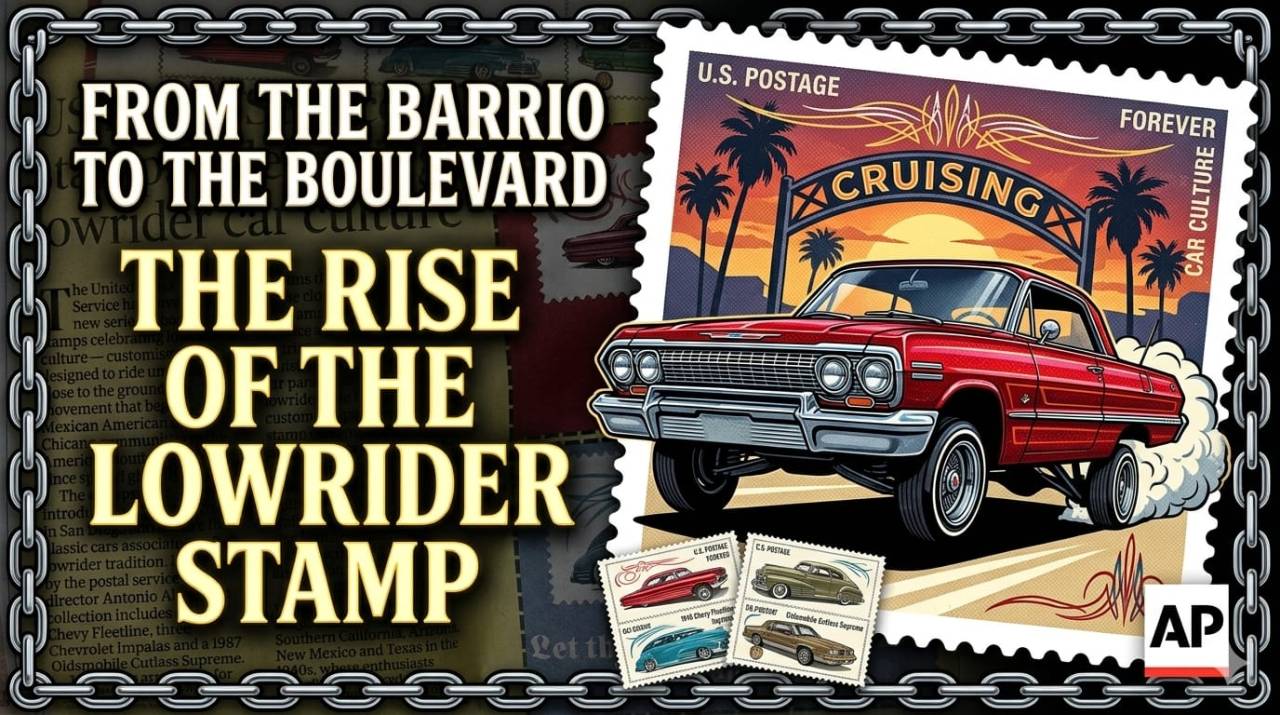
Once policed and pushed to the margins, lowriders now roll into American history—on official U.S. postage stamps.
For decades, the lowrider was a symbol of defiance. It was a rolling canvas of Chicano identity that authorities often met with suspicion, "anti-cruising" ordinances, and strict height restrictions. But in a poetic shift from the fringes to the heart of American iconography, the United States Postal Service has officially released a series of stamps celebrating lowrider car culture. This isn’t just about postage but a high-speed validation of a subculture that has spent eighty years cruising toward respect.
From the Barrios to the Post Office
The movement traces its roots back to the 1940s in working-class Mexican American and Chicano neighborhoods across Southern California and the American Southwest. While mainstream "hot rod" culture was obsessed with speed and engine power, lowrider pioneers turned the philosophy upside down. Their mantra became "low and slow."
Enthusiasts began modifying their everyday vehicles—classics like the Chevrolet Fleetline or the iconic Chevrolet Impala—to sit as close to the asphalt as possible. They weren't just cars; they were personalized works of art. The USPS collection, designed by art director Antonio Alcalá, captures this perfectly by featuring five classic models, including a 1946 Chevy Fleetline, three different Chevrolet Impalas, and a 1987 Oldsmobile Cutlass Supreme.
Artistry in Motion
What makes a lowrider a lowrider isn't just the stance; it’s the meticulous, often obsessive attention to detail. The stamps highlight the "holy trinity" of lowriding aesthetics:
- Custom Paintwork: Layers of candy-colored lacquers, metal flakes, and intricate murals that tell stories of family, faith, and heritage.
- Hydraulics: The technological marvel of aircraft-surplus pumps and valves that allow the car to "hop" or drop to the ground at the flick of a switch—originally a clever way to bypass laws against low-hanging frames.
- Pinstriping: The stamps feature original pinstriping artwork by illustrator and sculptor Danny Alvarado, honoring the fine-line calligraphy that defines the genre.
A Culture of Resistance and Community
For the communities in California, Arizona, New Mexico, and Texas where this culture flourished, these cars were never just about the metal. In the post-World War II era, when social and economic barriers were high, the lowrider was a way to claim space. When you cruise down a boulevard at five miles per hour in a glittering, custom-built machine, you are forcing the world to see you.
The San Diego ceremony for the stamp launch wasn't just a government presser; it was a homecoming. It acknowledged that lowriding is a family affair, passed down through generations of car clubs that serve as community anchors, organizing toy drives and neighborhood fundraisers.
The Global Glide
Today, the lowrider aesthetic has transcended its Southwest borders. You can find "Lowrider Sundays" in Tokyo, Brazil, and across Europe. What started as a local expression of Chicano pride has become a global visual language for craftsmanship and individuality.
By placing these vehicles on a "Forever" stamp, the United States Postal Service has signaled that this history is officially inseparable from the American story. It’s a reminder that beauty often comes from those who were once told they were "too low" to be seen. The next time you lick a stamp or drop a letter in the box, you’re carrying a piece of a culture that learned how to dance on the pavement.


















Leave a Comment