
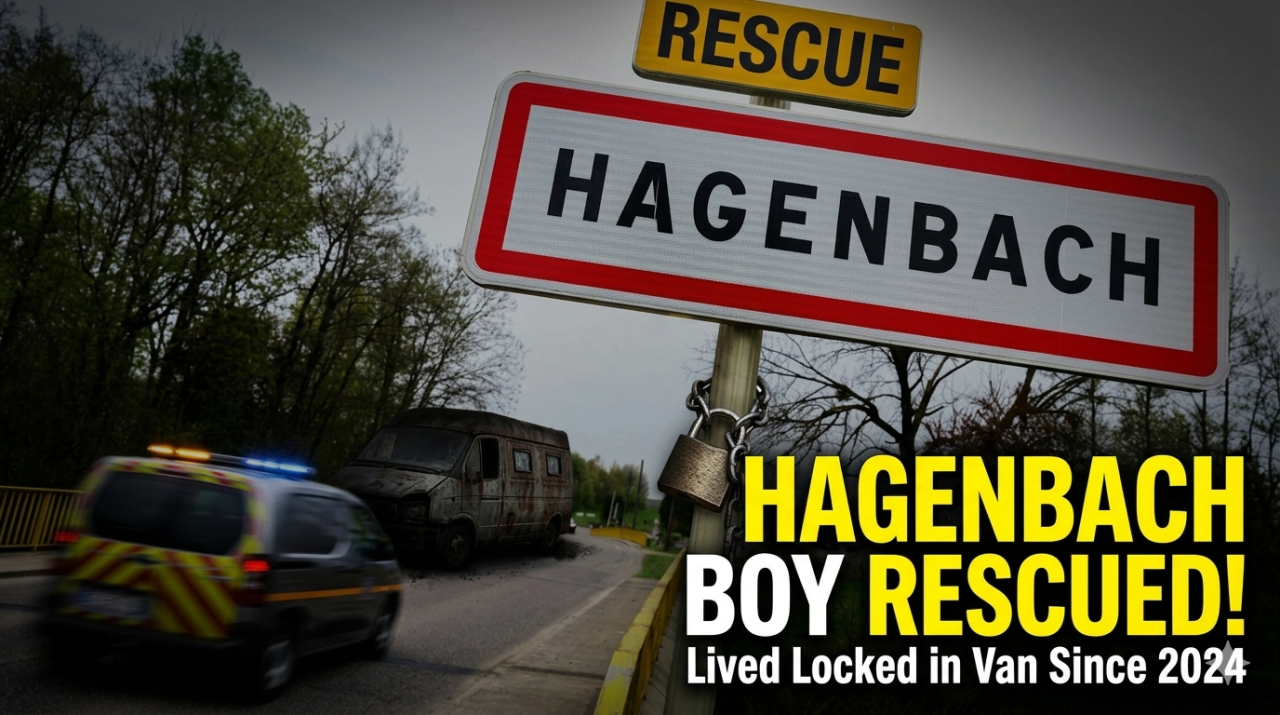
For two years, the world moved on while a child’s life was reduced to the four walls of a rusted van. Inside the shocking Hagenbach rescue that exposes the dark side of 'protection.'
In the quiet, border-hugging village of Hagenbach, where France meets the edges of Switzerland and Germany, the air is usually filled with the sounds of rural life—rustling trees, the occasional passing car, and the hum of a close-knit community. But for nearly two years, a far more haunting sound was emanating from a stationary utility van: the faint, desperate stirrings of a child whose world had been reduced to the cold metal confines of a vehicle.
Today, that silence was finally broken. Following a neighbor's tip regarding "sounds of a child" coming from the van, local police made a discovery that has sent shockwaves through the region. Inside, they found a 9-year-old boy, naked and curled in a fetal position, living atop a mound of trash and human waste.
A Rescue Shrouded in Trauma
According to Nicolas Heitz, the local prosecutor, the scene was one of profound neglect. The child was severely malnourished and, perhaps most tragically, had lost the ability to walk. Having been forced to remain in a seated or crouched position for so long within the cramped van, his muscles had effectively failed him. He told investigators a harrowing detail that underscores the passage of time: he had not showered since 2024.
While the boy was immediately hospitalized to address his physical state, the legal and psychological investigation into his "disappearance" began to peel back the layers of a deeply fractured family dynamic.
The "Protection" Paradox
The boy’s father, who is now in custody, offered a defense that sits uncomfortably between delusion and desperation. He claimed he locked the boy in the van starting in November 2024 to "protect" him. According to the father, his partner had intended to send the child—then only seven years old—to a psychiatric hospital.
However, Prosecutor Heitz noted a glaring absence of evidence for this narrative. Medical records show no history of psychiatric issues; in fact, before he vanished from public view, the boy was a successful student with good grades. Even more heartbreaking is the child’s own testimony. While he admitted to having "big difficulties" with his father’s partner, he told investigators he believed his father "had no choice" but to lock him away.
It is a classic, tragic example of a child’s unconditional loyalty—rationalizing the unthinkable actions of a parent as a necessary evil.
A Community in the Dark
The case raises a haunting question often explored here at InsightfulTake: How does a child vanish in plain sight for two years?
The answer lies in a web of calculated deception. The boy’s teachers were told he had transferred to a different school. Friends and family were led to believe he was indeed in a psychiatric institution. Meanwhile, a 12-year-old sister and a 10-year-old stepsister lived in the family home, seemingly unaware—or at least kept silent—about the prisoner in the van parked outside. These children have now been placed in the care of social services.
The father’s partner has denied any knowledge of the boy's presence in the van, though she faces preliminary charges for failing to assist a minor in danger.
The Road to Recovery
As Hagenbach residents express their silent shock, the investigation continues into whether anyone else in the community suspected the truth. This story serves as a grim reminder of the "bystander effect" and how easily the vulnerable can slip through the cracks of a busy, modern world when a narrative of "institutionalization" is used to mask abuse.
For the young boy, the journey back to health will be long. He must learn to walk again, not just physically, but emotionally, in a world that he hasn't seen since he was seven.
At InsightfulTake, we believe this case highlights the urgent need for more robust community vigilance and a re-evaluation of how we track the "disappearance" of children within the educational and social systems.
Behind the headlines of a "van rescue" lies a child who lost his childhood to a pile of trash and a blanket—all under the guise of protection. It is a story that demands not just our attention, but our collective resolve to ensure "protection" never again looks like a prison.
-With inputs from The Associated Press
In the quiet, border-hugging village of Hagenbach, where France meets the edges of Switzerland and Germany, the air is usually filled with the sounds of rural life—rustling trees, the occasional passing car, and the hum of a close-knit community. But for nearly two years, a far more haunting sound was emanating from a stationary utility van: the faint, desperate stirrings of a child whose world had been reduced to the cold metal confines of a vehicle.
Today, that silence was finally broken. Following a neighbor's tip regarding "sounds of a child" coming from the van, local police made a discovery that has sent shockwaves through the region. Inside, they found a 9-year-old boy, naked and curled in a fetal position, living atop a mound of trash and human waste.
A Rescue Shrouded in Trauma
According to Nicolas Heitz, the local prosecutor, the scene was one of profound neglect. The child was severely malnourished and, perhaps most tragically, had lost the ability to walk. Having been forced to remain in a seated or crouched position for so long within the cramped van, his muscles had effectively failed him. He told investigators a harrowing detail that underscores the passage of time: he had not showered since 2024.
While the boy was immediately hospitalized to address his physical state, the legal and psychological investigation into his "disappearance" began to peel back the layers of a deeply fractured family dynamic.
The "Protection" Paradox
The boy’s father, who is now in custody, offered a defense that sits uncomfortably between delusion and desperation. He claimed he locked the boy in the van starting in November 2024 to "protect" him. According to the father, his partner had intended to send the child—then only seven years old—to a psychiatric hospital.
However, Prosecutor Heitz noted a glaring absence of evidence for this narrative. Medical records show no history of psychiatric issues; in fact, before he vanished from public view, the boy was a successful student with good grades. Even more heartbreaking is the child’s own testimony. While he admitted to having "big difficulties" with his father’s partner, he told investigators he believed his father "had no choice" but to lock him away.
It is a classic, tragic example of a child’s unconditional loyalty—rationalizing the unthinkable actions of a parent as a necessary evil.
A Community in the Dark
The case raises a haunting question often explored here at InsightfulTake: How does a child vanish in plain sight for two years?
The answer lies in a web of calculated deception. The boy’s teachers were told he had transferred to a different school. Friends and family were led to believe he was indeed in a psychiatric institution. Meanwhile, a 12-year-old sister and a 10-year-old stepsister lived in the family home, seemingly unaware—or at least kept silent—about the prisoner in the van parked outside. These children have now been placed in the care of social services.
The father’s partner has denied any knowledge of the boy's presence in the van, though she faces preliminary charges for failing to assist a minor in danger.
The Road to Recovery
As Hagenbach residents express their silent shock, the investigation continues into whether anyone else in the community suspected the truth. This story serves as a grim reminder of the "bystander effect" and how easily the vulnerable can slip through the cracks of a busy, modern world when a narrative of "institutionalization" is used to mask abuse.
For the young boy, the journey back to health will be long. He must learn to walk again, not just physically, but emotionally, in a world that he hasn't seen since he was seven.
At InsightfulTake, we believe this case highlights the urgent need for more robust community vigilance and a re-evaluation of how we track the "disappearance" of children within the educational and social systems.
Behind the headlines of a "van rescue" lies a child who lost his childhood to a pile of trash and a blanket—all under the guise of protection. It is a story that demands not just our attention, but our collective resolve to ensure "protection" never again looks like a prison.
-With inputs from The Associated Press





























Leave a Comment