
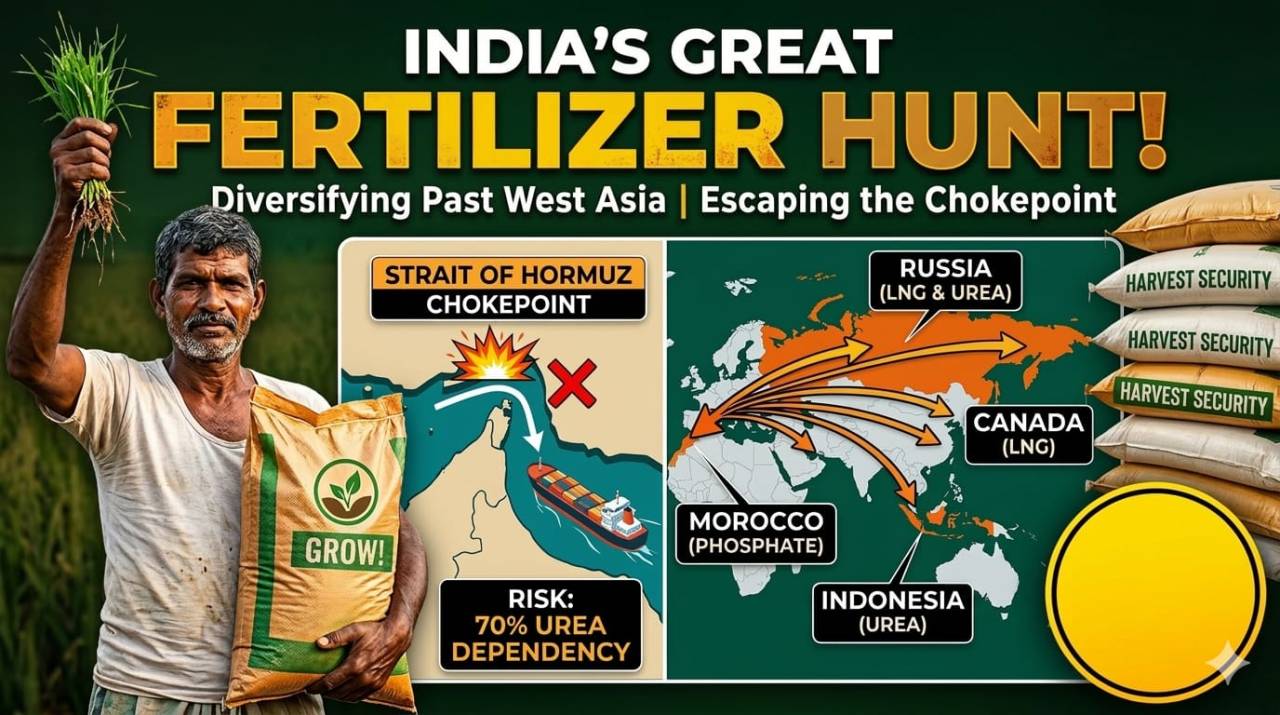
When a distant strait tightens, it’s not just ships that stall—it’s the fate of millions of Indian farms. As global tensions redraw trade routes, India is racing across continents to secure the one resource that decides whether its next harvest thrives or fails.
In the high-stakes game of global food security, India is quietly redrawing its strategic map. Faced with a volatile West Asia and the ever-present threat of supply chain disruptions, New Delhi has embarked on an ambitious exercise in what policymakers now call “fertilizer diplomacy”—a global outreach stretching from the phosphate reserves of Morocco to the industrial corridors of Indonesia.
At stake is not merely trade efficiency, but something far more fundamental: the assurance that when the Kharif season begins this June, millions of Indian farmers will not be held hostage to distant geopolitical shocks.
The “Strait” Jacket: Why Diversification is No Longer Optional
For decades, India’s fertilizer lifeline has flowed through the narrow waters of the Strait of Hormuz, a maritime chokepoint that handles nearly 70% of India’s urea imports. While efficient, this dependence has evolved into a structural vulnerability.
The risks are not hypothetical. Any escalation in tensions across West Asia—whether a blockade, naval standoff, or regional conflict—could choke supply lines overnight. The ripple effects would be immediate: shortages at the grassroots level, panic procurement, and a spike in food inflation in an already price-sensitive economy.
Recognizing this, India has pivoted toward a “hedge and harvest” doctrine. The strategy is simple in theory but complex in execution—diversify sources, deepen bilateral agreements, and insulate domestic agriculture from external shocks. Engagements with Belarus, Canada, and Senegal are not transactional deals; they are strategic insurance policies against an uncertain world.
A Three-Pronged Resource Scramble
India’s fertilizer challenge is not limited to a single commodity. It spans an entire ecosystem of inputs essential for soil productivity and crop yield. What is emerging is a coordinated, multi-layered procurement strategy:
|
Resource |
New / Expanded Sources |
Strategic Intent |
|
Urea |
Indonesia, Russia, China |
Reduce dependence on the Strait of Hormuz and ensure steady nitrogen supply |
|
DAP & Phosphatics |
Morocco, Jordan, Egypt |
Secure long-term reserves for root development and grain output |
|
Natural Gas (Feedstock) |
USA, Australia, Russia |
Offset the 3.2% dip in domestic urea production due to gas reallocation |
This is not merely diversification—it is a recalibration of India’s agricultural supply chain architecture.
The Domestic Squeeze: Energy vs Agriculture
The urgency of this global outreach is deeply rooted in domestic constraints. India’s fertilizer sector consumes nearly 30% of the country’s natural gas, making it one of the most energy-intensive industries.
Recent policy shifts have prioritized gas allocation for urban consumption—particularly piped cooking gas and CNG networks. While essential for urban energy security and environmental goals, this reallocation has inadvertently tightened supply for fertilizer production.
The result is visible: a 3.2% decline in domestic urea output over the first three quarters of the fiscal year. In a country where agricultural cycles are tightly synchronized with seasonal patterns, even marginal production dips can cascade into significant supply stress.
Thus, the global “hunt” is less a choice and more a structural necessity.
Beyond Fertilizers: The Rise of LNG Diplomacy
Experts like Sachchida Nand of the Indian Council for Research on International Economic Relations argue that India’s fertilizer strategy is, at its core, an energy strategy in disguise.
Urea production is intrinsically linked to natural gas. Without stable gas supplies, fertilizer self-sufficiency remains elusive. Recognizing this, India is expanding its LNG import basket, turning to relatively stable partners such as the United States and Canada.
This shift marks a subtle but significant geopolitical recalibration—moving dependence away from volatile regions toward predictable, rules-based trade environments. It is diplomacy not through rhetoric, but through resource alignment.
“Production planning and logistics are being actively coordinated to maintain adequate availability,” notes the Fertiliser Association of India, underscoring the scale of coordination required to align global shipments with India’s monsoon calendar.
A Global Strategy with Local Consequences
As the world’s largest importer of urea and diammonium phosphate (DAP), India’s procurement decisions carry global weight. Every new agreement, every diversified source, subtly reshapes international price dynamics and trade flows.
Yet, the true impact of this strategy will not be measured in diplomatic communiqués or trade statistics. It will be felt in the fields of Punjab, the farms of Telangana, and across the vast agricultural heartland.
For the Indian farmer, this global pivot is not an abstract policy shift. It is the difference between certainty and risk, between abundance and scarcity—between a bumper harvest and a season defined by constraint.
In an era where geopolitics increasingly shapes the price of food, India’s fertilizer diplomacy may well determine the resilience of its next harvest—and, by extension, the stability of its future.













Leave a Comment