
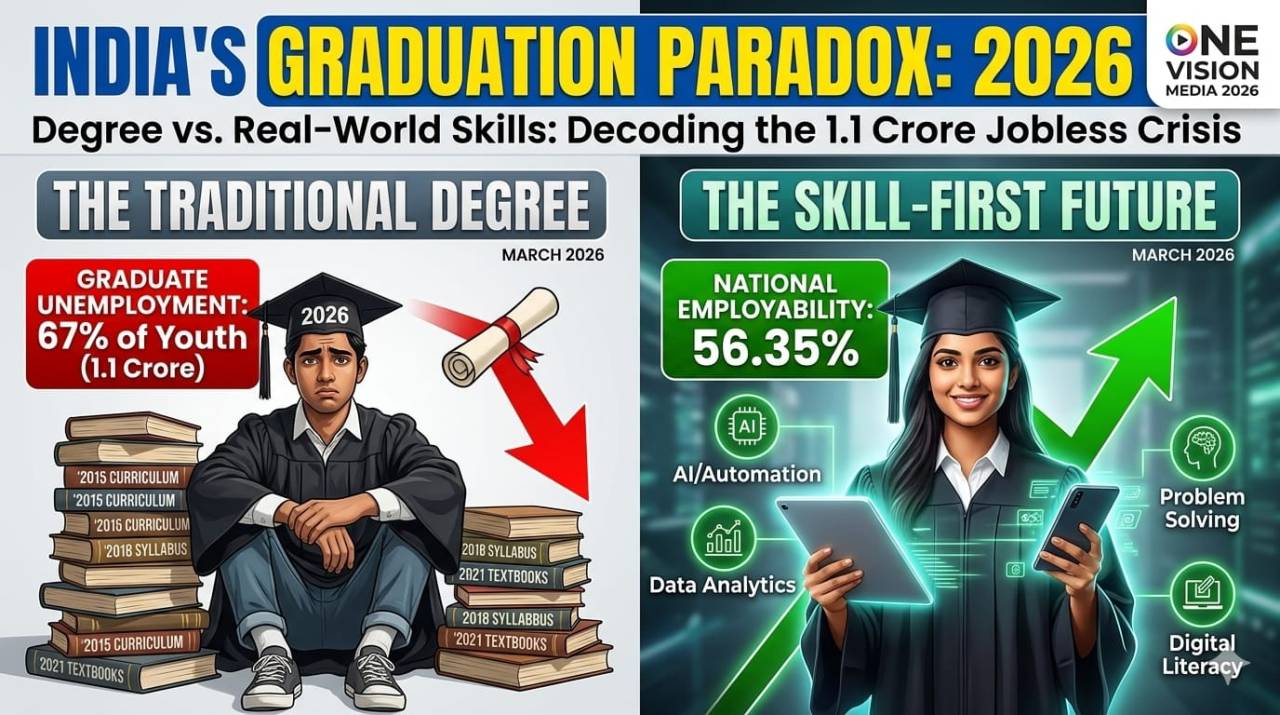
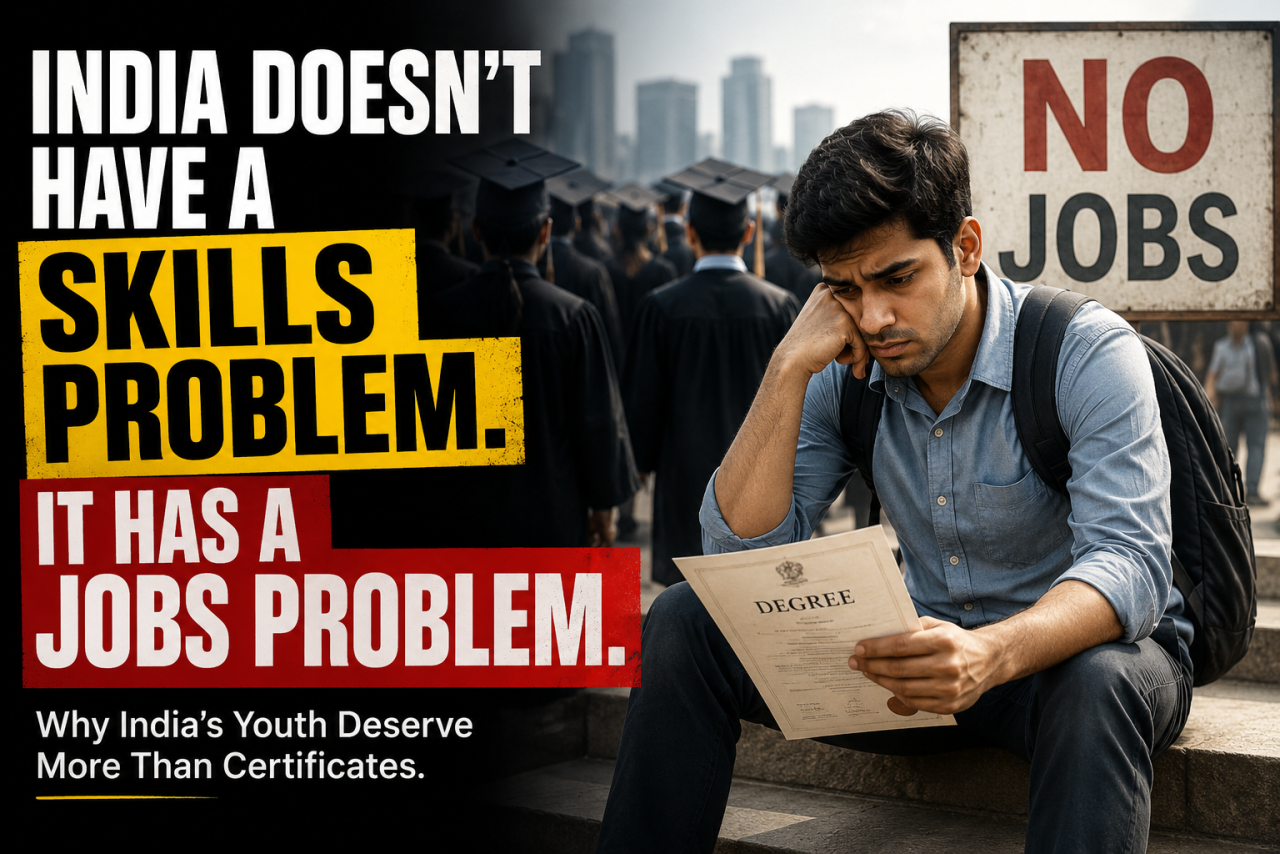
A degree was once a guarantee of stability. Today, it is becoming a waiting ticket in India’s unemployment queue. When 67% of jobless youth are graduates, the crisis is no longer about education—it is about relevance.
The dream of a stable career through higher education is facing a harsh reality check. According to the State of Working India 2026 report by Azim Premji University, a staggering 67% of unemployed youth in India are graduates. This is a massive jump from 2004, when graduates made up only 32% of the unemployed population. Today, nearly 1.1 crore graduates are sitting at home without work.
The crisis is not just about a lack of jobs. It is a fundamental mismatch between the supply of degrees and the demand for actual skills.
The Explosion of Degrees vs. The Stagnation of Jobs
Between 2004 and 2023, India added approximately 50 lakh graduates every single year. However, the number of employed graduates rose by only 28 lakh annually. Even more concerning is the nature of that employment. Out of those 28 lakh, only 17 lakh managed to secure salaried positions.
The data reveals a "Graduate Paradox":
- The Share of Graduates: In 2004, only 10% of youth (20–29 years) were graduates. By 2023, that number rose to 28% (6.3 crore people).
- The Unemployment Burden: As of 2023, 110 lakh (1.1 crore) graduates were unemployed.
- The Earnings Trap: In 2011, a male graduate earned more than double a non-graduate. By 2023, this "wage premium" has narrowed significantly. In some cases, non-graduates are seeing faster earnings growth than those with degrees.
Why the Degree is Losing Its Value
The report highlights that graduate employment has simply not kept pace with graduate supply. This has led to a situation of "too many graduates and too few jobs." However, the problem goes deeper than just numbers. It is about employability.
Employers today are moving away from traditional credentials. They now prioritize problem-solving, practical exposure, and adaptability. Our current education system remains fixated on marks and attendance. Meanwhile, the global industry demands high-level technical skills and digital literacy. When a student spends lakhs of rupees on a degree but lacks the skill to handle a real-world project, the degree becomes a "paper shield" that offers no protection against unemployment.
The Growing Wage Crisis
The economic advantage of having a degree is shrinking. In 2011, a young graduate man earned around ₹21,800 a month. By 2023, this figure adjusted for the current market has shown a downward trend in real value. Simultaneously, the earnings for non-graduates rose from ₹9,000 in 2011 to over ₹10,500 in 2023.
This narrowing gap suggests that the market now values specific labor and vocational skills more than a general academic degree. For many, the high cost of a college education is no longer yielding a high return on investment.
Solving the Systemic Failure
Blaming students for being "unskilled" is only half the story. This is a systemic failure. To turn this around by 2030, we must bridge the gap between what is taught and what is required.
- Curriculum Alignment: Colleges must work directly with industry leaders to ensure syllabi are relevant.
- Skill-Based Learning: We must stop preparing students for exams and start preparing them for challenges.
- Focus on Salaried Growth: Policy must focus on creating high-quality salaried roles rather than just promoting self-employment in the informal sector.
Final Thoughts
The "Degree But Jobless" trend is a wake-up call for the nation. With 1.1 crore graduates unemployed, we cannot afford to continue with an "education-as-usual" approach. A degree should be the beginning of a career, not the start of a long wait for a job. We must prioritize capabilities over certificates to ensure our youth have a future worth the investment.
















Leave a Comment