
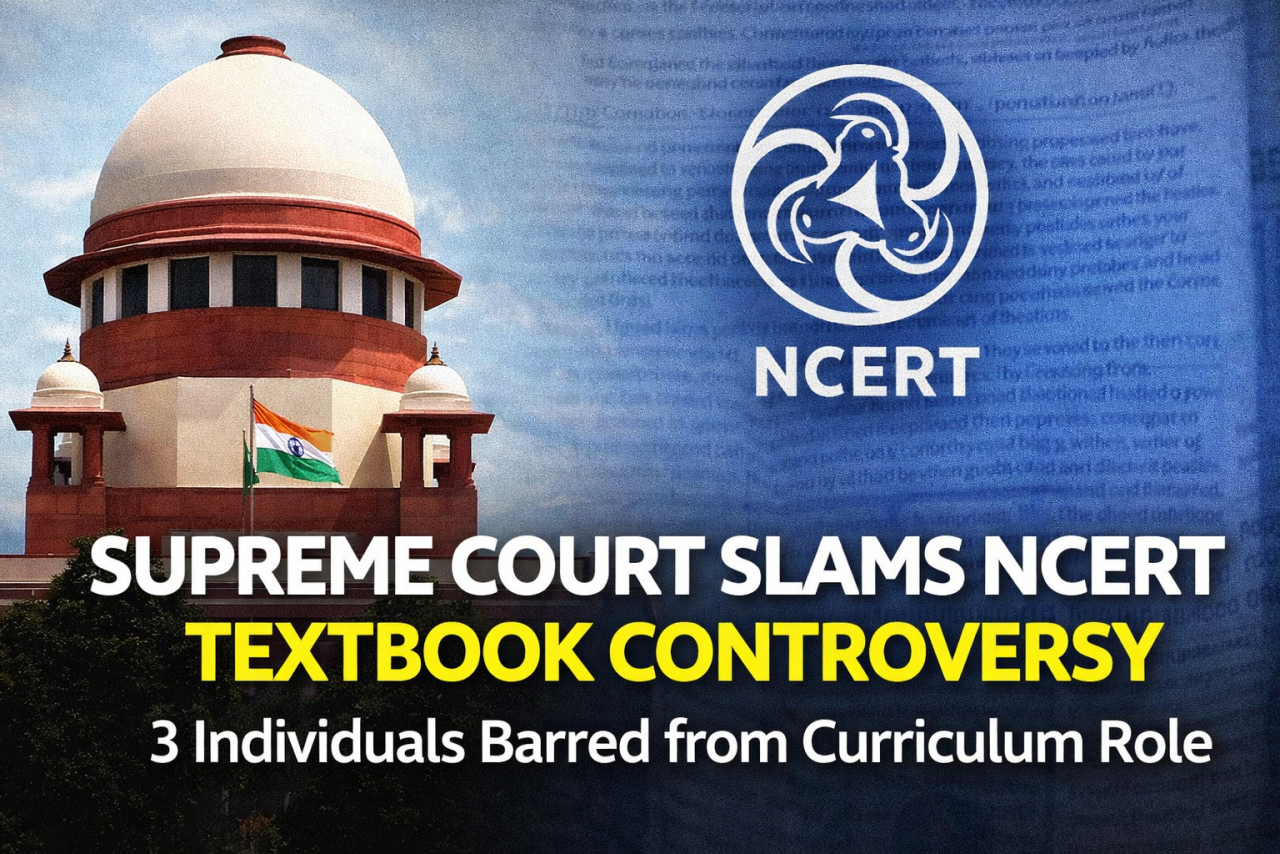
A major debate has erupted in India’s academic world after the Supreme Court questioned how NCERT textbooks are prepared and barred three individuals from curriculum roles. The ruling could reshape how school textbooks are written and reviewed in the country.
In a development that has sparked fresh debate over transparency and accountability in India’s academic institutions, the Supreme Court of India has directed the government and the National Council of Educational Research and Training (NCERT) to exclude three individuals from any role in school curriculum preparation following controversy over a Class 8 textbook chapter on the judiciary.
The court’s intervention came after questions were raised about the manner in which a chapter discussing corruption and delays in the judicial system had been drafted and circulated. The bench, led by Sanjiv Khanna along with Justices Joymalya Bagchi and Vipul M. Pancholi, expressed concern over the absence of institutional safeguards in the preparation of school curriculum.
At the centre of the dispute are historian Michel Danino, educator Suparna Diwakar and legal researcher Alok Prasanna Kumar, who were associated with drafting or reviewing the controversial content. The court directed that the three should not be involved in any manner in the preparation or finalisation of school textbooks until the matter is properly examined.
Court Questions Oversight in Curriculum Design
The bench was particularly critical of the apparent lack of structured oversight in preparing educational material that would be taught to young students across the country. According to the court, school curriculum—especially topics related to the judiciary—must pass through rigorous institutional review before reaching classrooms.
During the proceedings, the judges noted that the disputed chapter had been circulated digitally to a limited group without broader academic scrutiny. Such a process, they suggested, raises serious concerns about how sensitive topics are handled in educational content.
“The process appears surprisingly open-ended,” the bench observed while reviewing affidavits filed by NCERT. The judges indicated that the current system allowed significant academic material to be prepared and circulated without clearly defined approval mechanisms.
The court remarked that when the subject matter concerns the functioning of the judiciary, the absence of legal experts in the review process is particularly troubling. It suggested that any committee responsible for curriculum development should ideally include a former senior judge, a reputed academic and an experienced legal practitioner.
Government Asked to Revisit Committee Structure
The controversy has also drawn attention to the National Syllabus and Teaching Learning Material Committee (NSTC), a body constituted by NCERT to design textbooks for Classes 3 to 12. The Supreme Court questioned the composition of this committee, noting that despite its responsibility for teaching students about legal institutions, it did not include a prominent jurist.
The court therefore asked the Union government to reconsider the committee’s composition and ensure that adequate subject-matter expertise is incorporated into curriculum development.
If the chapter on the judiciary is to be reintroduced in future textbooks, the court directed that it must first be reviewed and finalised by a properly constituted panel of domain experts.
Concerns Over Public Perception of the Judiciary
The case has emerged at a time when debates around institutional credibility and academic freedom are increasingly shaping discussions within India’s education system. The court acknowledged that educational material should encourage critical thinking but warned against presenting incomplete or misleading perspectives to impressionable students.
Judges noted that while the judiciary, like any institution, can be subject to criticism, the context and presentation of such criticism in school textbooks must be responsible and balanced.
The bench also took note of the government’s statement that the NCERT director and senior officials had already expressed unconditional regret over the way the chapter had been prepared and circulated. Authorities informed the court that the content was being reviewed for future editions of textbooks.
Broader Questions for India’s Academic Ecosystem
Beyond the immediate dispute, the ruling has triggered a wider discussion in academic circles about the governance of school curricula in India. Education experts say the episode highlights the need for greater transparency, peer review and institutional accountability in the process of developing textbooks that shape the intellectual outlook of millions of students.
For decades, NCERT textbooks have served as a foundational reference for schools across the country, influencing not only classroom teaching but also competitive examinations and academic discourse. Any controversy involving their content therefore carries implications far beyond a single chapter or subject.
As the government begins reviewing the structure and procedures of curriculum committees, the case may become a defining moment in how educational content is prepared, scrutinised and approved in India.
For scholars, teachers and policymakers alike, the Supreme Court’s intervention sends a clear message: the integrity of academic material is not merely an educational concern—it is also a matter of institutional responsibility.
















Leave a Comment