
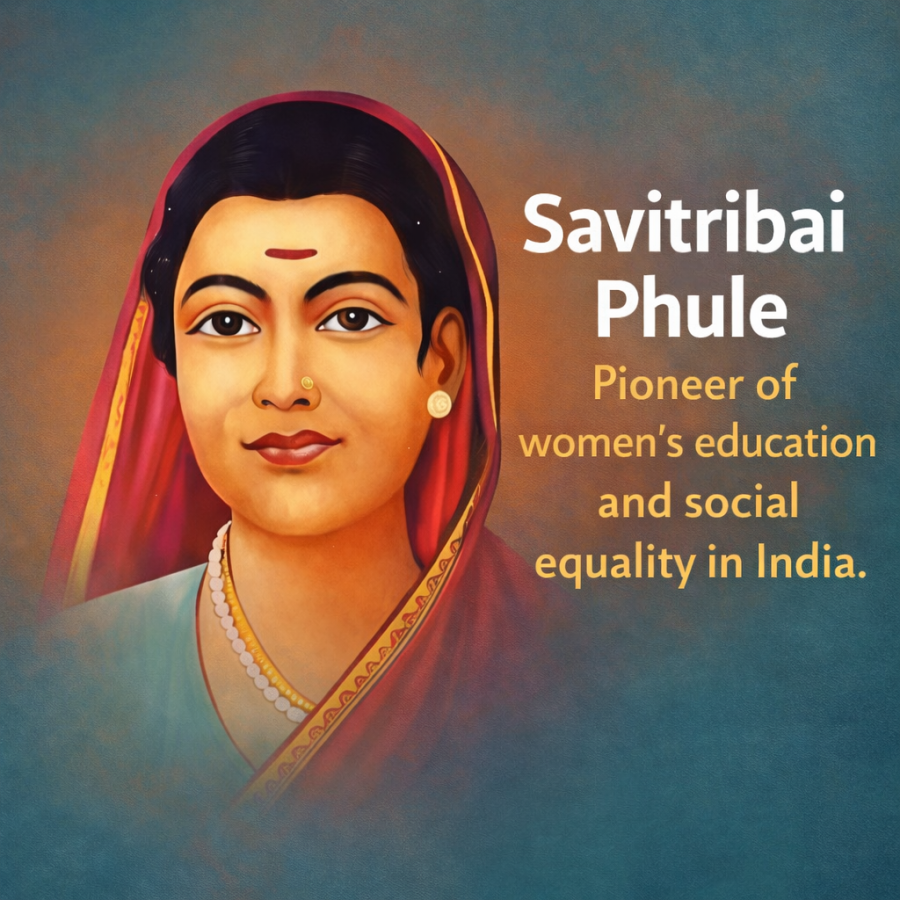
Savitribai Phule challenged caste, gender and ignorance with courage and compassion, proving that education can become the most powerful weapon against injustice and social inequality.
In the history of Indian society, few figures have challenged injustice as courageously and as quietly as Savitribai Phule. Remembered as India’s first woman teacher, she was far more than an educator. She was a social reformer, a poet, a feminist, and above all, a moral force who questioned traditions that denied dignity to women and the oppressed. More than a century after her time, Savitribai Phule’s ideas continue to guide India’s struggle for equality, education, and social justice.
Born on January 3, 1831, in Naigaon village of Maharashtra, Savitribai grew up in a society where women were denied education and confined to domestic roles. Child marriage was common, caste discrimination was rigid, and education was a privilege reserved mainly for upper-caste men. In such an environment, the idea of a woman teaching children—especially girls and Dalits—was seen as a threat to social order.
Savitribai’s life changed after her marriage to Jyotirao Phule, a visionary reformer who believed that education was the most powerful weapon against oppression. Jyotirao taught Savitribai to read and write, an act that itself was revolutionary. Later, she received formal teacher training, becoming one of the first trained women teachers in India.
In 1848, Savitribai and Jyotirao Phule opened the first school for girls in Pune. This moment marked the beginning of a social revolution. Savitribai walked daily to the school, fully aware of the hostility she would face. Conservative sections of society threw stones, mud, and cow dung at her. Yet she continued, carrying an extra sari so she could change before entering the classroom. This act symbolized her determination: education was worth every humiliation.
Savitribai did not limit her work to girls from privileged backgrounds. She actively worked for the education of children from Dalit and marginalized communities. At a time when caste discrimination was deeply rooted, her classrooms became spaces of equality. For her, education was not just about literacy; it was about self-respect and freedom from social bondage.
Her reform work extended beyond schools. Savitribai strongly opposed child marriage and the harsh treatment of widows. She worked to stop the cruel practice of forcing widows to shave their heads and supported their right to live with dignity. Along with Jyotirao Phule, she established shelters for widows and victims of sexual exploitation. These shelters also worked to prevent female infanticide, another dark reality of 19th-century India.
Savitribai was also a powerful poet and thinker. Her poems, written in simple yet forceful language, encouraged women and the oppressed to break free from ignorance and fear. She believed that education would awaken people to their rights and responsibilities. Her writings reflect a deep understanding of social inequality and a firm belief in human equality.
In 1873, Savitribai played a key role in the Satyashodhak Samaj (Society of Truth Seekers), founded by Jyotirao Phule. The organization worked against caste discrimination and religious hypocrisy. Savitribai’s participation in this movement highlighted her role not just as a supporter, but as an independent thinker and leader.
Her life of service continued till her last breath. In 1897, when a plague outbreak struck Pune, Savitribai personally cared for the sick, carrying patients on her own shoulders to hospitals. During this selfless service, she contracted the disease and passed away. Her death reflected the values she lived by—compassion, courage, and commitment to humanity.
In today’s India, Savitribai Phule’s presence feels as urgent as it was in the past. While access to education has expanded, gender inequality, caste discrimination, and social exclusion still exist. Girls in many parts of the country continue to drop out of school due to poverty, early marriage, and lack of safety. Dalit and marginalized communities still struggle for equal opportunities. In such a context, Savitribai’s belief that education is the foundation of social change remains deeply relevant.
Her life also speaks strongly to modern debates about women’s empowerment. Savitribai did not seek empowerment through slogans but through action—by teaching, organizing, writing, and serving. She showed that real change begins when women are given knowledge and the confidence to question injustice.
Savitribai Phule was not a reformer for her time alone. She was a reformer for every generation that dares to imagine a fairer society. Her legacy reminds us that education is not merely a tool for employment, but a path to dignity, equality, and freedom. As India moves forward in the 21st century, the ideals she stood for continue to light the way—quietly, firmly, and without compromise.
In the history of Indian society, few figures have challenged injustice as courageously and as quietly as Savitribai Phule. Remembered as India’s first woman teacher, she was far more than an educator. She was a social reformer, a poet, a feminist, and above all, a moral force who questioned traditions that denied dignity to women and the oppressed. More than a century after her time, Savitribai Phule’s ideas continue to guide India’s struggle for equality, education, and social justice.
Born on January 3, 1831, in Naigaon village of Maharashtra, Savitribai grew up in a society where women were denied education and confined to domestic roles. Child marriage was common, caste discrimination was rigid, and education was a privilege reserved mainly for upper-caste men. In such an environment, the idea of a woman teaching children—especially girls and Dalits—was seen as a threat to social order.
Savitribai’s life changed after her marriage to Jyotirao Phule, a visionary reformer who believed that education was the most powerful weapon against oppression. Jyotirao taught Savitribai to read and write, an act that itself was revolutionary. Later, she received formal teacher training, becoming one of the first trained women teachers in India.
In 1848, Savitribai and Jyotirao Phule opened the first school for girls in Pune. This moment marked the beginning of a social revolution. Savitribai walked daily to the school, fully aware of the hostility she would face. Conservative sections of society threw stones, mud, and cow dung at her. Yet she continued, carrying an extra sari so she could change before entering the classroom. This act symbolized her determination: education was worth every humiliation.
Savitribai did not limit her work to girls from privileged backgrounds. She actively worked for the education of children from Dalit and marginalized communities. At a time when caste discrimination was deeply rooted, her classrooms became spaces of equality. For her, education was not just about literacy; it was about self-respect and freedom from social bondage.
Her reform work extended beyond schools. Savitribai strongly opposed child marriage and the harsh treatment of widows. She worked to stop the cruel practice of forcing widows to shave their heads and supported their right to live with dignity. Along with Jyotirao Phule, she established shelters for widows and victims of sexual exploitation. These shelters also worked to prevent female infanticide, another dark reality of 19th-century India.
Savitribai was also a powerful poet and thinker. Her poems, written in simple yet forceful language, encouraged women and the oppressed to break free from ignorance and fear. She believed that education would awaken people to their rights and responsibilities. Her writings reflect a deep understanding of social inequality and a firm belief in human equality.
In 1873, Savitribai played a key role in the Satyashodhak Samaj (Society of Truth Seekers), founded by Jyotirao Phule. The organization worked against caste discrimination and religious hypocrisy. Savitribai’s participation in this movement highlighted her role not just as a supporter, but as an independent thinker and leader.
Her life of service continued till her last breath. In 1897, when a plague outbreak struck Pune, Savitribai personally cared for the sick, carrying patients on her own shoulders to hospitals. During this selfless service, she contracted the disease and passed away. Her death reflected the values she lived by—compassion, courage, and commitment to humanity.
In today’s India, Savitribai Phule’s presence feels as urgent as it was in the past. While access to education has expanded, gender inequality, caste discrimination, and social exclusion still exist. Girls in many parts of the country continue to drop out of school due to poverty, early marriage, and lack of safety. Dalit and marginalized communities still struggle for equal opportunities. In such a context, Savitribai’s belief that education is the foundation of social change remains deeply relevant.
Her life also speaks strongly to modern debates about women’s empowerment. Savitribai did not seek empowerment through slogans but through action—by teaching, organizing, writing, and serving. She showed that real change begins when women are given knowledge and the confidence to question injustice.
Savitribai Phule was not a reformer for her time alone. She was a reformer for every generation that dares to imagine a fairer society. Her legacy reminds us that education is not merely a tool for employment, but a path to dignity, equality, and freedom. As India moves forward in the 21st century, the ideals she stood for continue to light the way—quietly, firmly, and without compromise.
























Leave a Comment