
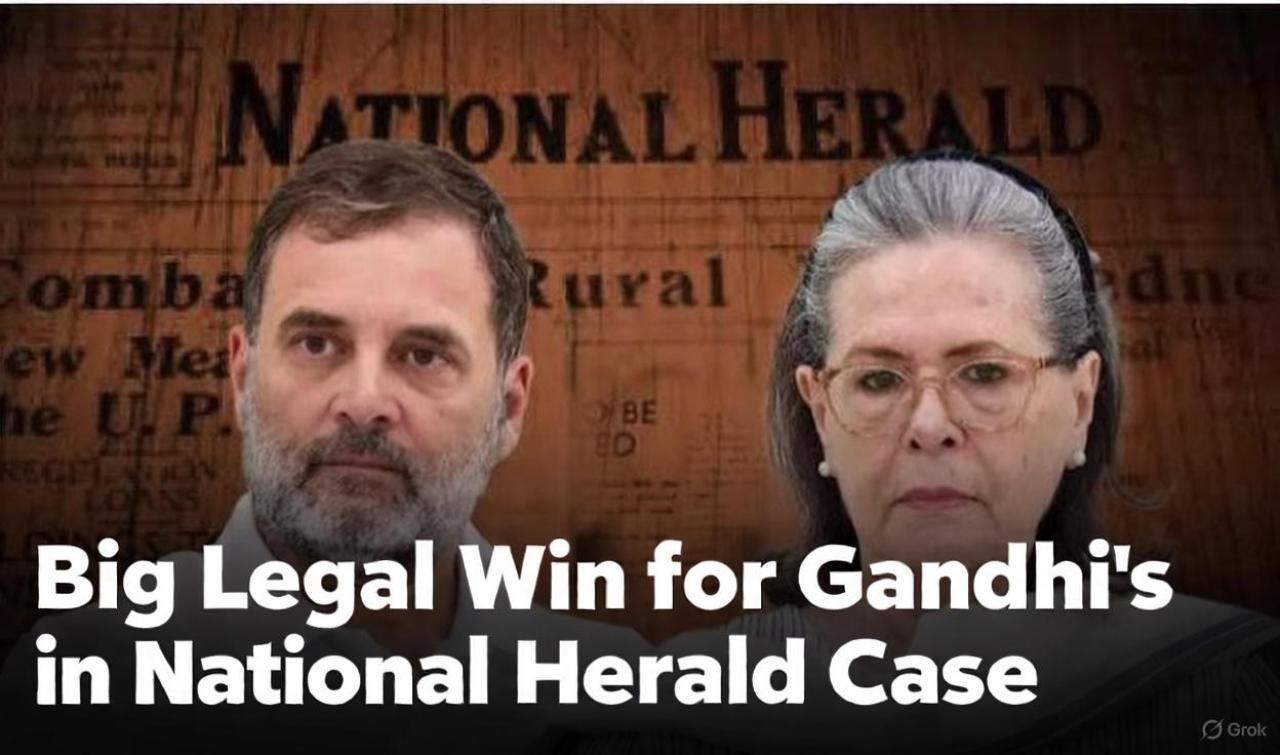
In a significant legal development that has sent ripples through India’s political landscape, a Delhi court has declined to take cognizance of the supplementary charge sheet filed by the Enforcement Directorate (ED) in the long-running National Herald case. The ruling provides a major, albeit potentially temporary, breather for senior Congress leaders Sonia Gandhi and Rahul Gandhi, who were central figures in the federal agency's money laundering allegations.
The decision, delivered by Special Judge Vishal Gogne of the Rouse Avenue Court, marks a critical juncture in a case that has been at the heart of a bitter "political vendetta" narrative between the ruling Bharatiya Janata Party (BJP) and the primary opposition, the Indian National Congress.
The Court’s Reasoning: Procedural Overreach?
In a comprehensive 117-page order, the court articulated that the ED’s current prosecution complaint was "impermissible in law." The crux of the judicial refusal lies in the procedural foundation of the investigation. The court noted that the ED’s move reflected a "unilateral overreach" of other law enforcement agencies, specifically the Central Bureau of Investigation (CBI).
The judge highlighted a fundamental legal hurdle: the current money laundering probe was founded on a private complaint filed by Dr. Subramanian Swamy under Section 200 of the CrPC, rather than a First Information Report (FIR) registered by a jurisdictional police or investigative agency.
"Since the present prosecution complaint pertaining to the offence of money laundering is founded on cognizance and summoning order upon a complainant... and not upon an FIR, cognizance of the present complaint is impermissible in law," the court stated.
Furthermore, the court observed that the ED appeared to have "out-paced" the scheme of the Prevention of Money Laundering Act (PMLA) by proceeding without a solid "predicate offence"—a primary crime that must exist for money laundering charges to be applicable.
A War of Words: Congress Claims Vindication, BJP Remains Firm
The Congress party was quick to hail the verdict as a victory for truth. Party President Mallikarjun Kharge took to social media, asserting that the "conspiracy of malicious intent for political revenge" had been foiled.
General Secretary KC Venugopal echoed these sentiments, describing the ED’s case as "without jurisdiction" and "without an FIR." He accused the agency of acting as a tool for the BJP to frame the Congress leadership in a "bogus" case.
On the other side of the aisle, the BJP sought to downplay the significance of the ruling. BJP leader Gaurav Bhatia clarified that the refusal to take cognizance is not equivalent to a "clean chit." He remarked on X that the law "doesn't run on hashtags," implying that the legal battle is far from over.
Deep Dive into the Allegations
The ED’s charge sheet, filed in April, had accused Sonia and Rahul Gandhi of illegally acquiring the assets of Associated Journals Limited (AJL), the publisher of the National Herald newspaper. The agency alleged that through Young Indian (YI), the Gandhis took over the debt-ridden AJL in a "surreptitious manner" to amass assets worth over ₹2,000 crore through a mere loan of ₹50 lakh.
The agency also claimed to have traced a trail of roughly ₹988 crore as proceeds of crime. Other prominent names mentioned in the charge sheet include Sam Pitroda, Suman Dubey, and various entities like Dotex Merchants, which the ED claims served as a shell company to facilitate loans for the conspiracy.
In defense, senior advocates RS Cheema and Abhishek Manu Singhvi, representing the Gandhis, argued that YI was a non-profit entity aimed at reviving the legacy of AJL. They maintained that no assets were moved to the Gandhis personally and that the transaction constituted no money laundering whatsoever.
Final Take
While the court has declined the current charge sheet, it has granted the ED the liberty to argue its case further at the next hearing. The federal agency has already signaled its intent to challenge the order in a higher court.
Interestingly, the Delhi Police's Economic Offences Wing (EOW) has recently registered an FIR in the matter. This move is seen by many as an attempt to create the "predicate offence" required to sustain the ED’s investigation under PMLA rules. As the EOW moves to conclude its investigation "quickly," the legal tug-of-war is expected to intensify in the coming months.
For now, the Gandhis remain out of the immediate line of fire, but with the ED's legal team consulting on an appeal, the National Herald saga continues to be a defining chapter in India’s judicial and political history.

















Leave a Comment