
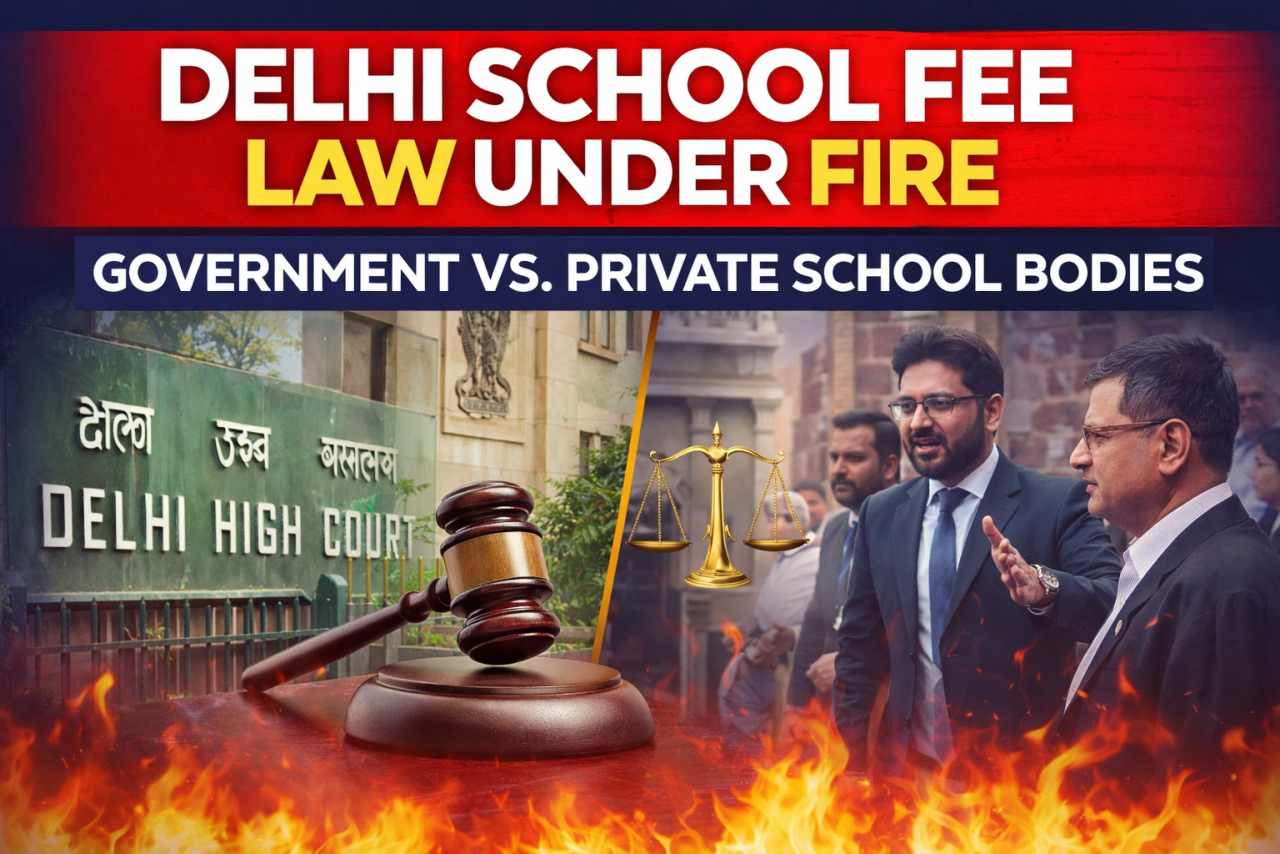
At a time when rising school fees are becoming a growing concern for urban families, the Directorate of Education has stepped forward to defend the Delhi School Education (Transparency in Fixation and Regulation of Fees) Act, 2025, arguing that the law introduces accountability without undermining the autonomy of private schools.
The debate over school fee regulation in the national capital has intensified after the Directorate of Education (DoE) defended the constitutionality of the Delhi School Education (Transparency in Fixation and Regulation of Fees) Act, 2025 before the Delhi High Court. The government argues that the new law does not strip private schools of their authority to set fees but instead introduces a regulatory framework designed to ensure transparency and prevent profiteering in the education sector.
The issue came to the forefront after several private school bodies and education groups filed petitions challenging the law. These petitions question whether the Act interferes with the autonomy of private educational institutions, particularly those that operate without government aid. In response, the DoE submitted a detailed affidavit on March 6 asserting that the legislation merely introduces “checks and balances” to make fee determination fair and accountable.
According to the government’s submission, the Act does not remove the power of school managements to determine their own fee structures. Instead, it establishes a system of oversight to ensure that fee increases are justified and not driven by commercial motives. The DoE emphasised that the legislation aligns with the broader vision of the National Education Policy 2020, which advocates greater transparency and accountability across the education ecosystem.
At the heart of the mechanism created by the Act is the role of the School Level Fee Regulation Committee (SLFRC). Under the new system, school managements will continue to propose fee structures, but these proposals must be placed before the committee for review. The committee includes representatives from parents and school authorities, thereby ensuring that multiple stakeholders participate in the decision-making process.
The government has also highlighted that if a dispute arises regarding the committee’s decision, schools will have the option to seek review through a two-tier mechanism. The matter can first be taken to a Divisional Fee Regulatory Committee, and if required, to a Revision Committee. Officials argue that this layered approach creates a balanced system where both institutions and parents have a fair opportunity to present their concerns.
Legal scrutiny of the Act has intensified because the petitions challenge its constitutional validity. Petitioners contend that the law undermines their fundamental right to carry on a profession or occupation by restricting their freedom to determine fees independently. Some associations representing private and minority schools have also argued that the legislation interferes with the rights guaranteed under Article 30 of the Constitution, which allows minorities to establish and administer educational institutions of their choice.
However, the government has strongly rejected these claims. In its affidavit, the DoE maintained that regulatory measures aimed at preventing commercialisation in education do not violate constitutional rights. Instead, they serve a larger public interest by ensuring that education remains accessible and affordable for families.
Officials also pointed out that the law fills a regulatory gap that existed under the Delhi School Education Act, 1973. According to the government, while the earlier law governed various aspects of school administration, it did not establish a comprehensive system for determining and monitoring fee structures. The new Act, the government argues, addresses this gap by providing a structured and transparent mechanism.
The petitions challenging the law have been filed by several school associations, including the Action Committee of Unaided Private Schools, the Forum of Minority Schools, and civil society organisations such as Justice for All. These groups argue that the Act represents an unnecessary intrusion into institutional governance and could create administrative hurdles for schools.
On the other hand, advocates of the legislation believe that it addresses a long-standing concern among parents regarding steep and often unpredictable fee hikes in private schools. Over the years, the rising cost of private education has triggered frequent disputes between parents and school administrations, particularly in metropolitan cities like Delhi.
Education experts say the case could set an important precedent for fee regulation across India. Several states have already experimented with regulatory frameworks to monitor school fees, but legal challenges have often followed. The outcome of this case, therefore, could influence how governments balance institutional autonomy with consumer protection in the education sector.
The bench led by Chief Justice Devendra Kumar Upadhyaya and Justice Tejas Karia is expected to examine the arguments presented by both sides in the coming hearings. As the legal battle unfolds, the verdict may shape the future relationship between private school managements, parents, and regulators—not only in Delhi but potentially across the country.
For India’s academic community, the case raises a fundamental question: how should education be governed in an era where institutions seek financial sustainability while society demands affordability and transparency? The answer may ultimately emerge from the courtrooms of Delhi, but its impact will likely resonate far beyond the capital.


























Leave a Comment