
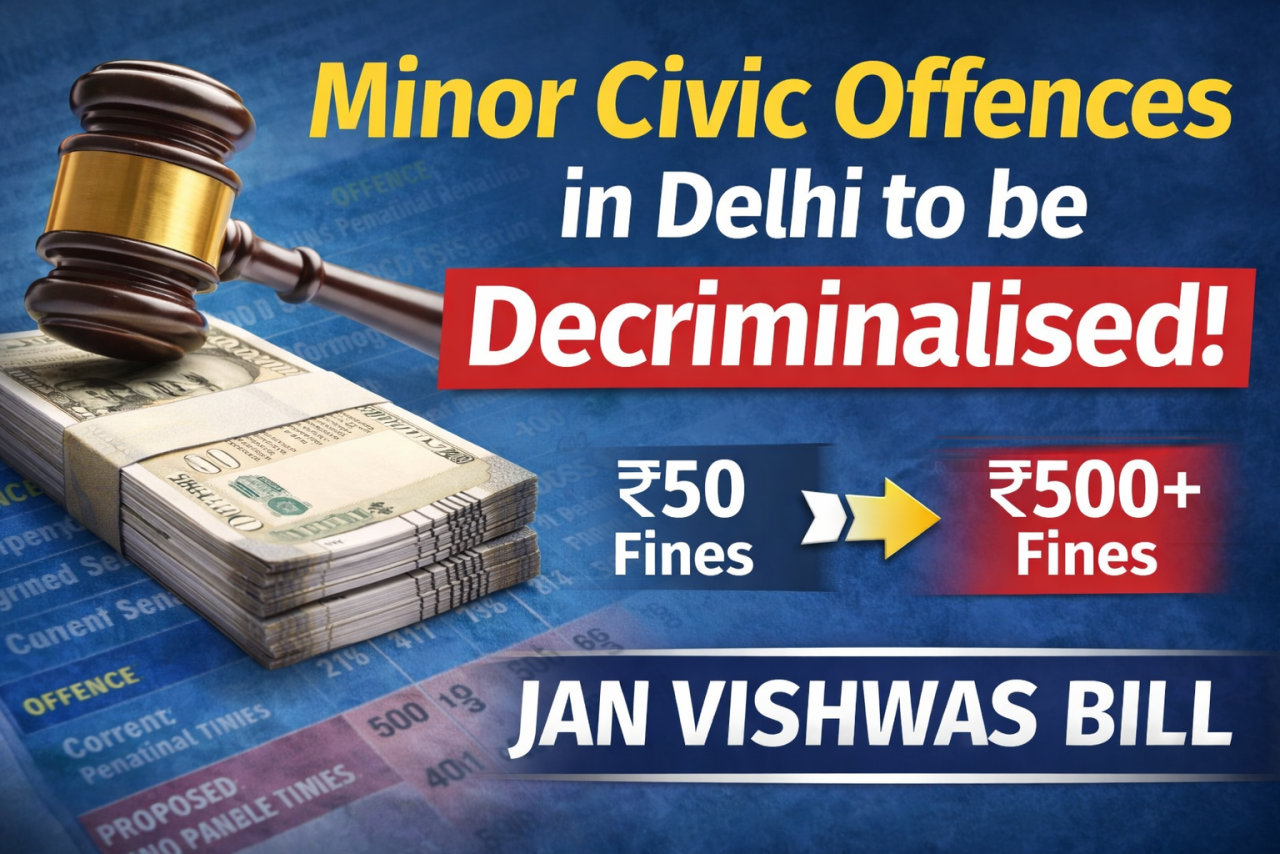
Delhi is set to scrap jail terms for minor civic offences—but the bigger question is: are higher fines the new way to enforce discipline?
The Government has introduced a new bill in Parliament aimed at changing how minor civic offences are treated in Delhi. The proposed law, part of the Jan Vishwas Bill 2026, focuses on decriminalising several small violations and replacing harsher punishments like imprisonment with financial penalties. The move will apply to areas under the Municipal Corporation of Delhi (MCD) and the New Delhi Municipal Council (NDMC).
This change is significant because it alters how everyday civic issues—such as public nuisance, street vending violations, and sanitation lapses—are handled. Instead of treating these as criminal acts that could lead to jail time, the system will now rely more on fines and warnings.
What is changing?
Under the current system, several minor offences fall under strict legal provisions that can include imprisonment. The new bill proposes to remove jail terms for many of these violations and replace them with monetary penalties.
For example, activities like public urination, creating foul smells, or minor sanitation issues currently attract small fines, often around ₹50. Under the new proposal, these fines could increase to ₹500. Similarly, running unlicensed food stalls or vending without permission could now attract penalties of up to ₹1,000.
In some cases, the penalties will follow a graded approach. For instance, failure to remove waste may first result in a warning, followed by a ₹500 fine if the violation continues. This approach is intended to encourage compliance without immediately penalising citizens harshly.
Focus on decriminalisation
A key feature of the bill is the removal of imprisonment provisions for minor offences. At present, certain violations—such as breaches of municipal by-laws—can lead to both fines and jail time. The proposed law seeks to eliminate jail terms for such offences entirely.
Officials say the aim is to reduce the burden on courts and make enforcement more practical. Instead of lengthy legal proceedings, authorities will be able to impose penalties more quickly and efficiently.
Impact on daily life
For residents, this means fewer chances of facing criminal charges for small civic issues. However, it also means higher fines for violations. The government appears to be shifting from a punitive legal system to a deterrence-based system where financial penalties play a bigger role.
For example, keeping surroundings clean and following municipal rules will become more important, as repeated violations could lead to higher cumulative fines. The focus is on encouraging responsible behaviour rather than punishing people through the legal system.
Effect on businesses and vendors
Small businesses, street vendors, and shop owners are among those most affected by these changes. Operating without proper licences or violating municipal norms will now result in steeper fines instead of legal cases.
For instance, hawking without a licence or obstructing municipal officials may attract penalties of ₹500 or more. While this reduces the risk of imprisonment, it increases the financial cost of non-compliance.
The government believes this will simplify regulations and make it easier for businesses to operate within the law, while still ensuring accountability.
Why this change is important
The move is part of a broader effort to improve ease of living and ease of doing business. By decriminalising minor offences, the government aims to reduce fear among citizens and businesses while also making enforcement more straightforward.
Legal experts note that criminalising small civic issues often leads to unnecessary litigation and delays. By replacing jail terms with fines, the system can become faster and more efficient.
At the same time, higher penalties ensure that rules are still taken seriously. The balance between enforcement and flexibility is central to this reform.
What happens next?
The bill is currently under consideration in Parliament. Once passed, the changes will be implemented across Delhi’s municipal jurisdictions. Authorities will likely update enforcement mechanisms and inform the public about the new rules.
Residents and business owners should pay attention to these developments and understand the revised penalties. While the risk of imprisonment may be reduced, the financial consequences of violations will increase.
Final Take
The proposed decriminalisation of minor civic offences in Delhi marks a shift in how urban governance is approached. By focusing on penalties instead of prosecution, the government is trying to make the system more practical and less burdensome. However, with higher fines in place, compliance will remain essential for everyone living and working in the city.



























Leave a Comment