
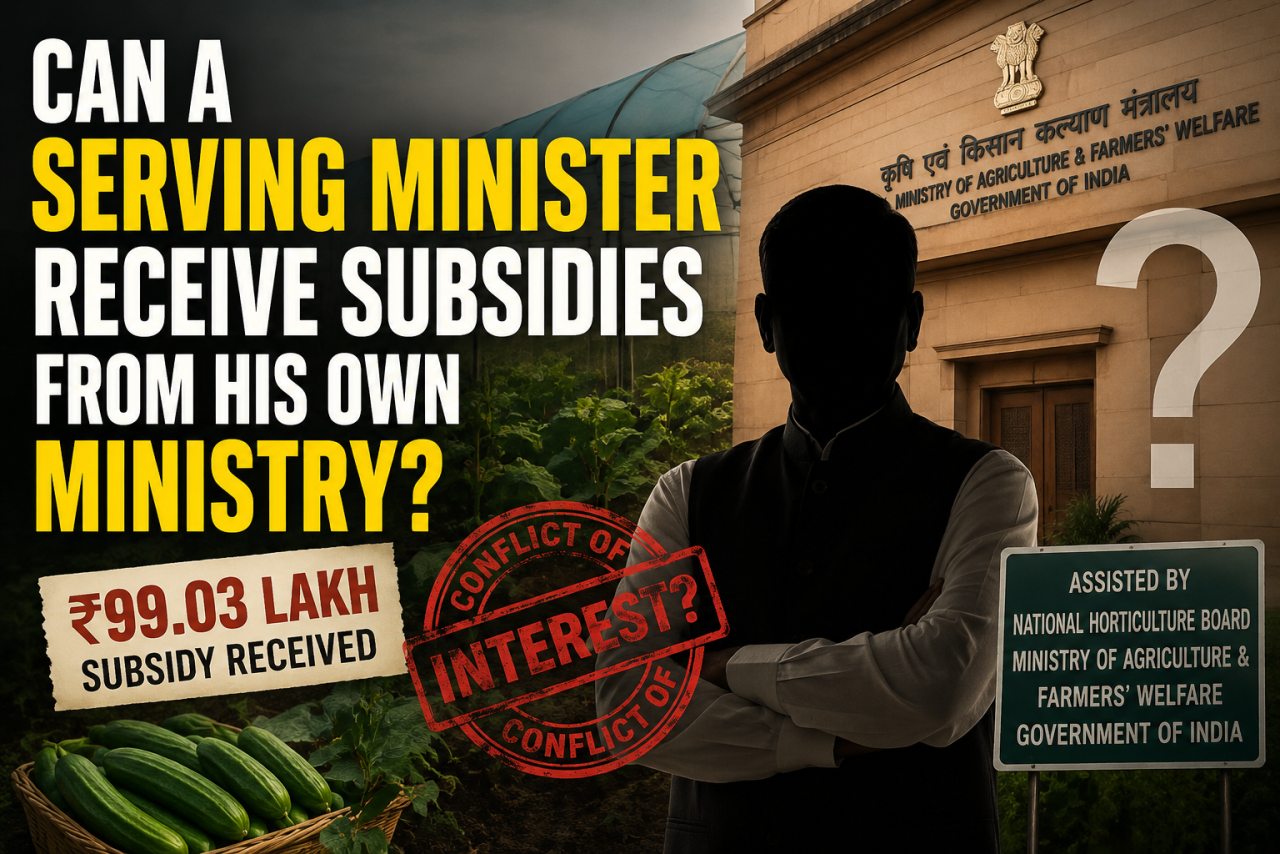
A ₹99 lakh subsidy. A serving Union minister. One ministry. The paperwork may be legal, but the ethical questions are becoming impossible to ignore.
There is a particular kind of audacity that only works when you believe no one is paying attention.
Union Minister of State for Agriculture Bhagirath Choudhary received a subsidy of ₹99.03 lakh for a commercial cucumber farming project on his land in Peeh village of Rajasthan's Deedwana-Kuchaman district. The money came from a scheme administered by the very ministry in which he serves. The approving body, the National Horticulture Board (NHB), is one where he sits as ex-officio Vice-President.
Three roles. One man. One payment.
What the Scheme Actually Is
The subsidy was sanctioned under the Development of Commercial Horticulture through Production and Post-Harvest Management of Horticulture Crops scheme. This is not a welfare programme aimed at helping distressed small farmers. It is designed to encourage large-scale commercial cultivation of high-value crops such as cucumber, capsicum, tomato, orchids and roses.
The scheme provides financial assistance of up to 50 percent of the project cost, subject to a maximum subsidy of ₹1 crore per family.
According to available information, Choudhary's project involved commercial cucumber cultivation over 16,592 square metres, including polyhouses, barbed-wire fencing, an artificial pond and an orchard. It was one of 467 projects approved by the NHB in 2025.
The total project cost was around ₹1.99 crore. Nearly half of it came from public funds.
The Minister's Defence
Choudhary responded swiftly after the controversy surfaced.
He said the application had been filed in 2018, long before he became a minister in 2024. He described himself as a lifelong farmer, pointed out that a signboard at his farm openly disclosed the loans and subsidies received, and argued that thousands of farmers benefit from similar schemes.
"What did I hide?" he asked.
Taken individually, these are not unreasonable arguments.
The NHB's Project Approval Committee, which formally clears projects, does not include Choudhary as a member. He has also stated that the subsidy followed the standard process, with the polyhouse being constructed first and the payment released several months later.
But the defence runs into one unavoidable problem: timing.
Reports indicate that the subsidy was credited only about three months ago, well after Choudhary had assumed office as Minister of State for Agriculture. Whatever the date of the application, the financial benefit reached him while he was serving in the ministry that oversees the NHB.
That distinction matters.
The Real Question Nobody Is Asking
The government's likely response is straightforward: the minister did not sit on the committee that approved his project.
That may answer a procedural question. It does not answer the ethical one.
The NHB functions under the administrative control of the Ministry of Agriculture. As Minister of State for Agriculture, Choudhary serves as the Board's ex-officio Vice-President. The officials administering the Board ultimately report through the ministry of which he is a part.
To argue that the process unfolded in complete institutional isolation, without any awareness of the applicant's position, asks the public to suspend common sense.
The issue extends beyond one individual.
An Indian Express report also revealed that the mother, wife and son of senior IAS officer Naresh Pal Gangwar, currently serving as Secretary in the Ministry of Fisheries, Animal Husbandry and Dairying, were among the beneficiaries of the same scheme in Rajasthan. Together, the family reportedly received subsidies exceeding ₹1.16 crore.
Viewed separately, each case may invite explanation. Viewed together, they raise a larger question about who ultimately benefits from public subsidy programmes.
"Na Khaaunga, Na Khaane Doonga"
The BJP came to power in 2014 on the strength of an uncompromising anti-corruption campaign.
Its most memorable slogan—"Na khaaunga, na khaane doonga" ("I will not be corrupt, nor will I allow others to be")—became a political promise as much as a campaign line.
Twelve years later, a Union Minister stands at the centre of a controversy involving public money flowing into his own commercial agricultural enterprise through a board attached to the ministry he serves.
Congress leader Pawan Khera summed up the opposition's criticism in one sentence:
"For the BJP, subsidy begins at home."
It is an effective political line because it points to a broader concern.
The controversy is not about hidden cash or offshore accounts. On paper, everything may appear procedurally valid. The application may have been filed years ago. The committee may have acted independently. The subsidy may have been released according to established rules.
Yet public confidence depends on more than procedural compliance.
When a serving minister receives financial benefits from a scheme administered by his own ministry, questions about conflict of interest become unavoidable, regardless of whether any law has been broken.
What Accountability Should Look Like
It is entirely possible that Choudhary complied with every procedural requirement.
That, however, is not the end of the matter.
A serving minister should not receive financial benefits from schemes administered by his own ministry. This is not merely a legal question; it is an ethical standard that underpins public trust in democratic governance.
If the government is serious about the transparency it has championed for more than a decade, the response should not end with a press conference or a political defence.
The matter deserves examination by an independent institution—whether the Lokpal, the Central Vigilance Commission (CVC) or Parliament's Public Accounts Committee. More importantly, India needs a clear rule: serving ministers should recuse themselves from any government scheme administered by their own ministries if they, their immediate families or close associates stand to receive a financial benefit.
Until such safeguards exist, the signboard outside Bhagirath Choudhary's farm may proudly declare:
"Assisted by National Horticulture Board, Ministry of Agriculture & Farmers' Welfare, Government of India."
What it does not say is the question at the heart of this controversy:
Should a serving minister have been one of the beneficiaries in the first place?
There is a particular kind of audacity that only works when you believe no one is paying attention.
Union Minister of State for Agriculture Bhagirath Choudhary received a subsidy of ₹99.03 lakh for a commercial cucumber farming project on his land in Peeh village of Rajasthan's Deedwana-Kuchaman district. The money came from a scheme administered by the very ministry in which he serves. The approving body, the National Horticulture Board (NHB), is one where he sits as ex-officio Vice-President.
Three roles. One man. One payment.
What the Scheme Actually Is
The subsidy was sanctioned under the Development of Commercial Horticulture through Production and Post-Harvest Management of Horticulture Crops scheme. This is not a welfare programme aimed at helping distressed small farmers. It is designed to encourage large-scale commercial cultivation of high-value crops such as cucumber, capsicum, tomato, orchids and roses.
The scheme provides financial assistance of up to 50 percent of the project cost, subject to a maximum subsidy of ₹1 crore per family.
According to available information, Choudhary's project involved commercial cucumber cultivation over 16,592 square metres, including polyhouses, barbed-wire fencing, an artificial pond and an orchard. It was one of 467 projects approved by the NHB in 2025.
The total project cost was around ₹1.99 crore. Nearly half of it came from public funds.
The Minister's Defence
Choudhary responded swiftly after the controversy surfaced.
He said the application had been filed in 2018, long before he became a minister in 2024. He described himself as a lifelong farmer, pointed out that a signboard at his farm openly disclosed the loans and subsidies received, and argued that thousands of farmers benefit from similar schemes.
"What did I hide?" he asked.
Taken individually, these are not unreasonable arguments.
The NHB's Project Approval Committee, which formally clears projects, does not include Choudhary as a member. He has also stated that the subsidy followed the standard process, with the polyhouse being constructed first and the payment released several months later.
But the defence runs into one unavoidable problem: timing.
Reports indicate that the subsidy was credited only about three months ago, well after Choudhary had assumed office as Minister of State for Agriculture. Whatever the date of the application, the financial benefit reached him while he was serving in the ministry that oversees the NHB.
That distinction matters.
The Real Question Nobody Is Asking
The government's likely response is straightforward: the minister did not sit on the committee that approved his project.
That may answer a procedural question. It does not answer the ethical one.
The NHB functions under the administrative control of the Ministry of Agriculture. As Minister of State for Agriculture, Choudhary serves as the Board's ex-officio Vice-President. The officials administering the Board ultimately report through the ministry of which he is a part.
To argue that the process unfolded in complete institutional isolation, without any awareness of the applicant's position, asks the public to suspend common sense.
The issue extends beyond one individual.
An Indian Express report also revealed that the mother, wife and son of senior IAS officer Naresh Pal Gangwar, currently serving as Secretary in the Ministry of Fisheries, Animal Husbandry and Dairying, were among the beneficiaries of the same scheme in Rajasthan. Together, the family reportedly received subsidies exceeding ₹1.16 crore.
Viewed separately, each case may invite explanation. Viewed together, they raise a larger question about who ultimately benefits from public subsidy programmes.
"Na Khaaunga, Na Khaane Doonga"
The BJP came to power in 2014 on the strength of an uncompromising anti-corruption campaign.
Its most memorable slogan—"Na khaaunga, na khaane doonga" ("I will not be corrupt, nor will I allow others to be")—became a political promise as much as a campaign line.
Twelve years later, a Union Minister stands at the centre of a controversy involving public money flowing into his own commercial agricultural enterprise through a board attached to the ministry he serves.
Congress leader Pawan Khera summed up the opposition's criticism in one sentence:
"For the BJP, subsidy begins at home."
It is an effective political line because it points to a broader concern.
The controversy is not about hidden cash or offshore accounts. On paper, everything may appear procedurally valid. The application may have been filed years ago. The committee may have acted independently. The subsidy may have been released according to established rules.
Yet public confidence depends on more than procedural compliance.
When a serving minister receives financial benefits from a scheme administered by his own ministry, questions about conflict of interest become unavoidable, regardless of whether any law has been broken.
What Accountability Should Look Like
It is entirely possible that Choudhary complied with every procedural requirement.
That, however, is not the end of the matter.
A serving minister should not receive financial benefits from schemes administered by his own ministry. This is not merely a legal question; it is an ethical standard that underpins public trust in democratic governance.
If the government is serious about the transparency it has championed for more than a decade, the response should not end with a press conference or a political defence.
The matter deserves examination by an independent institution—whether the Lokpal, the Central Vigilance Commission (CVC) or Parliament's Public Accounts Committee. More importantly, India needs a clear rule: serving ministers should recuse themselves from any government scheme administered by their own ministries if they, their immediate families or close associates stand to receive a financial benefit.
Until such safeguards exist, the signboard outside Bhagirath Choudhary's farm may proudly declare:
"Assisted by National Horticulture Board, Ministry of Agriculture & Farmers' Welfare, Government of India."
What it does not say is the question at the heart of this controversy:
Should a serving minister have been one of the beneficiaries in the first place?















Leave a Comment