
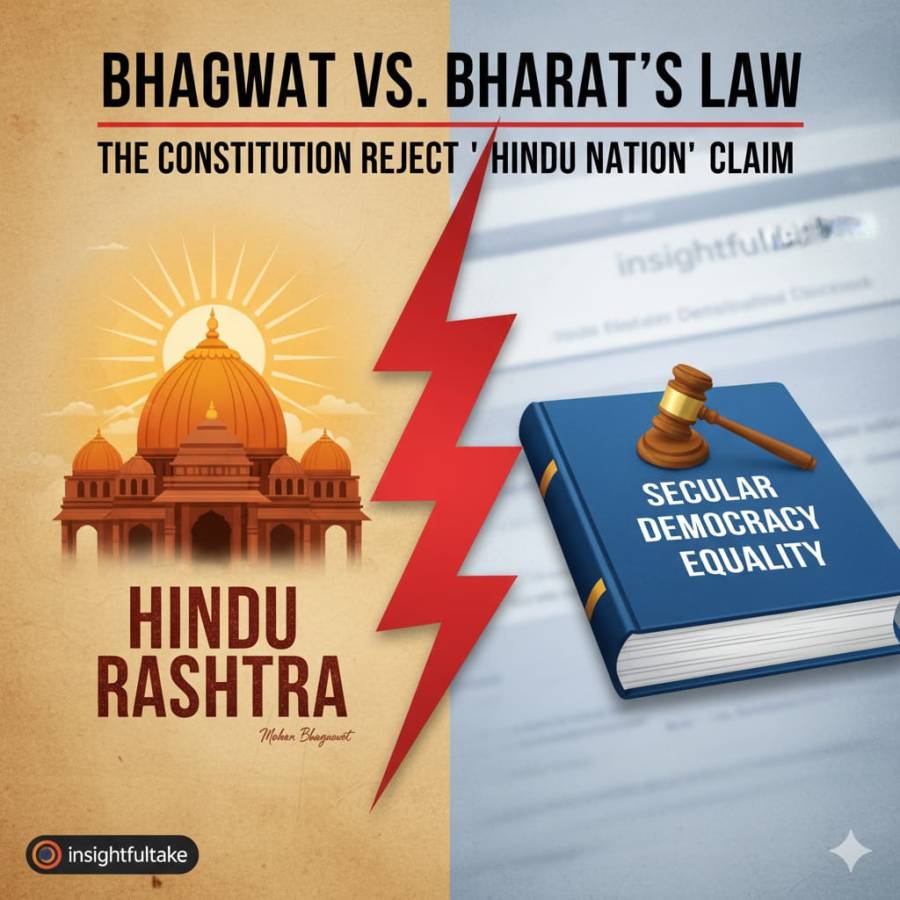
Speaking in Kolkata, RSS chief Mohan Bhagwat recently made a bold assertion that India is a “Hindu nation” by nature, and this “truth” requires no constitutional approval. He argued that just as the sun needs no law to rise in the east, India’s identity as a Hindu Rashtra is a self-evident fact of history and ancestry.
However, in a modern democracy, "truth" is not defined by cultural sentiment or ancient lineage alone—it is defined by the social contract that binds a diverse people together. That contract is the Constitution of India. When we place Bhagwat’s claims alongside our founding document, a fundamental contradiction emerges.
The Preamble: A Direct Rebuttal
Bhagwat claims that constitutional approval is unnecessary. Yet, the Preamble—the soul of the Constitution—states that "We, the People of India" have resolved to constitute India into a Sovereign Socialist Secular Democratic Republic.
The inclusion of the word "Secular" (formally added in 1976 but implied since 1950) is not just a label; it is a legal shield. It ensures that the state has no official religion. By asserting India is a "Hindu nation," one effectively ignores the Preamble, which establishes India as a nation for all its citizens, regardless of their faith.
The Legal Mirage of "Ancestry"
The RSS chief argues that anyone who "cherishes the glory of Indian ancestors" is part of this Hindu nation. While this may be a cultural viewpoint, the Constitution offers a different "truth" regarding identity:
- Article 15: Prohibits discrimination on grounds of religion.
- Article 25: Guarantees the freedom of conscience and the right to practice any religion.
If India were legally a Hindu Rashtra, the state would naturally prioritize Hindu traditions. However, the Constitution explicitly places the Citizen above the Devotee. In the eyes of the law, a first-generation convert or a member of a minority group has the exact same claim to "Bharat" as someone tracing their Hindu ancestry back a thousand years.
Secularism is "Basic Structure" (Unchangeable)
A common argument is that laws can be changed. However, the Supreme Court of India, in the famous Kesavananda Bharati case (1973), ruled that certain features of the Constitution are part of its "Basic Structure."
The Court has repeatedly affirmed that Secularism is one of these unchangeable pillars. This means that even if a government had a massive majority in Parliament, they cannot legally turn India into a theocratic Hindu Rashtra without dismantling the very foundation of the Republic. Bhagwat’s claim that constitutional approval is “not needed” is legally impossible because the Constitution is the nation’s legal identity.
Democracy vs. Majoritarianism
Bhagwat’s comparison to the sun rising in the east suggests that Hindu identity is the natural state of India. But democracy is not a natural occurrence; it is a conscious, human choice to protect the minority from the "natural" dominance of the majority.
The "truth" of the Constitution is that India was born out of a rejection of the "Two-Nation Theory." While Pakistan chose to be an Islamic Republic, India chose to be a Secular Republic. To claim India is a Hindu Rashtra is to move closer to the very ideology the founders of our nation fought against during the partition.
Final Take
Cultural pride and religious identity are personal rights protected by our laws. However, when these sentiments are used to redefine the political nature of the state, they clash with the Supreme Law of the Land.
The "truth" for 1.4 billion Indians is not found in an ancestral past, but in the living document that guarantees equality to the Dalit, the Muslim, the Christian, and the Hindu alike. India is not a Hindu Rashtra; it is a Constitutional Democracy, and that is the only truth that keeps the nation united.
The Republic survives not on shared ancestry, but on shared rights.
By Gautam Jha
Managing Editor




















Leave a Comment