
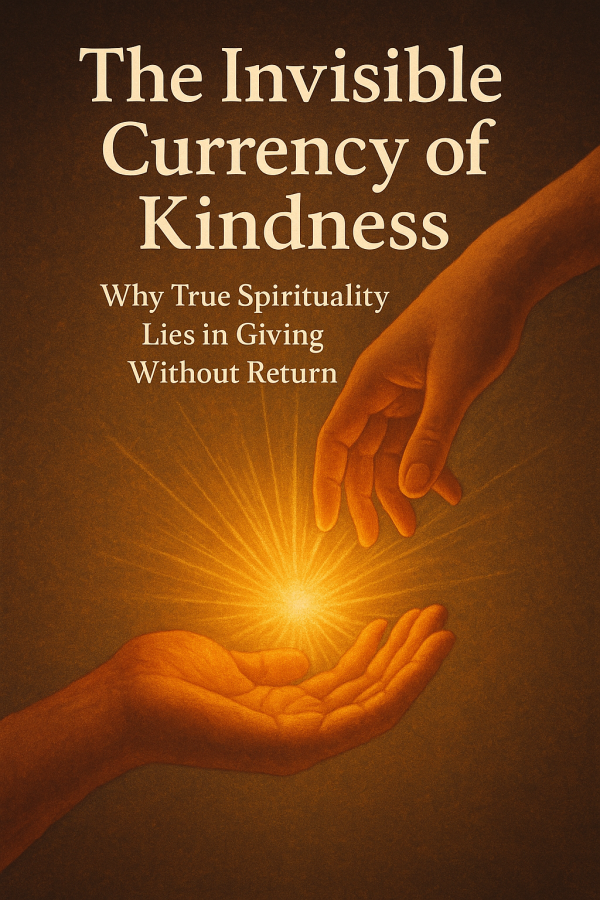
In the vast bazaar of life, where men and women trade ambitions, possessions, and passions, there exists a tender commerce untouched by greed or gain—the commerce of kindness. It is a silent currency, invisible to the eye but radiant to the soul. And in its unseen exchange lies the very essence of spirituality.
Spirituality is often mistaken for ritual, or confined to the cloisters of faith. We imagine it as the echo of chants, the smoke of incense, the rhythm of prayer. Yet, the truest spirituality does not dwell in temples of marble or scriptures of gold; it breathes in the humble act of giving without desire for return. It is not an ascent into the clouds of abstraction, but a descent into the heart of humanity. For every act of unselfish kindness is a liturgy in motion—a living prayer to the divine that abides within all beings.
The Moral Geometry of Giving
Science teaches us that every action has an equal and opposite reaction. But in the realm of kindness, the law inverts itself: a selfless deed multiplies instead of returning in kind. When a person performs an act for one who cannot repay it—when the hand that gives knows not the name of the receiver—something transcendent unfolds. The giver is enriched, not by gratitude, but by grace.
Philosophy affirms that the human spirit seeks meaning beyond survival. When the instinct for self-preservation evolves into empathy, man ceases to be a creature and becomes a creator. He begins to participate in the divine arithmetic where subtraction becomes addition, and loss becomes gain. In this subtle transformation, kindness emerges not as a moral accessory, but as the very architecture of the soul’s evolution.
India’s Eternal Wisdom
Long before the West coined the word “spirituality,” India had woven it into her social fabric. The Upanishads spoke of Atman—the inner self that mirrors the universal soul. The Bhagavad Gita declared, “Karmanye vadhikaraste, ma phaleshu kadachana”—perform your duty without attachment to reward. This is not mere philosophy; it is the luminous doctrine of kindness. Every act done without expectation becomes an offering “yajna” to the eternal spirit.
When a farmer leaves grains for the birds, when a stranger gives water to a weary traveller, when a mother feeds the child of another—these are not random gestures; they are rituals of divine remembrance. Through them, the individual dissolves into the infinite, and the infinite awakens within the individual. In that sacred reciprocity lies the soul of India, radiant and enduring.
The Science of the Spirit
Modern psychology too, in its cautious way, has begun to glimpse the ancient truth. Research at Harvard and Stanford shows that altruistic behaviour releases oxytocin—the hormone that fosters trust, warmth, and emotional bonding. Acts of kindness lower blood pressure, reduce stress, and even extend life expectancy. Neuroscience calls it the “helper’s high.” But what the laboratories observe as chemical reaction, the mystic recognizes as spiritual resonance. When we give selflessly, we do not merely alter our brain chemistry; we tune the vibration of our soul to the music of creation.
The saint and the scientist, the sage and the psychologist—all stand before the same revelation in different tongues: that man’s highest fulfilment lies not in acquisition but in compassion. Every genuine act of kindness is an experiment in transcendence, a proof of the spirit’s supremacy over matter.
The Poverty of the Rich and the Wealth of the Poor
The world today glitters with wealth but withers in warmth. We are rich in possessions yet poor in peace. Mansions rise but hearts shrink. The ancient sages warned us that prosperity without compassion is poverty disguised. Kindness is the invisible currency that makes all other riches meaningful. A millionaire may command ten thousand luxuries, but if he cannot weep for another’s sorrow or rejoice in another’s joy, he remains destitute in the truest sense.
In contrast, the villager who shares his last piece of bread with a stranger attains a nobility beyond empires. For he has mastered the first lesson of spirituality—that the divine is not a distant deity but a living pulse in every creature. His act, simple yet sacred, declares that love, not wealth, is the true measure of a perfect day.
The Cosmic Chain of Compassion
Every act of selfless love sets in motion a chain reaction invisible yet immense. The stranger we help may help another. A spark of mercy may kindle a hundred unseen lights. In that unseen diffusion, humanity’s spirit endures. The Gita calls it “lokasangraha”—the welfare of the world. Buddhism echoes it as karuna, Christianity as charity, Islam as ihsan, and Sikhism as seva. Beneath their differing languages, all faiths utter the same eternal hymn: to serve without self is to see God face to face.
Thus, kindness is not merely an emotion; it is a metaphysical force. It binds the strong to the weak, the known to the unknown, the living to the divine. It is the silent bridge between the temporal and the eternal.
Perfection Reimagined
The quote that inspired this reflection—“You can’t live a perfect day without doing something for someone who will never be able to repay you”—is not moral advice; it is metaphysical truth. Perfection, in the human sense, is not flawlessness but fullness. A perfect day is one that completes the circle of giving. It may be spent in labour, burden, or even sorrow; yet, if one selfless act blooms within it, the day attains sanctity. It becomes a verse in the grand poem of existence—a poem written by countless unseen hands through the centuries.
The Spiritual Renaissance
In our age of restless pursuit, “where success is measured by applause and worth by wealth”, there is a quiet rebellion waiting to be born. It will not be marked by revolutions or manifestos but by small, luminous gestures: a hand extended, a word of comfort, an unrecorded sacrifice. This rebellion is spirituality returning home through the door of kindness.
When we begin to live by this invisible currency, life regains its sacred rhythm. We rediscover the lost kinship between soul and soil, between man and man. The universe, once again, feels intimate. Every act of kindness, however small, becomes a ripple in the ocean of divine harmony.
The Eternal Whisper
In the end, spirituality is not the escape from the world, but the embrace of it. The saint’s robe and the beggar’s bowl are not different when both are moved by compassion. The Invisible Currency of Kindness asks no denomination, no faith, no language. It is the purest medium of exchange between the human and the divine.
To live kindly is to live spiritually.
To give without return is to pray without words.
And in that silent prayer, the universe bows—ever so gently—and smiles.

























Leave a Comment