
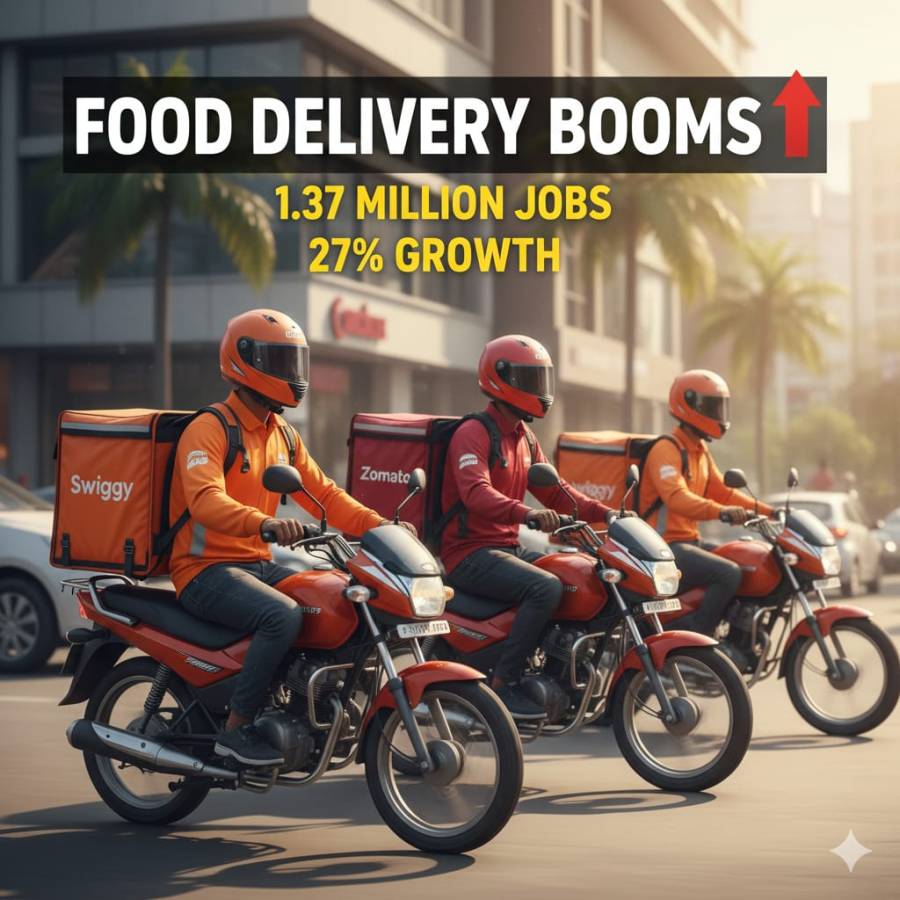
If you live in a city in India, the sight of orange and red t-shirts weaving through traffic on motorcycles is as common as a bus or an auto-rickshaw. These are the delivery partners for companies like Swiggy and Zomato, the two giants that currently dominate the Indian food delivery landscape. A recent study by the National Council of Applied Economic Research (NCAER) and the investment group Prosus highlights just how rapidly this sector has grown.
The Numbers Behind the Growth
According to the report, the food delivery sector has become a powerhouse for employment. In the financial year 2023–24, the industry directly employed 1.37 million workers. To put this in perspective, just two years prior (2021–22), that number was 1.08 million. This represents a staggering 27% increase in the workforce.
While India’s overall employment growth rate stood at 7.9%, the food delivery sector grew at a Compounded Annual Growth Rate (CAGR) of 12.3%. This means the sector is expanding much faster than most other parts of the Indian economy, making it one of the fastest-growing sources of “gig work”—a type of flexible, task-based employment.
Economic Impact: GVO and GVA
To understand the economic health of this industry, economists look at two key metrics: Gross Value of Output (GVO) and Gross Value Added (GVA).
- Gross Value of Output (GVO): This is the total turnover of the sector. The GVO of the food delivery sector reached ₹1.2 trillion ($1.2 lakh crore) in 2023–24. This is more than double the ₹613 billion recorded in 2021–22.
- Gross Value Added (GVA): GVA is calculated by taking the total output (GVO) and subtracting the costs of inputs. For 2023–24, the GVA was estimated at ₹476 billion, which contributes roughly 0.2% to India’s national GVA.
While 0.2% might sound small, the speed at which it is growing is the real story. The GVA grew at 16.9%, nearly twice as fast as India’s overall economic growth during the same period.
The Reality on the Ground: The “Gig” Challenge
While the growth figures look impressive on paper, they do not tell the whole story. Labor unions and worker representatives have raised serious concerns about the quality of life for those behind the handlebars.
Sunand, the president of the Rajdhani App Workers’ Union, argues that the rising employment numbers are not necessarily a sign of a “healthy” job market. Instead, he suggests that people are turning to food delivery because of a lack of better opportunities—essentially, it is a consequence of rising unemployment in other sectors.
Key Issues Faced by Workers
- Long Working Hours: Many delivery partners work 12 to 14 hours a day to make ends meet.
- Low Income: Despite the long hours, incomes remain “abysmally low” for many.
- Rate Card Cuts: Workers often face continuous cuts in their “rate cards” (the amount paid per delivery) by the platform companies, making it harder to earn a living wage.
Economic Insight: Gig work is often sought after for its “flexibility,” but for many urban and semi-urban workers, it has become a primary source of income under demanding conditions.
Final Take
The food delivery sector is a double-edged sword for the Indian economy. On one hand, it has created over a million jobs and contributed significantly to the services economy, growing at a pace that far outstrips traditional industries. On the other hand, the “job distress” reported by workers suggests that growth alone isn't enough; the quality of employment and worker welfare remain critical issues to address.
As the sector continues to expand, the challenge for policymakers and companies will be to balance rapid economic growth with fair treatment and sustainable livelihoods for the millions of people who keep India fed.
























Leave a Comment