
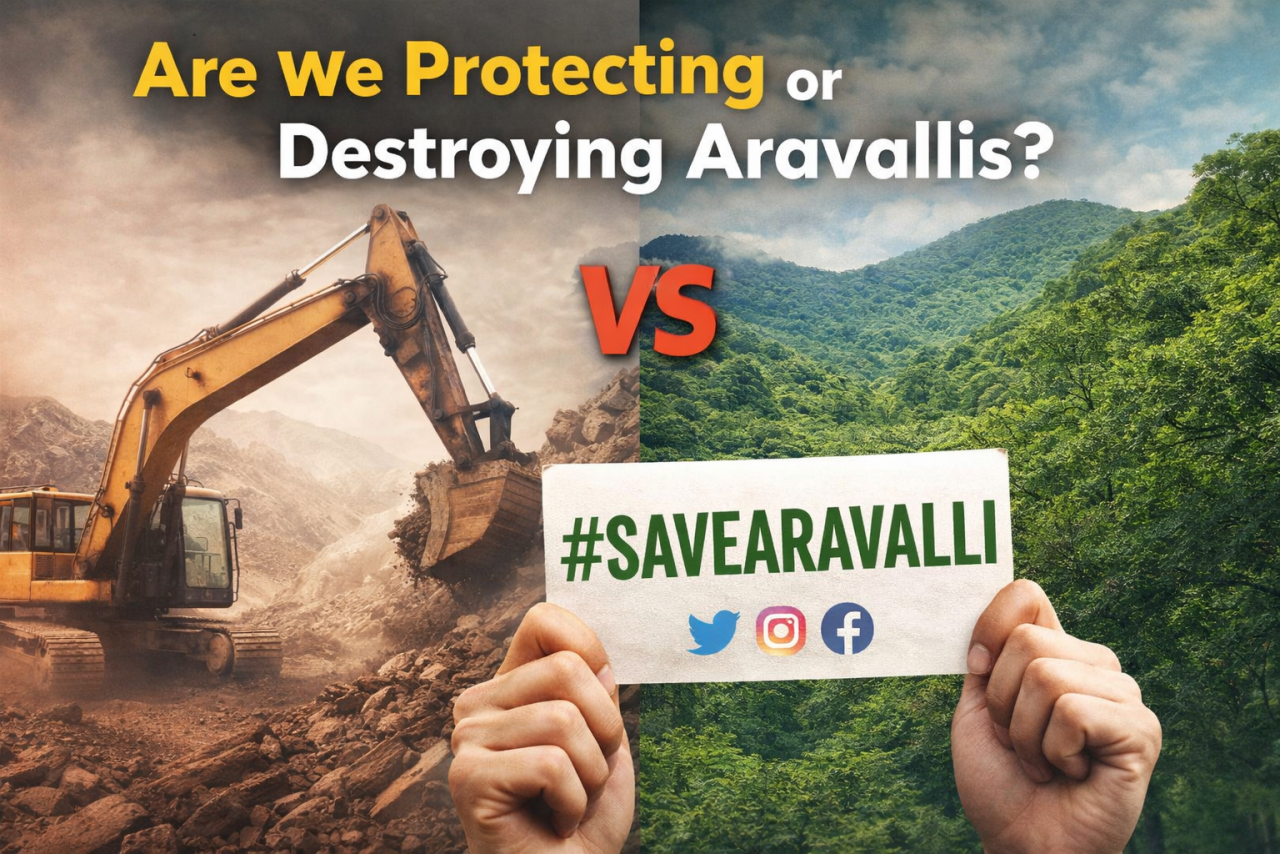
The Aravalli range is one of the oldest mountain systems in the world. Stretching across Gujarat, Rajasthan, Haryana and Delhi, these hills are far more than rocks and ridges. They act as a natural shield against desertification, recharge groundwater, regulate climate, support forests and wildlife, and protect millions of people living in the National Capital Region (NCR). Yet today, the Aravallis stand at the centre of a growing national debate—one that has now moved from government files to newspaper headlines and finally to social media streets.
Two recent developments capture this moment clearly. One is the Centre’s new definition of Aravalli hills, reported by streamline media and national dailies. The other is the rising wave of public protest on social media under campaigns like #SaveAravalli, where citizens, activists and environmentalists are voicing deep concern. Together, they raise an important question: Are we protecting the Aravallis in law, or slowly erasing them through definitions?
What the Centre Says: Protection Through Definition
According to the government, most of the Aravalli hills are protected. A central panel has introduced a new definition that classifies landforms rising at least 100 metres above local relief as Aravalli hills. Local relief means the height difference between a hill and the surrounding base area. Under this definition, more than 90% of the Aravalli area is claimed to be under protection.
The Centre has also stated that only 0.19% of the Aravalli region is open for mining, and even that is subject to Supreme Court orders and strict regulation. No new mining leases are allowed in notified Aravalli areas, except for limited categories such as atomic, critical, or strategic minerals as per law. On paper, this appears reassuring.
However, experts and environmentalists point out a crucial gap. The definition leaves out a large number of smaller hills—those below 100 metres in height—which form the backbone of the Aravalli ecosystem. Data from the Forest Survey of India (FSI) suggests that over 1.18 lakh hills in the region fall below this height threshold. If these hills are excluded, vast areas may no longer receive legal protection, even though they play an essential ecological role.
This is where the controversy begins.
What Critics Fear: Protection Lost in Technical Language
Environmental experts argue that nature does not work in neat categories. Small hills, shallow ridges and rocky outcrops are not separate from the larger Aravalli system—they are part of it. They store rainwater, support vegetation, prevent soil erosion and act as green corridors for wildlife.
Critics say that by focusing only on height-based criteria, the new definition ignores geological continuity and ecological function. They also point out that the Supreme Court had earlier rejected narrow definitions and had ordered a comprehensive mapping of the entire Aravalli range, especially in Rajasthan. The silence on this aspect has raised eyebrows.
Political leaders from opposition parties have also criticised the move, calling it a dilution of environmental protection that could open the door to mining, construction and real estate activity in fragile zones.
The People Respond: #SaveAravalli Goes Digital
As policy debates unfolded, citizens took the issue to social media. The #SaveAravalli movement has gained traction on platforms like X, Instagram and Facebook. Environmentalists, students, scientists, artists and ordinary residents are sharing posts, maps, photographs and personal stories.
Many posts highlight how the Aravallis protect Delhi and NCR from dust storms, heatwaves and air pollution coming from the Thar Desert. Others point to shrinking forests, drying lakes and falling groundwater levels in Haryana and Rajasthan as warning signs.
What makes this digital protest significant is its tone. It is not driven by slogans alone but by concern for the future. People are asking simple but powerful questions: If the Aravallis disappear, what happens to our water? Our air? Our climate?
Why the Aravallis Matter More Than Ever
The Aravallis are often called the “green wall” against desertification. They slow down hot desert winds, trap dust, and help maintain ecological balance. In an age of climate change, their role has become even more critical.
Cities like Gurugram, Faridabad, Alwar and Jaipur already face severe water stress. The Aravallis recharge aquifers that supply water to these regions. Cutting hills, blasting rocks or allowing unchecked construction weakens this natural system.
Once destroyed, these ancient hills cannot be rebuilt. Unlike buildings or roads, ecosystems take centuries to recover—if they recover at all.
Development vs Environment: A False Choice
The debate is often framed as development versus conservation. But this is a false choice. Sustainable development means growing without destroying the natural systems that support life.
Short-term economic gains from mining or construction may benefit a few, but the long-term cost is borne by many—through water shortages, pollution, extreme heat and loss of biodiversity.
True development should strengthen natural assets, not weaken them.
Clarity, Science and Public Trust
The Aravalli issue shows why environmental decisions must be transparent, science-based and inclusive. Definitions should protect ecosystems as they exist in reality, not just on paper. Public concerns must be addressed honestly, not dismissed as misinformation.
Social media protests may not replace laws, but they remind governments that environmental protection is not a technical issue alone—it is a moral one.
A Shared Responsibility
Saving the Aravallis is not only the government’s duty. It is a shared responsibility of citizens, institutions and future generations. The hills may be ancient, but the choice before us is very modern: protect now, or regret later.
The Aravallis have protected us for thousands of years. The question is simple—will we protect them in return?
By Gautam Jha
Managing Editor



























Leave a Comment