
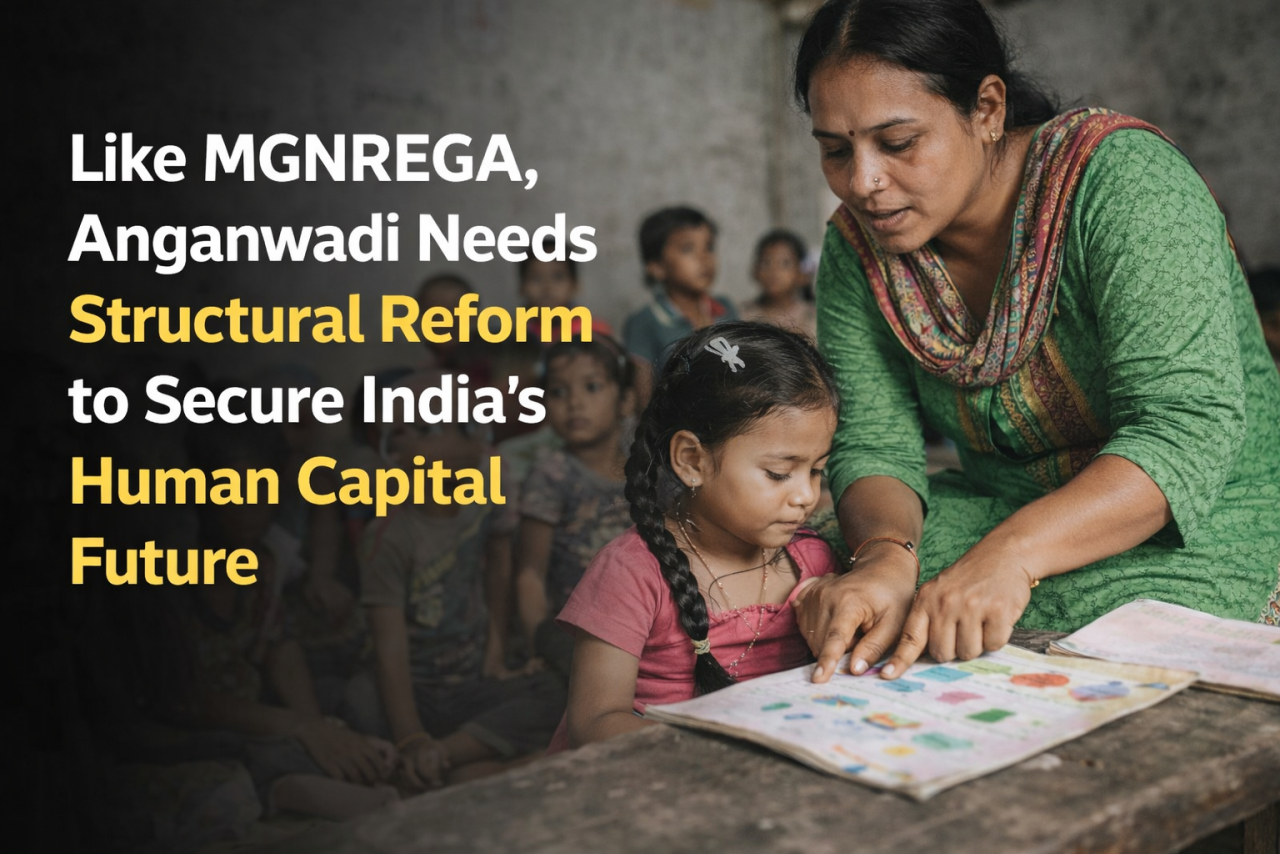
India’s Anganwadi system today resembles the stage at which MGNREGA once stood—vast in scale, ambitious in intent, yet constrained by outdated assumptions about how society, work, and the economy function. Both programmes were born out of necessity, designed to address deep structural vulnerabilities. MGNREGA responded to rural distress and employment insecurity; Anganwadi was created to tackle malnutrition and maternal-child health. Over time, MGNREGA evolved in response to economic realities. Anganwadi, despite its centrality to India’s demographic future, has not undergone a comparable reset.
With over 25 lakh Anganwadi centres and a similar number of frontline workers, India runs one of the largest early childhood care systems in the world. It reaches more than 10 crore beneficiaries, primarily children below six years, pregnant women, and lactating mothers. Yet outcomes remain sobering. National Family Health Survey–5 data shows that more than one-third of Indian children under five are stunted, nearly one-fifth are wasted, and cognitive learning gaps begin even before formal schooling starts. These figures suggest that the challenge India faces is no longer just one of access or calorie intake, but of quality early childhood care and development.
Scientific and economic evidence underscores why this matters. Nearly 85 per cent of brain development occurs before the age of six. Skills acquired—or missed—during these years shape learning capacity, health outcomes, and productivity for life. Nobel laureate James Heckman’s research demonstrates that investments in early childhood deliver the highest returns compared to later-stage interventions, often exceeding returns from higher education or job training. For a country aspiring to become a high-income economy, neglecting this stage is not merely a social failure but an economic miscalculation.
Despite this, Anganwadi continues to operate within an outdated policy framework. Most centres function for only three to four hours daily, reflecting an era when women’s workforce participation was limited and extended childcare demand was minimal. Today, rising urbanisation, shrinking family support systems, and the economic necessity of dual-income households have changed that reality. Parents increasingly need safe, full-day childcare environments that support learning, not just nutrition.
The frontline workforce remains another critical weakness. Anganwadi workers perform tasks that combine the roles of educator, nutrition counsellor, health mobiliser, and community anchor. Yet they are officially classified as “honorary” workers, receiving modest compensation that often falls below minimum wage benchmarks. Training standards vary widely across states, and career progression is limited. This is analogous to early MGNREGA criticism, where outcomes suffered because workers, planners, and supervisors lacked adequate institutional support.
MGNREGA’s transformation offers valuable lessons. The scheme improved not by abandoning its core purpose, but by refining its design—indexing wages, digitising payments, strengthening transparency mechanisms, and focusing on durable asset creation. These reforms increased credibility, reduced leakages, and aligned the programme more closely with economic objectives. Anganwadi requires a similar evidence-based overhaul.
First, the system’s purpose must be clearly redefined. Anganwadi should be repositioned as India’s primary early childhood development platform, integrating nutrition, health, care, and play-based learning. Globally, countries with strong early childcare systems—such as Sweden and South Korea—also demonstrate higher female labour force participation and more resilient economies. Access to reliable childcare enables women to work, increases household incomes, and strengthens community productivity.
Second, operational models must align with current needs. Several Indian states have experimented with extended-hour Anganwadi centres and structured early learning modules. These pilots show improved attendance, better child engagement, and increased parental trust. Scaling such models nationally would reflect present-day socio-economic realities rather than legacy assumptions.
Third, human resources must be treated as an investment, not a cost. Formal recognition of Anganwadi workers, improved remuneration, continuous training, and performance-linked incentives would professionalise the system. India’s public expenditure on health and education remains modest relative to its aspirations; targeted investment in early childhood personnel would yield long-term fiscal dividends through better learning outcomes and reduced health burdens.
Fourth, accountability frameworks must evolve. Monitoring should move beyond tracking food distribution or attendance to assessing developmental outcomes such as school readiness, language acquisition, and social skills. Digital tools like Poshan Tracker are a starting point, but data must inform policy correction rather than administrative compliance.
Finally, Anganwadi reform requires national mission status. MGNREGA’s impact was amplified because it was anchored at the highest political level and implemented through a whole-of-government approach. Early childhood development demands similar prioritisation, cutting across health, education, nutrition, and labour policies.
India’s demographic advantage is not guaranteed by population size alone. It depends on whether today’s children are prepared—physically, cognitively, and emotionally—to participate in tomorrow’s economy. The Anganwadi system already has reach, trust, and infrastructure. What it needs is a structural reset grounded in logic, data, and economic reasoning. Like MGNREGA, the evolution of Anganwadi is not optional but essential to securing India’s human capital future.
By Gautam Jha
Managing Editor




















Leave a Comment