

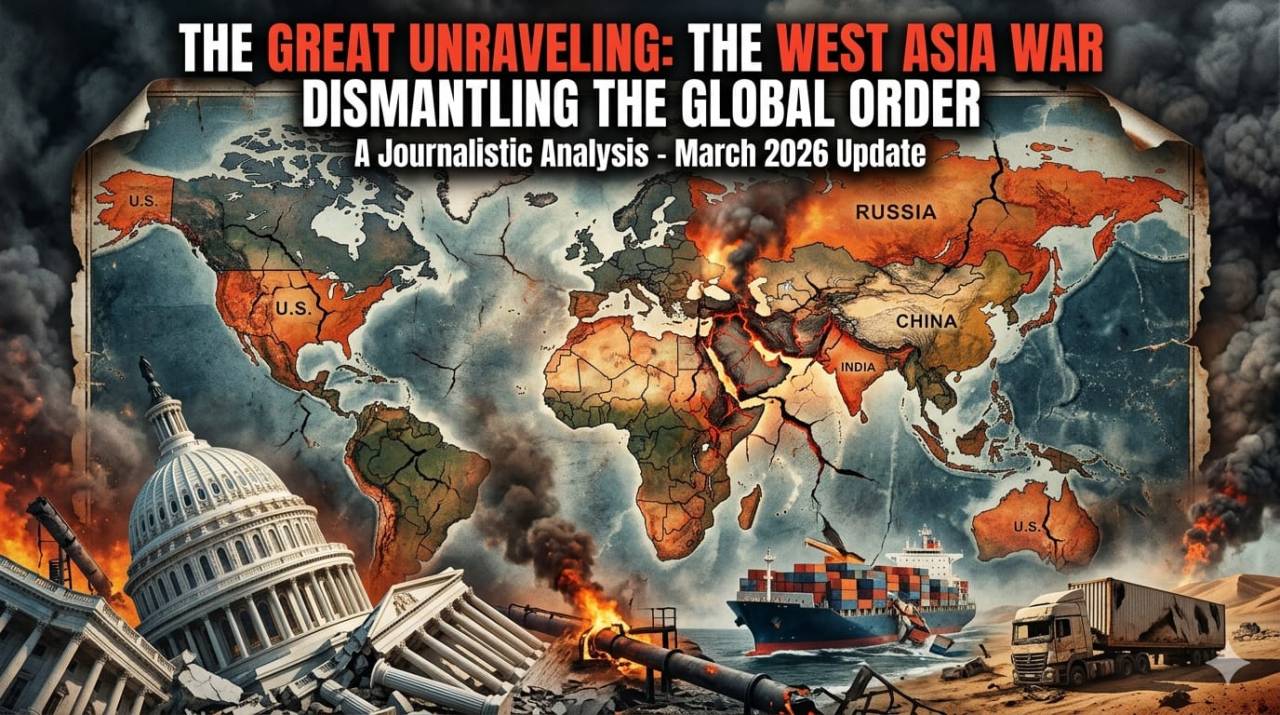
As the global order continues to shift in the mid-2020s, the role of the United States has once again come under intense scrutiny. Over the past year, Washington’s actions across continents have prompted comparisons that many would have once considered exaggerated. Increasingly, critics argue that the United States is behaving less like a post-World War II democratic stabiliser and more like a modern echo of imperial Great Britain, attempting to enforce global dominance through power, pressure, and intervention rather than consensus and restraint.
The most unsettling illustration of this trend was the U.S. military action in Venezuela that led to the capture of President Nicolás Maduro and his transfer to American soil in handcuffs. Framed by U.S. authorities as a law-enforcement operation connected to narcotics charges, the action bypassed international institutions, regional mechanisms, and basic diplomatic norms. For much of the world, it appeared as an assertion that American jurisdiction can extend wherever U.S. interests demand. Historically, colonial powers justified similar actions under the guise of law, order, or moral responsibility. The echoes are difficult to ignore.
Closely tied to this episode is Washington’s aggressive posture toward Latin America more broadly. Threats and warnings directed at Mexico, Cuba, and Colombia have intensified, often couched in language of border security, migration control, or anti-drug enforcement. While these concerns are not illegitimate, the tone and methods employed suggest a revival of the Monroe Doctrine mindset, where the Western Hemisphere is treated as a strategic backyard rather than a collection of sovereign nations. For countries that have long struggled to escape the shadow of U.S. influence, this resurgence of coercive diplomacy feels less like partnership and more like domination.
In West Asia, U.S. airstrikes against Iranian targets further reinforce this perception. Once again, military force was used without a clear international mandate, justified by claims of deterrence and regional stability. The broader result, however, has been heightened instability and the sidelining of diplomatic channels. Britain’s imperial past was similarly marked by frequent military expeditions meant to “manage” distant regions while deepening resentment and resistance. The lesson history teaches is that such actions rarely produce lasting peace.
South Asia offers another revealing example. The United States publicly claimed credit for helping de-escalate tensions between India and Pakistan during the Operation Sindoor. India firmly rejected this assertion, stating that the ceasefire resulted from direct bilateral engagement. This insistence on claiming diplomatic victories, even when local actors deny U.S. involvement, reflects a desire to project omnipresence in global conflict resolution. Colonial powers once portrayed themselves as indispensable arbiters in disputes they often helped create or exacerbate.
The war in Ukraine further complicates the picture. The United States has positioned itself as the principal external actor shaping the conflict’s trajectory, providing military aid, influencing negotiations, and steering international responses. While Russia’s invasion is widely condemned, Washington’s approach has drawn criticism for prolonging the conflict while asserting control over Europe’s security architecture. The imbalance between rhetoric about peace and actions that deepen militarisation mirrors patterns seen in earlier eras of great-power competition.
Perhaps the most symbolic moment of all has been the renewed discussion within U.S. political circles about Greenland. Suggestions of acquiring the territory, or asserting greater control over it due to strategic and resource considerations, were met with outrage in Denmark and across Europe. The idea that land can still be discussed as an asset to be claimed reflects a worldview rooted in colonial logic. In a supposedly rules-based international order, such claims appear anachronistic and alarming.
Domestically, the United States itself has experienced visible political and institutional turbulence over the past year. Polarisation, governance challenges, and debates over executive power have weakened Washington’s moral authority abroad. Yet instead of recalibrating its global posture, the U.S. has doubled down on displays of strength. Historically, empires in decline often turn outward, using foreign dominance to compensate for internal uncertainty. Britain did so in the late stages of its imperial era, even as economic and political realities were shifting beneath its feet.
Supporters of U.S. policy argue that these actions are necessary in an increasingly unstable world marked by rising powers like China and an assertive Russia. They contend that American leadership, even when forceful, prevents chaos and protects democratic values. Critics counter that leadership without legitimacy breeds resistance, and that power exercised without restraint undermines the very order it claims to defend.
What makes the current moment especially significant is the global context. Much of the world is no longer willing to accept unilateral decisions made in Washington. Countries in Asia, Africa, and Latin America are more vocal, more connected, and less dependent than they were during earlier eras of Western dominance. Attempts to reassert a colonial-style hierarchy risk accelerating the very decline of influence they seek to prevent.
The comparison between the United States today and Great Britain of the past is not about identical methods or outcomes. It is about mindset. When a nation begins to assume that its interests justify intervention anywhere, that its laws can override others’ sovereignty, and that power alone ensures order, it steps onto a path history has already judged harshly.
The world no longer operates on colonial terms, and efforts to revive such a framework, however subtly, are bound to face resistance. Whether the United States chooses to adapt to this reality or continue down a confrontational path will shape not only its own future, but the stability of the global system it once helped build.
By Gautam Jha
Managing Editor
.jpeg)



















Leave a Comment