
The latest fiscal data suggests control on paper, but underlying risks could test the government’s economic discipline in the final month.
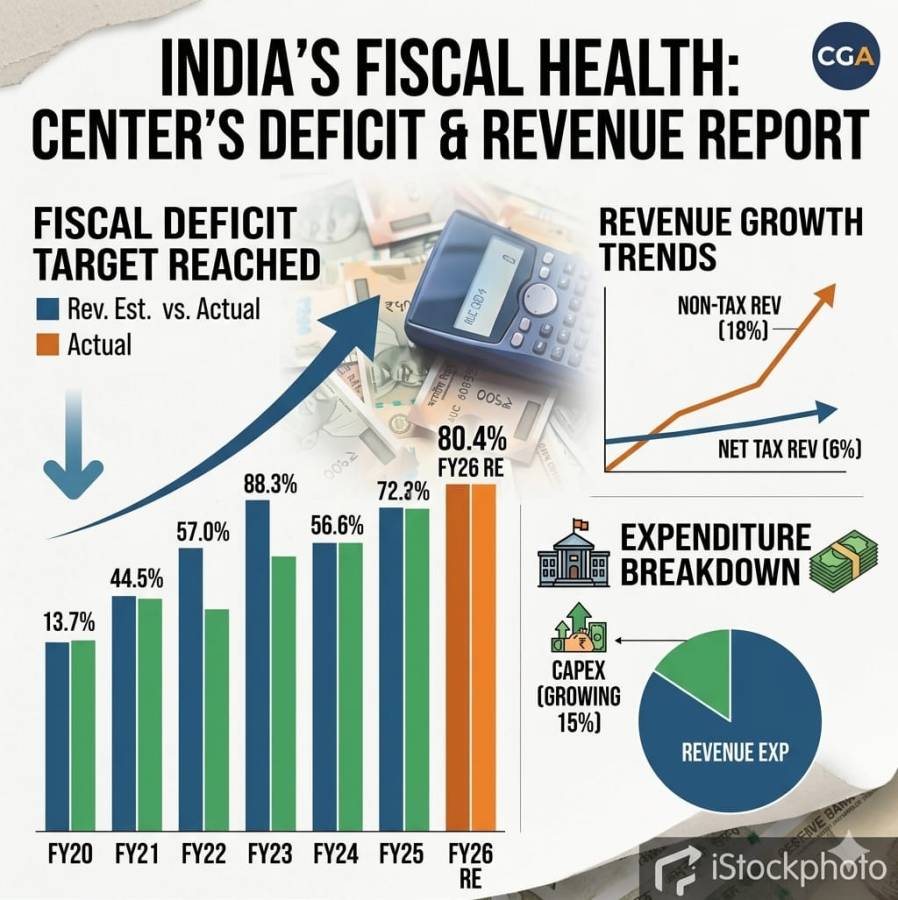
The latest data released by the Controller General of Accounts (CGA) provides a critical snapshot of India’s economic governance. For the period spanning April to February of the 2025–26 fiscal year, the Central Government’s fiscal deficit reached ₹12.5 lakh crore. This figure represents 80.4% of the Revised Estimates (RE), signalling a disciplined approach to fiscal management compared to previous years.
Understanding the Numbers
To put this in perspective, during the same period in the previous fiscal year (2024–25), the deficit stood at ₹13.4 lakh crore, which was 85.8% of that year’s target. The current trajectory suggests that the government is exercising better control over its gap between total expenditure and total non-borrowed receipts.
However, the road ahead isn't without its bumps. Due to a downward revision in the nominal Gross Domestic Product (GDP), the fiscal gap for FY26 is now projected to settle at approximately 4.5% of GDP. This is a slight uptick from the earlier estimate of 4.3%. In absolute terms, the target for the current year is set at ₹15.58 lakh crore, a marginal decrease from the ₹15.77 lakh crore recorded in the previous year.
Revenue and Expenditure Trends
The government’s financial health is a balance of what it earns versus what it spends. The report highlights several key trends:
- Capital Expenditure (Capex): A bright spot in the report is the 15% year-on-year growth in Capex, reaching ₹9.3 lakh crore. This accounts for roughly 79.7% of the annual target. High Capex is generally viewed as "productive" spending, as it goes toward infrastructure and long-term assets that drive future economic growth.
- Revenue Expenditure: This reached 80.5% of revised estimates, a 1% increase from last year. This category covers day-to-day operational costs such as salaries, subsidies, and interest payments.
- Tax Receipts: Net tax revenue saw a healthy 6% year-on-year rise, reaching 80.2% of the target.
- Non-Tax Revenue: This segment performed strongly, growing 18% year-on-year to reach 87% of the target, largely driven by robust dividend inflows from public sector undertakings and the central bank.
Potential Risks and Expert Outlook
While the numbers appear stable, economists warn of emerging downside risks. A significant concern is the recent ₹10 per litre cut in additional excise duty on petrol and diesel. While this move provides relief to consumers, it is expected to result in a revenue loss of approximately ₹1.3 lakh crore for the government.
Madan Sabnavis, Chief Economist at Bank of Baroda, notes that while February data suggests the deficit is under control, the government still needs to collect a significant portion of its tax revenue in the final month. He adds that any potential shortfall could be managed through expenditure adjustments or external factors that may naturally moderate spending.
Similarly, Gaura Sengupta, Chief Economist at IDFC First Bank, believes the government may still meet a 4.4% of GDP target through calibrated cash management and savings across departments.
Final Take
As the fiscal year draws to a close, the government faces a delicate balancing act. On one hand, it must sustain its commitment to infrastructure-led growth through capital expenditure; on the other, it must absorb the impact of tax cuts and a shifting GDP base.
With 80% of the fiscal deficit target already reached by February, the final month of March will be a crucial test of the Centre’s fiscal discipline and its ability to navigate evolving economic challenges.


.jpeg)























Leave a Comment