
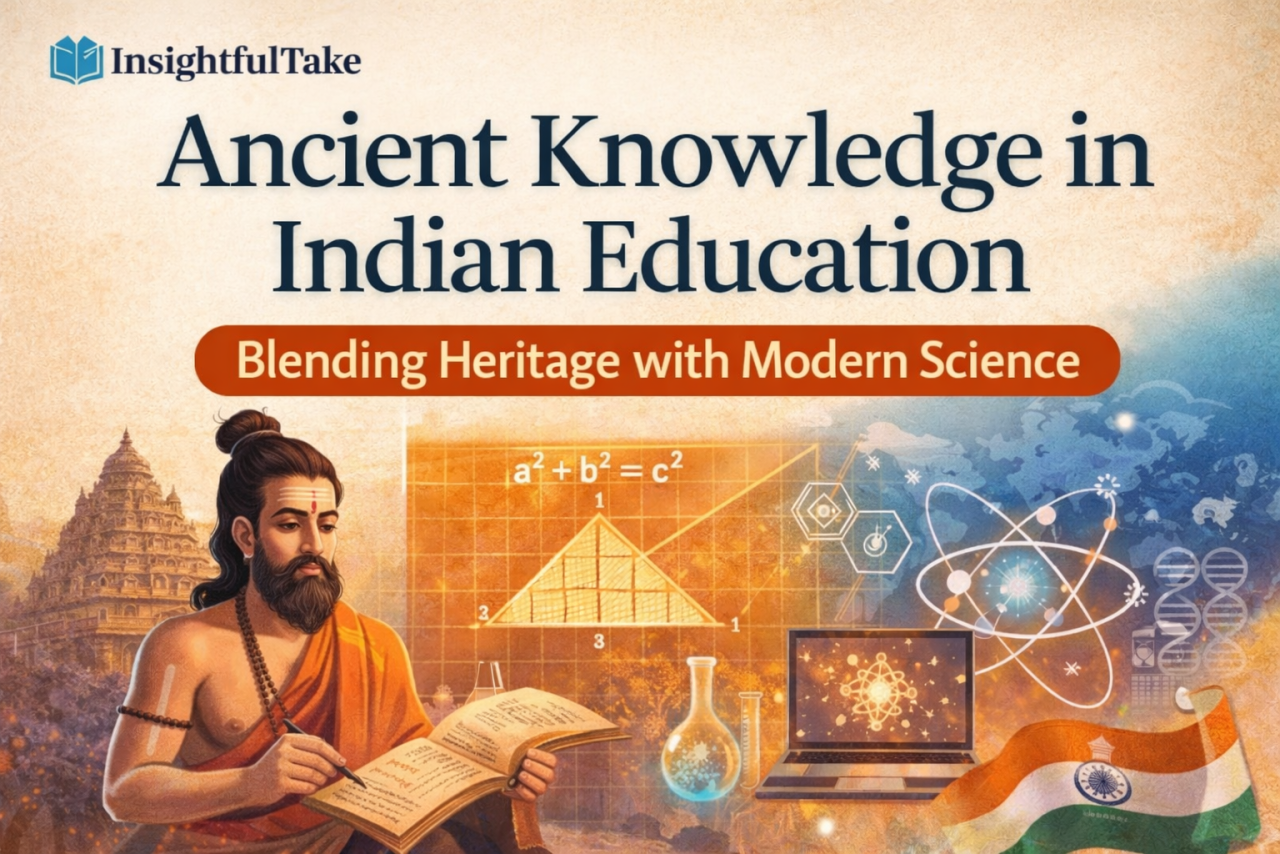
As India revises its school textbooks, a quiet but important debate is unfolding in classrooms and academic circles. The inclusion of ancient mathematician Baudhāyana’s work in NCERT books is being seen by some as a long-overdue correction to India’s educational narrative, and by others as a move that risks blending pride with ideology. At the heart of this discussion lies a larger question: can India recognise its ancient knowledge systems while preserving scientific rigour and academic balance?
Recent changes in Indian school textbooks, including references to Baudhāyana’s explanation of the right-angled triangle theorem, reflect a broader shift in India’s academic policy. These revisions aim to recognise India’s historical contributions to science, mathematics, philosophy, and culture. Supporters argue that such changes address a long-standing imbalance in how knowledge has been presented to Indian students. Critics, however, worry about whether these reforms genuinely strengthen education or open the door to selective interpretation driven by pride or politics.
There is little disagreement about the depth of India’s intellectual tradition. Long before modern Europe, Indian scholars made significant advances in mathematics, astronomy, medicine, linguistics, and logic. Texts like the Sulba Sutras contain precise geometric principles, Aryabhata made important astronomical observations, and Panini developed a highly structured system of grammar that continues to influence linguistic studies worldwide. These achievements are recognised by historians and scholars across the globe.
Despite this, for many decades Indian school curricula placed greater emphasis on Western discoveries, often presenting them as the primary foundation of scientific knowledge. While Western contributions are undoubtedly important, this narrow focus created the impression that India was largely a recipient of ideas rather than an active contributor. Over time, this shaped how students viewed their own intellectual heritage. Correcting this imbalance is both reasonable and academically justified.
The inclusion of Baudhāyana’s work provides a useful example of how this correction can be made responsibly. The NCERT textbook does not deny the importance of Pythagoras or Greek mathematics. Instead, it explains that similar geometric ideas existed in India centuries earlier. This approach helps students understand that knowledge often develops independently in different civilizations. It also reinforces the idea that science is a shared human effort rather than the achievement of any single culture.
Such recognition can positively influence student confidence. When learners see that their own civilisation contributed meaningfully to global knowledge, it fosters intellectual self-respect. Education is not limited to memorising facts; it shapes how students understand themselves and their society. A balanced acknowledgment of Indian achievements can help challenge the colonial mindset that still affects parts of the education system, while encouraging a healthier sense of national pride.
However, pride must be approached with caution. Education should never become a tool for promoting cultural or religious superiority. Scientific knowledge depends on evidence, logic, and verification. Ancient texts should be included in curricula only when their contributions are supported by credible scholarship. Exaggeration or selective presentation of history risks weakening scientific thinking rather than strengthening it. The purpose of education should be understanding, not glorification.
One concern often raised is the possible mixing of religion with science. Many ancient Indian ideas emerged from philosophical or religious contexts. This does not automatically make them unscientific, but it does require careful explanation. Students need to be taught to distinguish between empirically verifiable knowledge and belief-based ideas. For example, Baudhāyana’s geometric rules can be tested and proven, while some ancient cosmological ideas may be symbolic in nature. Both can be discussed in classrooms, but they should not be treated as the same kind of knowledge.
Another potential risk is political misuse. When curriculum changes are driven more by ideology than by academic research, they can create division rather than understanding. Education should encourage shared inquiry and critical thinking, not cultural competition. India’s intellectual heritage is diverse and includes Buddhist, Jain, Islamic, regional, and folk traditions, along with Vedic ones. Any serious effort to include Indian knowledge systems must reflect this diversity.
It is also important to note that recognising ancient contributions does not mean rejecting modern science. India’s future development depends on innovation, research, and global collaboration. Students must continue to learn modern mathematics, physics, biology, and technology as they exist today. Ancient knowledge should provide historical context and inspiration, not serve as a replacement for contemporary science. Progress is strongest when tradition and modernity complement each other.
From a policy perspective, the intent behind these academic reforms appears largely justified. Correcting historical neglect, strengthening student confidence, and offering a more accurate picture of global knowledge are valid educational goals. The real challenge lies in careful implementation. If guided by academic honesty, peer review, and openness to debate, these reforms can improve the quality of education. If taken too far, they risk undermining the scientific spirit they aim to promote.
In the end, recognising figures like Baudhāyana in school textbooks is not about placing religion above science or nationalism above truth. It is about restoring balance. Indians can take pride in their civilisational achievements while still respecting global scholarship and scientific rigour. Education should help students value their roots, question claims critically, and engage confidently with the modern world. When pride is guided by evidence and humility, it becomes a strength. When it replaces inquiry, it becomes a weakness. The future of India’s academic reforms will depend on which path is chosen.
By Gautam Jha
Managing Editor

























Leave a Comment