
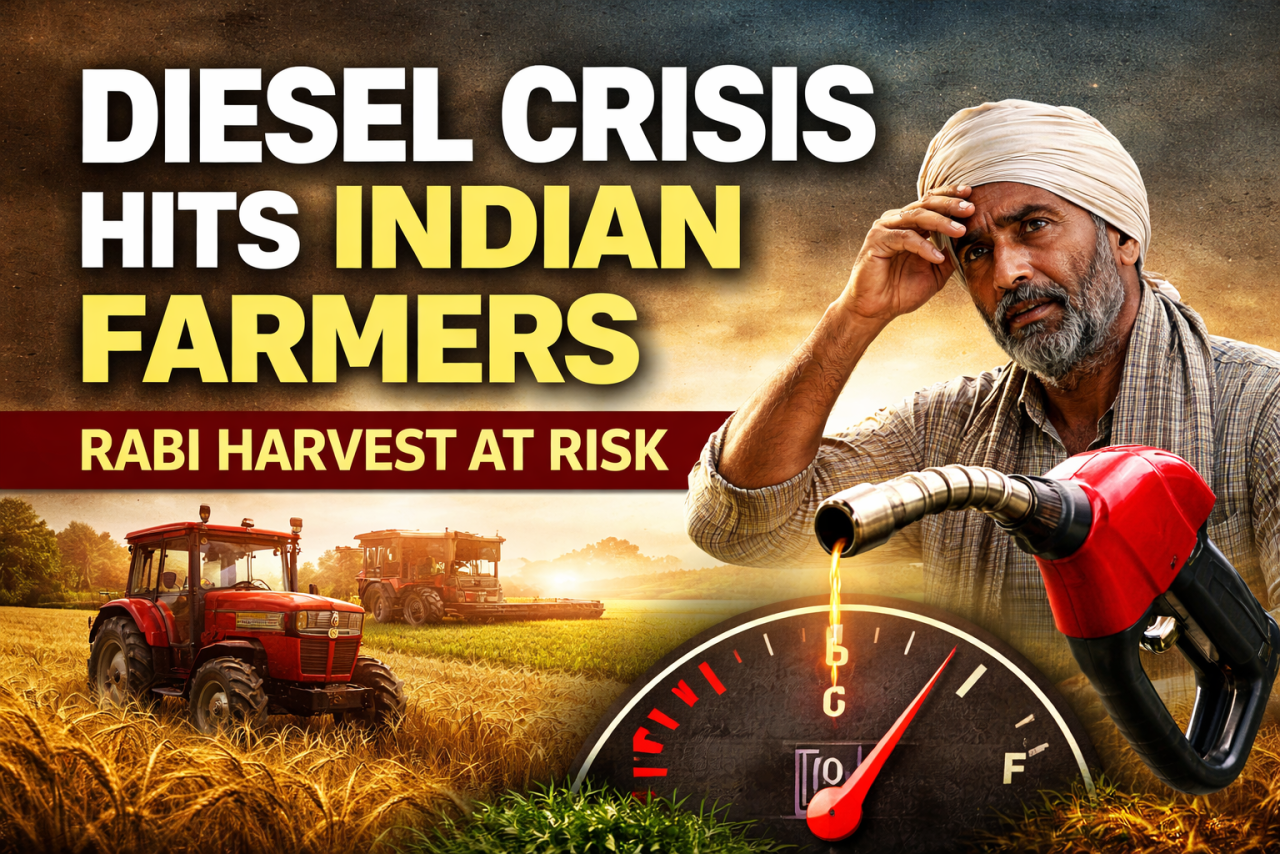
As India’s fields turn ready for harvest, a silent fuel crisis threatens to stall tractors, delay crops, and squeeze farmers at the worst possible moment.
As India’s vast rabi fields turn golden and ready for harvest, an unexpected anxiety is sweeping through the countryside—not of weather or pests, but of fuel. Diesel, the invisible engine behind India’s agricultural economy, is once again at the centre of a looming crisis that threatens both farm incomes and food security.
India’s agricultural system, despite decades of modernization, remains deeply dependent on diesel. From tractors ploughing fields to harvesters cutting wheat, from irrigation pumps drawing groundwater to trucks transporting produce to mandis—diesel powers nearly every stage of the rural value chain. Any disruption in its availability or affordability reverberates far beyond farms, affecting inflation, supply chains, and ultimately, the consumer.
A Seasonal Vulnerability
The timing of this concern is critical. The rabi harvesting season, particularly for wheat, typically begins in April and represents one of the most important agricultural cycles in India. During this short window, farmers must work quickly to harvest crops at peak quality. Even minor delays can reduce yields, lower grain quality, and cut incomes.
This seasonal urgency makes diesel not just important, but indispensable. Unlike urban consumers who can postpone travel or switch fuels, farmers have no such flexibility. Harvesting cannot wait.
The current anxiety stems from multiple factors: geopolitical tensions affecting global energy markets, precautionary restrictions on diesel sales in some regions, and fears of supply bottlenecks. While authorities maintain that stocks are sufficient, the perception of scarcity itself has triggered panic buying and localized shortages—creating a self-fulfilling cycle.
The Structural Dependence Problem
India’s diesel dependence in agriculture is not accidental; it is structural.
Despite policy pushes for electrification and solar-powered irrigation, a significant portion of rural India still lacks reliable electricity access for high-load farm operations. Diesel engines remain the most dependable option, especially in states like Punjab, Haryana, Uttar Pradesh, Bihar and Rajasthan—the country’s grain basket.
Moreover, mechanization has increased diesel dependence. As labour shortages push farmers toward machines, fuel consumption rises. A single combine harvester can consume several litres per hour, and during peak season, machines run almost continuously.
This raises an uncomfortable question: Has India modernized agriculture without adequately future-proofing its energy backbone?
Ripple Effects Beyond Farms
The implications of a diesel crunch extend far beyond agriculture.
First, procurement operations could be disrupted. Government agencies rely on timely transportation to move grains from fields to storage. Any delay can affect procurement targets, impacting buffer stocks and public distribution systems.
Second, food inflation risks intensify. If harvesting slows or transportation costs rise, market prices inevitably follow. In a country where food inflation directly affects millions of households, this is a serious macroeconomic concern.
Third, rural distress could deepen. Increased input costs—diesel being a major one—directly erode farmers’ margins. For small and marginal farmers, who already operate on thin profit lines, this can be devastating.
Policy Response: Reactive or Proactive?
The government’s stance so far has been reassuring. Officials emphasize adequate fuel stocks and discourage panic buying. Measures such as limiting loose fuel sales aim to prevent hoarding and misuse.
However, these responses are largely reactive.
India’s agricultural fuel vulnerability demands a more structural solution. Temporary advisories cannot address a systemic dependence that recurs with every global oil shock.
Rethinking Energy for Agriculture
This moment offers an opportunity to rethink how energy powers Indian agriculture.
- Accelerating Solar Irrigation
Schemes promoting solar pumps have shown promise but remain limited in scale. Expanding decentralized solar infrastructure can reduce dependence on diesel for irrigation. - Electrification with Reliability
Simply extending grid connections is not enough. Reliable, high-quality electricity supply is essential to replace diesel-powered machinery. - Biofuels and Local Alternatives
Promoting bio-diesel or ethanol-based solutions tailored for rural use could create localized energy ecosystems, reducing exposure to global oil volatility. - Efficient Mechanization
Encouraging fuel-efficient farm machinery and shared equipment models (such as custom hiring centres) can optimize diesel usage. - Digital Fuel Monitoring
Real-time tracking of fuel supply chains in rural areas can help prevent artificial shortages and improve distribution efficiency during peak seasons.
A Larger Economic Signal
At a broader level, the diesel issue underscores a critical vulnerability in India’s growth story. While the country aspires to be a global economic powerhouse, its agricultural backbone remains exposed to external energy shocks.
This is not merely a rural problem—it is a national economic risk.
Food security, inflation stability, and rural prosperity are all linked to how efficiently India can decouple its agriculture from fossil fuel volatility.
Beyond the Immediate Crisis
For now, the immediate priority is clear: ensure uninterrupted diesel supply during the harvest season to protect crops and farmer incomes.
But beyond this season lies a more pressing challenge—building an agricultural system that is resilient, energy-secure, and less dependent on global uncertainties.
India’s farmers are ready to harvest their crops. The question is whether the system that supports them is ready to sustain their future.

























Leave a Comment