
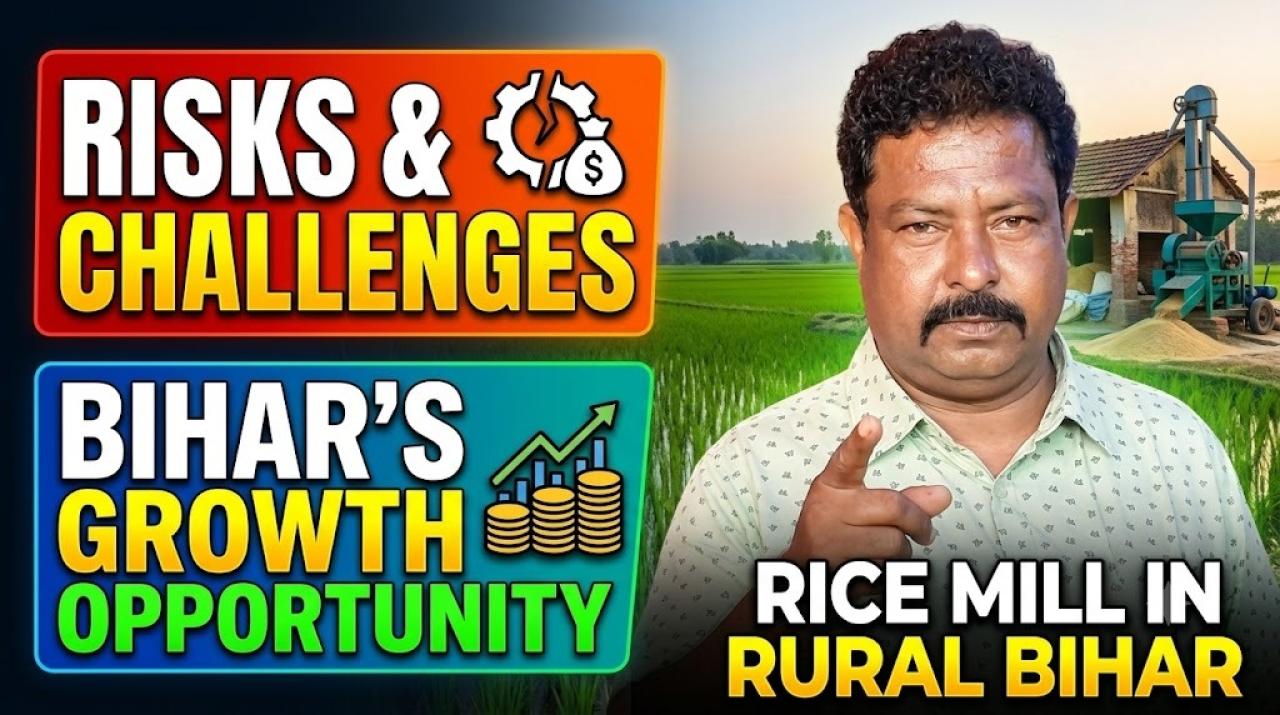
In rural Bihar, where migration and limited job opportunities remain major challenges, Ram Vinod Choudhary is building a business that supports farmers, creates jobs, and strengthens the local economy.
The business culture among the rural population of Darbhanga district in Bihar remains largely traditional. Agriculture is a major source of livelihood, with rice, wheat, and pulses among the principal crops. Many people depend on local retail shops, tailoring units, carpentry workshops, and small manufacturing ventures. Most of these businesses cater to local needs and contribute to the rural economy.
Given these conditions, a rice mill can be a promising business opportunity in a rural area where agriculture is a primary occupation. Recognising the potential of the local economy, Ram Vinod Choudhary decided to establish a rice mill in his native area in 2016. With his vision and determination, he has built a successful enterprise in rural Bihar.
In an interview with InsightfulTake, Ram Vinod Choudhary, Director of Choudhary Rice Mill, discusses the challenges and opportunities of running a rural business, creating local employment, supporting farmers, and navigating the changing business environment.
Is it fair to say that business does not naturally come to the minds of rural people?
Absolutely. Business is often considered a last resort for earning a livelihood in rural Bihar. Literacy levels are relatively low, and people are not always aware of the different career and business opportunities available to them. For most local people, getting a job is the first priority.
A large section of the population works in the unorganised sector, and poverty remains a major concern. When people struggle to meet their basic needs, it becomes difficult for them to think independently about starting a business or taking entrepreneurial risks. Darbhanga district has also received support under development programmes such as the Backward Regions Grant Fund (BRGF).
Under these circumstances, entrepreneurship does not automatically emerge as a preferred means of livelihood for most rural families.
How did the idea of starting a business come to you, given that you grew up and continue to live in this rural area?
My personal story is a little different. My grandfather understood the importance of business, and no one in our family has been employed in a conventional job. Everyone is engaged in some kind of business. Therefore, entrepreneurship comes naturally to me.
After graduation, I started trying my hand at different ventures. I was quite successful in these efforts, and every venture gave me the confidence to think bigger. That experience eventually brought me to where I am today.
My rice mill now provides employment to nearly 50 people. Although this number might not appear very large in terms of employment generation, its significance becomes clear when we consider the location and the local population. It gives me tremendous satisfaction to know that my business supports nearly 50 families.
How do you contribute to the local economy in Kusheshwar Asthan?
Choudhary Rice Mill provides employment opportunities to local people. It helps reduce the need for workers to migrate to other cities and states in search of jobs. Our operations also support the income of local farmers.
In addition, transportation, packaging, and several other associated businesses benefit from our activities. The rice mill does not operate in isolation. It creates opportunities for different people and businesses connected to the agricultural supply chain.
Slowly and gradually, we are helping one another build a local business ecosystem. This is important for rural development because the growth of one enterprise can create opportunities for several others.
What are the key challenges faced by businesses like Choudhary Rice Mill in rural Bihar, and how can these be addressed?
Businesses in rural Bihar face several challenges, including inadequate infrastructure, limited investment opportunities, and an unreliable power supply. These problems affect daily operations, increase costs, and make it difficult for enterprises to improve their productivity.
Government support and effective implementation of development schemes can help address many of these issues. Better infrastructure and a reliable electricity supply would improve operational efficiency and create a more favourable environment for rural industries.
At the same time, skill development programmes are extremely important. People need the right skills to operate machinery, manage industrial processes, and maintain quality standards. Such training can improve productivity and efficiency while enabling rural enterprises to compete more effectively.
If infrastructure development is combined with investment support and skill development, businesses in rural areas can achieve much greater growth.
Have any government initiatives or schemes benefited Choudhary Rice Mill or similar businesses in the region?
Yes, government initiatives such as the Pradhan Mantri Kisan Sampada Yojana, the Pradhan Mantri Krishi Sinchayee Yojana, and the Bihar Kisan Yantra Subsidy Scheme have played an important role in supporting agricultural development and improving rural infrastructure.
These initiatives can contribute to better facilities, improved agricultural productivity, and the modernisation of farming practices. Such improvements can benefit businesses connected with agriculture and food processing.
Government support for agricultural infrastructure and rural development can also help enterprises improve their production processes and quality standards. These initiatives have the potential to make a meaningful difference to rural businesses and the communities that depend on them.
Do you use digital technologies and e-commerce to expand your market beyond Kusheshwar Asthan?
At present, we do not use digital technologies or e-commerce to expand our market because our products are purchased by the Bihar State Food and Civil Supplies Corporation through Primary Agricultural Credit Societies (PACS). The Food Corporation of India subsequently procures rice through the established system.
Of course, we understand the power of digital technologies and how they can potentially expand our market reach many times over. However, our business operates in collaboration with the state government, and we do not deal directly with individual consumers.
As a result, digital platforms are not currently central to our business operations or market expansion strategy. Our focus remains on fulfilling the requirements of the established procurement system.























Leave a Comment