
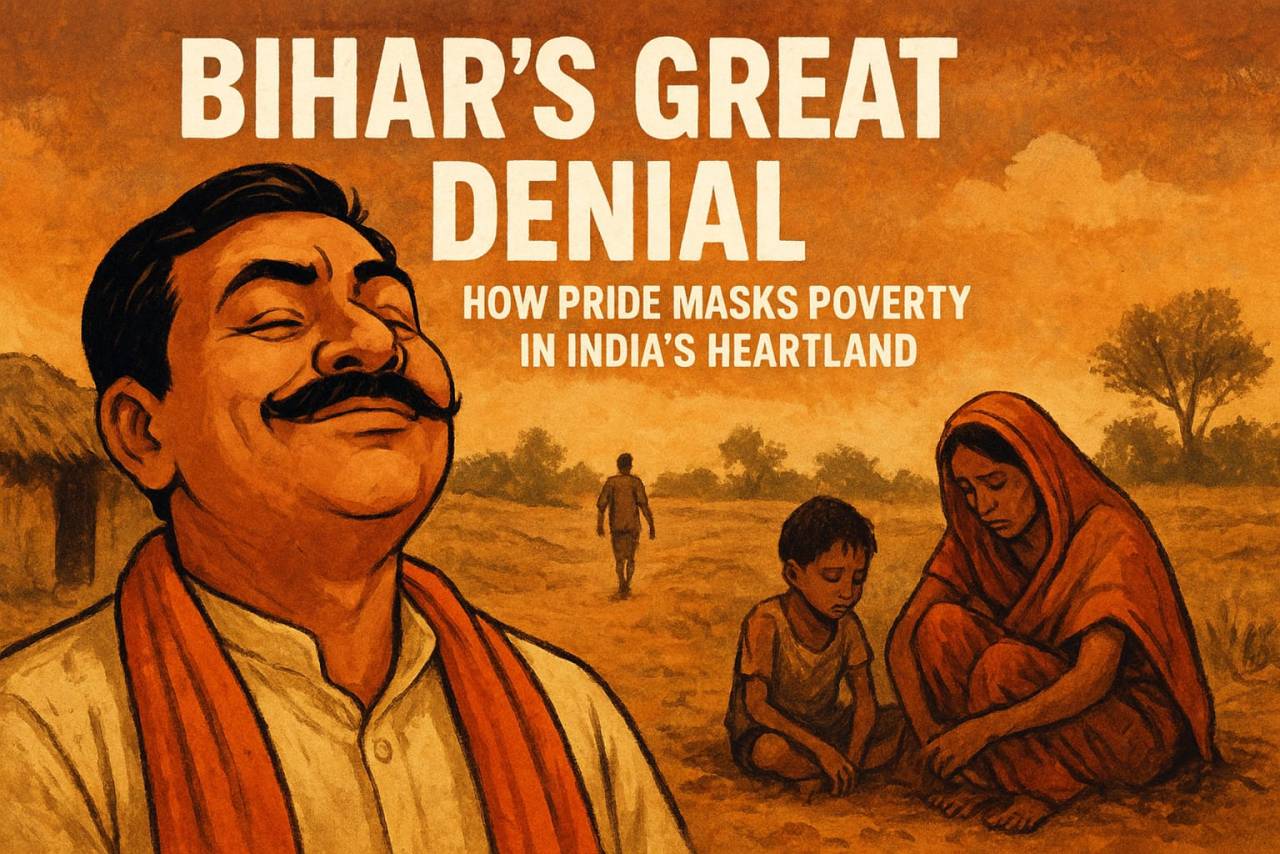
There is a peculiar dignity in denial, and nowhere is it more visible than in Bihar. Ask a Bihari why his state remains poor, and you will not receive a straightforward answer. Instead, you will hear an eloquent sermon on Nalanda’s wisdom, Chanakya’s brilliance, and Ashoka’s legacy. By the end of it, you might forget that the same land now exports laborers instead of philosophers.
Bihar’s poverty is not its biggest problem. Its refusal to accept it is. For decades, denial has served as Bihar’s defense mechanism, a comforting shield against the painful truth that the state has fallen behind. Poverty here has become a heritage site carefully preserved through nostalgia and pride.
The Escape of People and Reality
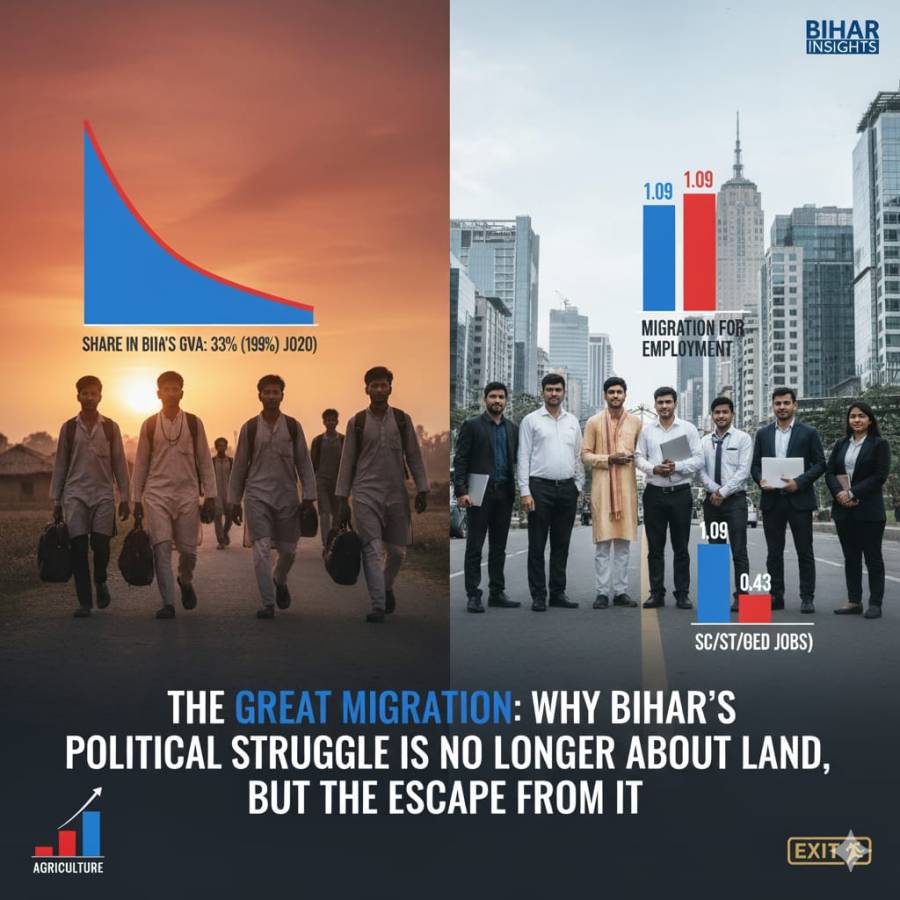
Every year, millions of Biharis leave their homes to find work in Delhi, Mumbai, Surat, and beyond. They build the cities that forgot them. Yet, when you ask why they migrate, you will hear explanations about “better opportunities” or “learning experience,” not desperation. Migration is treated as ambition, not necessity.
In most states, migration is a choice. In Bihar, it is an escape from broken systems. But the people have wrapped it in cultural pride. The migrant worker is not seen as a victim of policy failure but as a symbol of resilience. The truth is that migration has become Bihar’s most successful industry.
Corruption, Politics, and Cultural Excuses
Media outlets describe Bihar’s poverty as a consequence of corruption and lack of political will. They are right, but that is only half the story. Corruption thrives because it is tolerated. Governance has collapsed because people have stopped expecting accountability. When questioned, citizens often retreat into cultural nostalgia, declaring that “Bihar Ne Duniya ko Gyaan Diya Tha.”
It is a convenient escape from the present. History is used not as inspiration but as anesthesia. This habit of glorifying the past has allowed mediocrity to grow unchecked. It is easier to praise a fallen empire than to demand better roads or schools.
The Politics of Performance
Bihar’s politics is not about governance. It is about performance. Elections here are grand spectacles where caste identities replace development agendas. Leaders arrive with slogans, not solutions. Voters participate with emotion, not evaluation. After every election, the cycle of blame restarts.
Citizens speak of politics as if it were an external force, something imposed upon them. “Sarkar kharab Hai” is said with the same helplessness as “It rained too much.” The result is a democracy without self-awareness. Everyone complains, but few introspect.
The Youth and the Civil Service Dream
Bihar’s young generation blames education and unemployment, and they are right to do so. Schools are poorly managed, teachers are often absent, and examinations resemble bureaucratic rituals rather than assessments of merit. Despite this, coaching centers thrive, producing endless batches of civil service aspirants.
Becoming an IAS officer has become a collective fantasy. It is not merely a job; it is redemption. Every young person wants to clear the exam, not to serve Bihar, but to escape it with dignity. When success is measured by the distance one can travel from home, progress becomes impossible.
The Psychology of Glorified Misery
Bihar’s collective psyche has perfected what psychologists call “compensatory glorification.” When present-day reality is unbearable, people retreat to the safety of historical pride. Ancient Magadh, Mithila, and Nalanda are invoked as reminders that Bihar was once the light of India. The irony is that even Nalanda’s ruins are better maintained than Bihar’s infrastructure.
This tendency to glorify the past acts as an emotional tranquilizer. It helps people avoid confronting the hard truth that their state has been structurally stagnant for decades. It replaces urgency with nostalgia and civic action with resignation.
Denial as Stability
Noam Chomsky once wrote that the easiest way to keep people passive is to limit the range of acceptable opinion. Bihar is a textbook example. You can criticize politicians, but not the system that creates them. You can complain about unemployment, but not about the culture that normalizes it.
Denial keeps the peace. It allows everyone to maintain their illusions. The politician blames history, the bureaucrat blames politics, the teacher blames salary, and the youth blames fate. Each one finds comfort in being a victim, never a participant.
Final Take
Bihar does not need more nostalgia. It needs acceptance. The first step toward progress is admitting the problem. The people must have the courage to say, “Yes, we are poor, and yes, we are responsible for allowing it.” Only when denial breaks can accountability begin.
The day a Bihari stops quoting Chanakya and starts questioning his MLA, the transformation will start. When he stops treating migration as glory and begins to see it as loss, Bihar might finally reclaim what it once represented — wisdom, not excuses.
Until then, Bihar will remain an archaeological marvel of denial, where ruins are revered, roads are ignored, and hope leaves by train every evening.
By Gautam Jha
Managing Editor
























Leave a Comment