
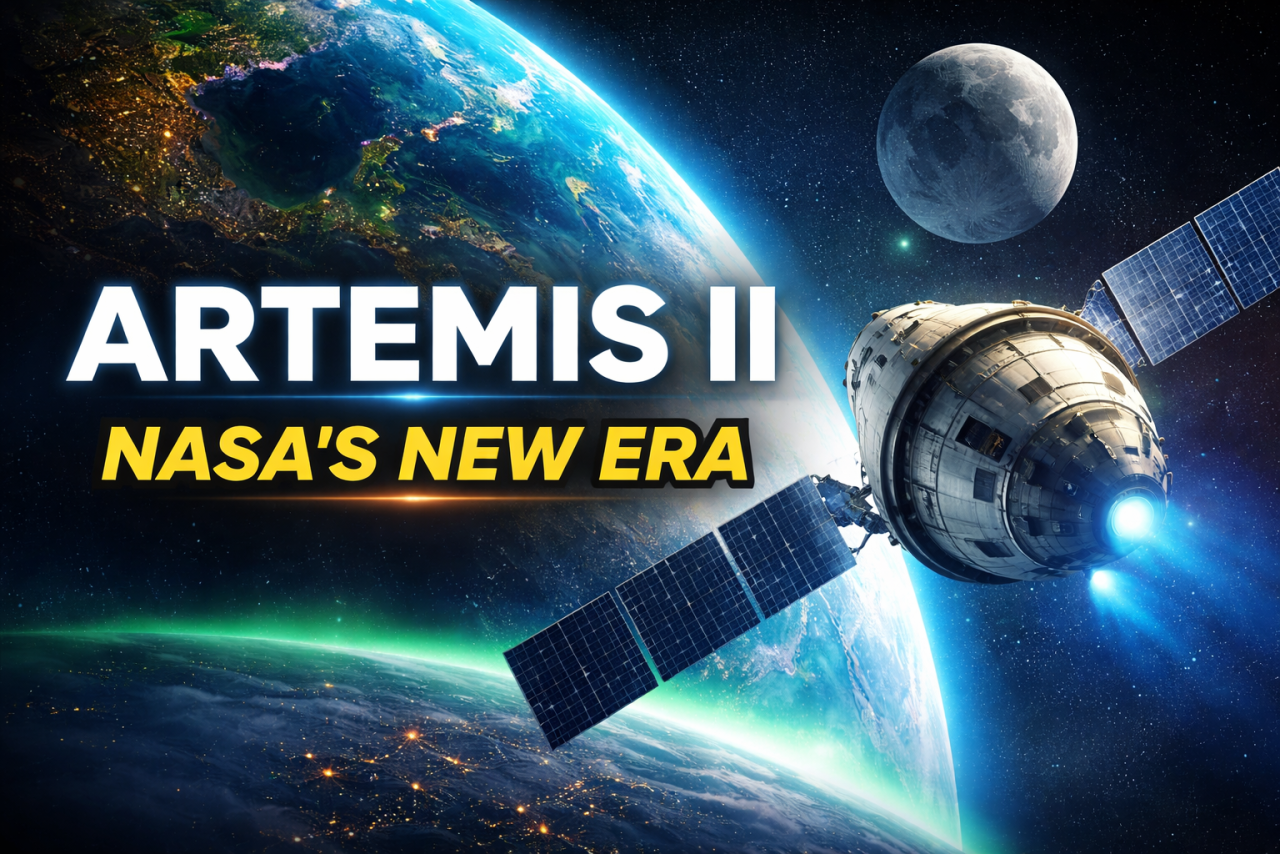
From 200,000 miles away, Earth looks silent and fragile. Artemis II reminds us how far we’ve come—and what could change next.
The return of humans to deep space is no longer theoretical—it is underway. Artemis II, NASA’s first crewed mission beyond low-Earth orbit since 1972, has carried four astronauts more than 200,000 miles from Earth. It marks a technical milestone, but also arrives at a time when space exploration is being reshaped by politics, budgets, and private industry.
A View Few Humans Have Ever Seen
Images released by NASA show Earth as only a handful of astronauts in history have witnessed it—distant, luminous, and suspended in darkness.
Captured from the Orion spacecraft, the visuals highlight three striking features. The first is the planet’s thin atmospheric layer, visible as a faint blue line, underscoring how fragile the boundary is between life and space. The second is the aurora, glowing green near the poles, spreading across the surface in sweeping patterns. The third is the “terminator”—the sharp dividing line between day and night—cutting across oceans and continents.
For the crew—Commander Reid Wiseman, Pilot Victor Glover, Mission Specialist Christina Koch, and Canadian astronaut Jeremy Hansen—the moment was more than operational. Following a successful trans-lunar injection burn, the spacecraft windows filled with Earth, prompting a pause to take in the view.
It is a scene reminiscent of the Apollo era, though today’s context is very different.
NASA’s New Direction Under Isaacman
The mission also reflects a broader shift within NASA itself. Since taking office in late 2025, Administrator Jared Isaacman has pushed for a more commercially driven approach to spaceflight.
Unlike traditional leadership, Isaacman’s background lies in private space missions, including Inspiration4 and Polaris Dawn. His strategy is built on a simple premise: NASA should rely more on private companies for infrastructure and transport.
That includes expanding partnerships with SpaceX and Blue Origin, particularly for lunar landers and support systems. The objective is to reduce costs, accelerate timelines, and maintain a competitive edge—especially as China advances its own lunar ambitions.
Supporters argue this model brings efficiency and innovation. Critics, however, warn that heavy dependence on private players could introduce new risks, including delays and shifting commercial priorities.
Budget Cuts Cast a Long Shadow
Even as Artemis II captures attention, NASA’s financial outlook is tightening.
The proposed U.S. budget for fiscal year 2026 includes a 24% reduction in NASA’s funding—approximately $6 billion. Science programs are expected to bear the brunt, with an estimated $3.4 billion in cuts that could affect dozens of missions.
Among the areas under scrutiny is Mars exploration, particularly plans to return samples from the planet’s surface. Some policymakers have questioned the cost-effectiveness of such missions.
At the same time, funding for a future lunar base—a key long-term goal of the Artemis program—remains limited, with about $175 million allocated as an initial investment.
The shift suggests a clear prioritization of human spaceflight and near-term lunar goals over broader scientific research. Whether Congress supports these changes will be critical in determining NASA’s direction in the coming years.
What Happens Next
Artemis II is now on a precise trajectory for its lunar flyby. The Orion spacecraft will loop around the Moon before returning to Earth, testing navigation, propulsion, and communication systems along the way.
The crew will also continue evaluating life-support systems and other critical technologies required for longer missions. These tests are essential groundwork for Artemis III, which aims to land astronauts on the Moon later this decade.
That mission is expected to rely heavily on commercial systems and will mark the true return of humans to the lunar surface.
More Than a Mission
Artemis II is not just a technological step forward. It reflects a changing model of space exploration—one shaped as much by economics and competition as by science and discovery.
Yet the most enduring takeaway may be the simplest. From deep space, Earth appears small, quiet, and indivisible.
It is a perspective that astronauts have described for decades. And as humanity prepares to return to the Moon, it remains a reminder of what is at stake—not just in reaching new worlds, but in understanding and preserving our own.


























Leave a Comment