
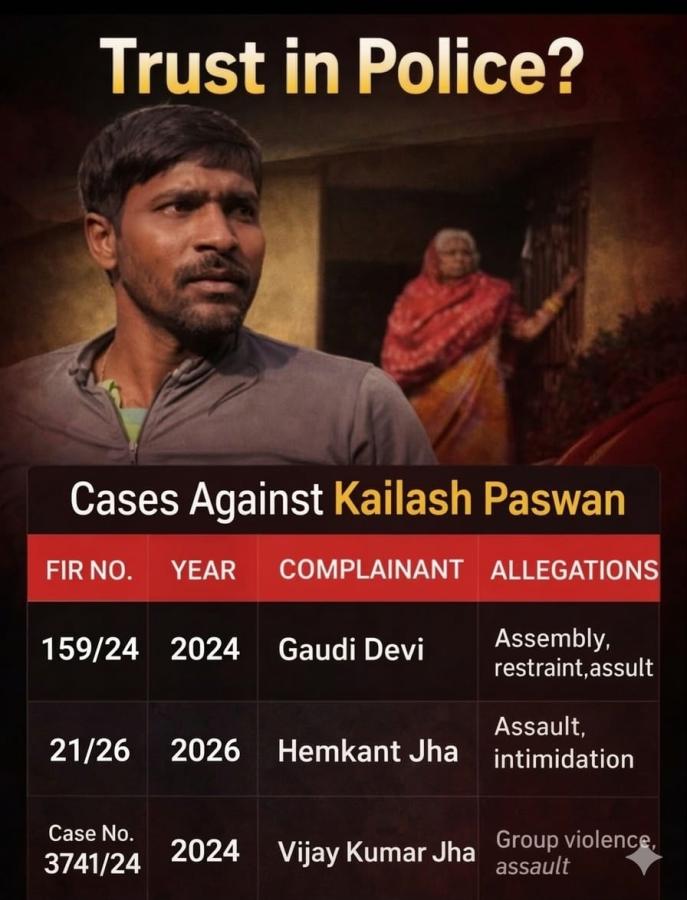
Multiple cases, repeated allegations, and yet no visible action—what is really happening in Darbhanga’s Harinagar?
In Harinagar village of Bihar’s Darbhanga district, a series of police complaints over the past few years has brought one name repeatedly into focus—Kailash Paswan. A close reading of FIR records reveals that he has been named in multiple cases involving allegations of violence, intimidation, and group clashes, raising serious concerns among residents about safety and enforcement.
One of the key cases, FIR No. 159/2024 registered at Kusheshwar Asthan Police Station, includes allegations of unlawful assembly, wrongful restraint, and assault. The complaint, filed by a local resident, describes an incident involving a group attack, where several individuals, including Kailash Paswan, Vikram Paswan, Abhishek Pawan, Asharfi Paswan and Ramvilash Paswan were named. The nature of the charges points to organized confrontation rather than a spontaneous dispute.
The pattern does not end there. Another complaint filed in January 2026 again lists Kailash Paswan, Vikram Pawan, Hakru Paswan and Avinash Paswan among the accused. Similar to earlier cases, the allegations revolve around intimidation, physical assault, and coordinated action by a group. The recurrence of such charges across separate incidents has drawn attention to what many locals describe as a consistent pattern of behaviour.
What makes the situation more troubling for residents is the repetition of names across these FIRs. Alongside Kailash Paswan, a set of individuals appears frequently in different cases, suggesting that these are not isolated conflicts but part of an ongoing cycle of disputes that periodically escalate into violence.
Despite the seriousness and frequency of these allegations, residents claim that no meaningful arrests have been made in connection with these cases. This perceived lack of action has become a central point of concern. For many in Harinagar, the issue is no longer just about individual incidents, but about whether the system is responding adequately to repeated complaints.
Locals describe an environment where tensions can escalate quickly. Disagreements, they say, often take a confrontational turn, and the fear of retaliation discourages many from speaking openly. In such a setting, the role of law enforcement becomes critical—not only to respond to incidents but also to prevent their recurrence.
The FIRs themselves paint a picture of recurring confrontation. Allegations under provisions dealing with rioting, causing hurt, and criminal intimidation indicate that these are not minor disagreements but incidents with the potential to disrupt community life. Each complaint adds to a growing record that residents believe should have triggered stronger intervention by now.
The absence of visible enforcement has also affected public confidence. When complaints are filed but outcomes remain unclear, it creates a perception that the process may not be delivering results. Over time, this perception can weaken trust in institutions meant to provide protection and justice.
The impact on daily life in Harinagar is significant. Residents speak of unease, especially during disputes or local disagreements that could escalate. Vulnerable groups, including women and elderly villagers, are often the most affected, as they have limited means to navigate prolonged conflict or legal processes.
At a broader level, the situation raises important questions about how repeated allegations are handled. When the same individual is named in multiple FIRs over time, it typically calls for closer scrutiny and stronger preventive measures. Monitoring patterns, ensuring timely investigation, and taking visible action are essential steps in maintaining law and order.
It is equally important to underline that the presence of allegations in FIRs does not establish guilt. The legal process must determine that based on evidence. However, the consistency of complaints against Kailash Paswan has made his name central to local discussions about law enforcement and accountability.
For many residents, the expectation is simple. They want assurance that complaints will lead to action and that repeated incidents will not be allowed to continue unchecked. The demand is not extraordinary—it is the basic expectation of safety in one’s own village.
The situation in Harinagar reflects a larger challenge seen in many parts of the country, where gaps between reporting and enforcement create uncertainty. Addressing this requires not just legal provisions, but consistent and visible implementation on the ground.
As more cases emerge and older ones remain unresolved in public perception, the pressure on authorities is likely to grow. Whether through stricter enforcement, closer monitoring, or faster investigation, the need for a clear response has become increasingly urgent.
For now, the records continue to tell a story of repeated allegations and rising concern. For the people of Harinagar, what matters most is what happens next.



















Leave a Comment