
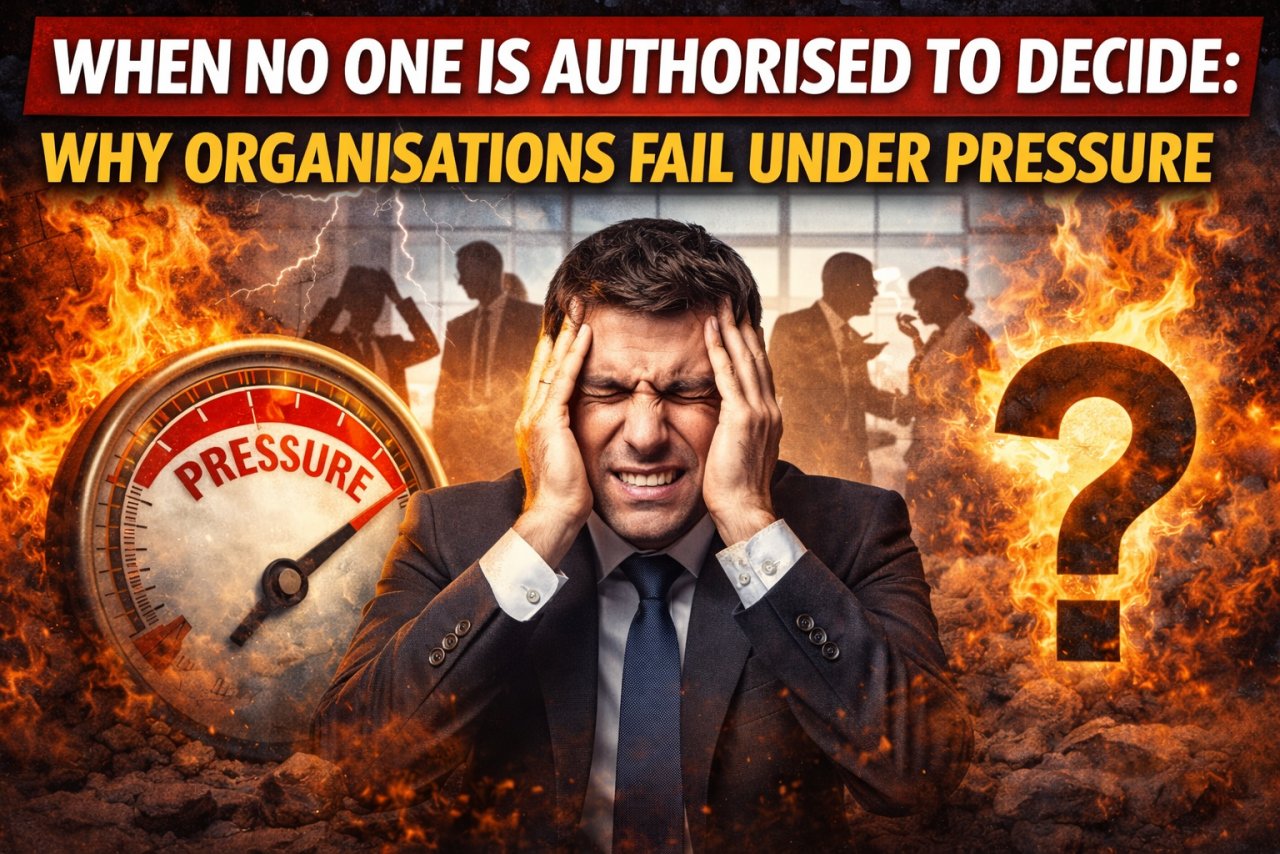
Most organisational failures do not begin with bad judgment or flawed communication. They begin earlier, at the precise moment when a decision is required and no one is clearly authorised to make it.
This weakness rarely reveals itself during stable periods. It emerges under pressure—when information is incomplete, scrutiny is immediate, and the organisation must act beyond the comfort of routine processes. In such moments, hesitation becomes public, often through media attention or stakeholder questioning, exposing internal uncertainty in real time.
Contrary to popular belief, organisational processes do not necessarily collapse during crises. Instead, they become constraints. What is designed to ensure control and consistency can, under pressure, slow action to a critical degree.
Why decision-making stalls in large organisations
Large organisations are structured to distribute responsibility while centralising accountability. This architecture supports scale, compliance, and risk management. However, it also creates friction when rapid decisions are required without full clarity or consensus.
Local leaders often possess the most contextual understanding but lack the authority to act. Senior leadership holds decision rights but is removed from immediate developments. Functional teams—legal, risk, communications, operations—focus on minimising exposure within their own domains.
Individually, none of these elements is broken. Collectively, they produce delay.
When escalation replaces leadership
Escalation frameworks are commonly treated as safeguards. In practice, they often become holding patterns. When authority is unclear, organisations default to consultation rather than decision-making. Multiple teams are engaged simultaneously, each offering rational input, but no one empowered to decide.
This is typically when communications teams come under pressure—not because messaging is unclear, but because communication becomes the point where internal hesitation turns visible.
At that stage, communication is not the problem. It is the symptom.
Expertise without permission
Organisations under scrutiny rarely lack intelligence, experience, or advice. What they lack is permission.
When decision authority has not been deliberately designed for moments of uncertainty, leaders hesitate even when they know what must be done. No one is authorised to choose between imperfect options. Meetings multiply. Language becomes cautious. Responsibility diffuses. Activity increases, but movement stops.
The organisation appears busy, yet nothing advances.
A simple question exposes this fragility:
If a high-risk issue emerged this afternoon, who could make a binding decision in the first hour—without further escalation?
If the answer depends on geography, function, or personal relationships, authority is already compromised.
Designing authority before crisis strikes
Some organisations address this risk by defining decision thresholds in advance. These frameworks clarify what can be decided locally, what must be escalated, and when temporary delegation applies. The objective is not speed for its own sake, but continuity of action when certainty is unavailable and pressure is public.
Organisations that navigate crises well treat authority as an operating system—deliberately designed, tested under stress, and trusted when consensus is impossible.
Most organisations believe they have done this. Very few have tested it.
The gap between authority that exists on paper and authority that holds in practice is where credibility is now made—or quietly lost.
Why this matters now
In 2026, organisations are judged less by what they promise and more by how decisively they act when information is incomplete and scrutiny is real-time. Reputational damage is the outcome leaders fear most, yet what exposes organisations to it repeatedly is something more fundamental: discovering, often in public, that decision-making authority is unclear or contested.
Organisations that take this seriously do not wait for crises to reveal where authority collapses. They examine it in advance, stress-test it under pressure, and redesign it where it fails.
That work is uncomfortable. But it is preventative.
And increasingly, it is the difference between organisations that stall—and those that hold.
By Sanchia Temkin
Associate Director: Content, APO Group


















Leave a Comment