
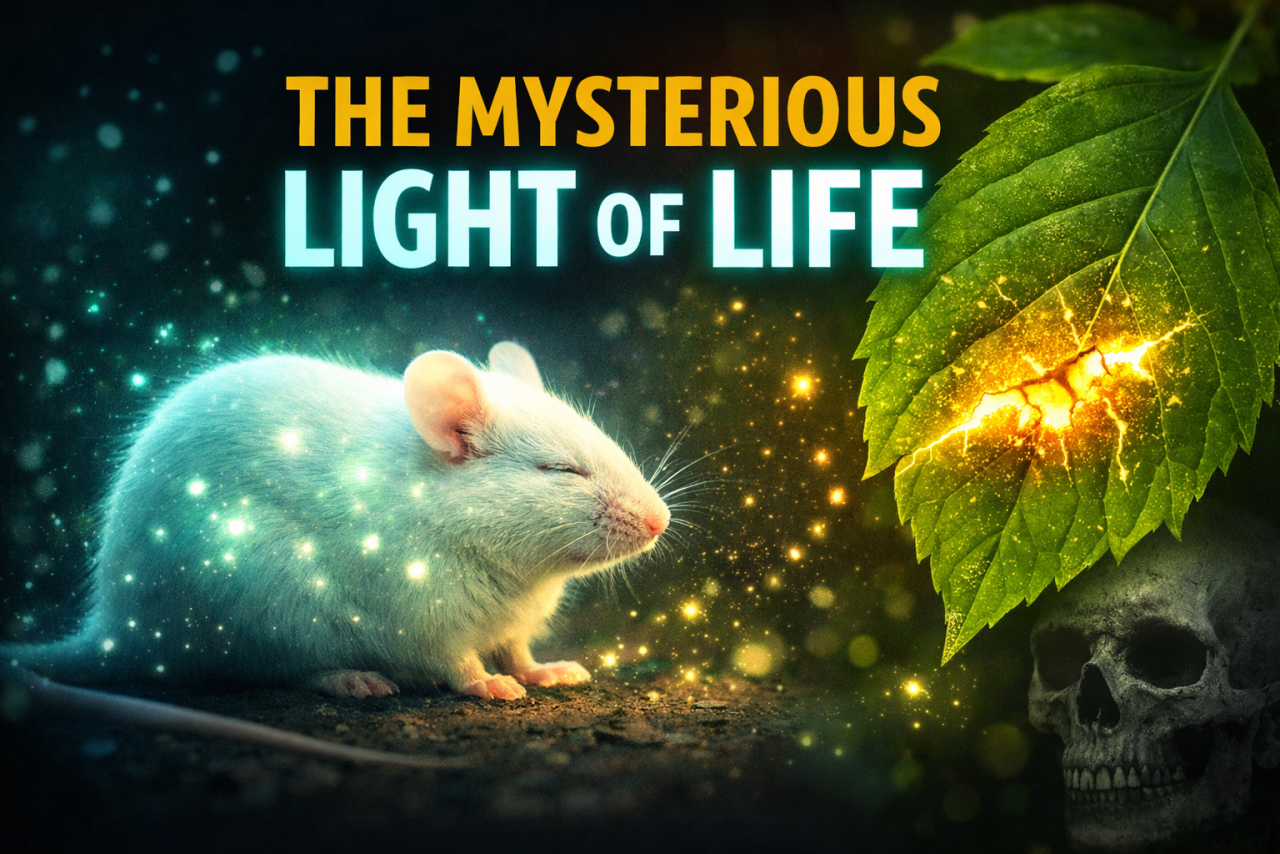
Scientists have found that living cells quietly glow, and the light disappears the moment life ends.
Scientists have discovered that living organisms emit a very faint light. This light comes from normal cell activity. It is known as biophoton emission. The light is too weak for the human eye to see. Researchers detected it using highly sensitive cameras. The experiments were done in completely dark chambers.
The study observed mice and plants. In living mice, the light appeared steady and continuous. It flickered softly across the body. When the mice died, the glow dropped sharply. This happened even when the bodies were kept warm. This ruled out temperature as the cause. The results showed that the light was linked to life itself. It was not a result of heat or decay.
Plants showed a similar pattern. Healthy leaves gave off a faint glow. Damaged leaves glowed more strongly. The injured parts produced more light. This happened because stress inside plant cells increased. The cells reacted to injury by producing more chemical activity. That activity released more biophotons. This made the glow brighter in affected areas.
Biophotons are produced during metabolism. Cells constantly carry out chemical reactions. These reactions help repair damage. They also help maintain normal function. During this process, small amounts of energy are released. Some of this energy escapes as light. This light is extremely weak. It can only be detected with special instruments.
The disappearance of the glow after death is significant. It shows that biophoton emission depends on active cellular processes. When cells stop functioning, the light fades. This makes the glow a possible indicator of living activity. It reflects processes that support life at a basic level.
Scientists believe this discovery may have future medical value. Biophoton detection could become a non-invasive method. It may help assess tissue health. It could help identify early damage. It may also help track aging inside the body. All of this could happen without surgery or radiation.
This research is still at an early stage. Current equipment is complex and expensive. Human tissues are thicker than plant leaves or mouse skin. This makes detection harder. Scientists need more sensitive tools. Larger studies are also required. Careful testing will be necessary to ensure accuracy.
Safety is another concern. Any future application in humans must be harmless. Researchers must confirm that measurements do not interfere with normal cell activity. Ethical guidelines will also play a role. These steps will take time.
The findings challenge how people think about life at the cellular level. Living cells are not just chemical machines. They also produce subtle physical signals. Light is one of them. This glow is not mystical. It is based on measurable science. It arises from known biochemical reactions.
The research paper behind this discovery was published with the DOI 10.1021/acs.jpclett.4c03546. It provides detailed experimental data. It explains how the measurements were taken. It also discusses limitations and future directions.
This discovery increases awareness about the complexity of life. It shows how advanced modern scientific tools have become. It also reminds us that many processes remain unseen. Even ordinary cells carry hidden signals. Understanding them may improve medicine in the future.


























Leave a Comment