
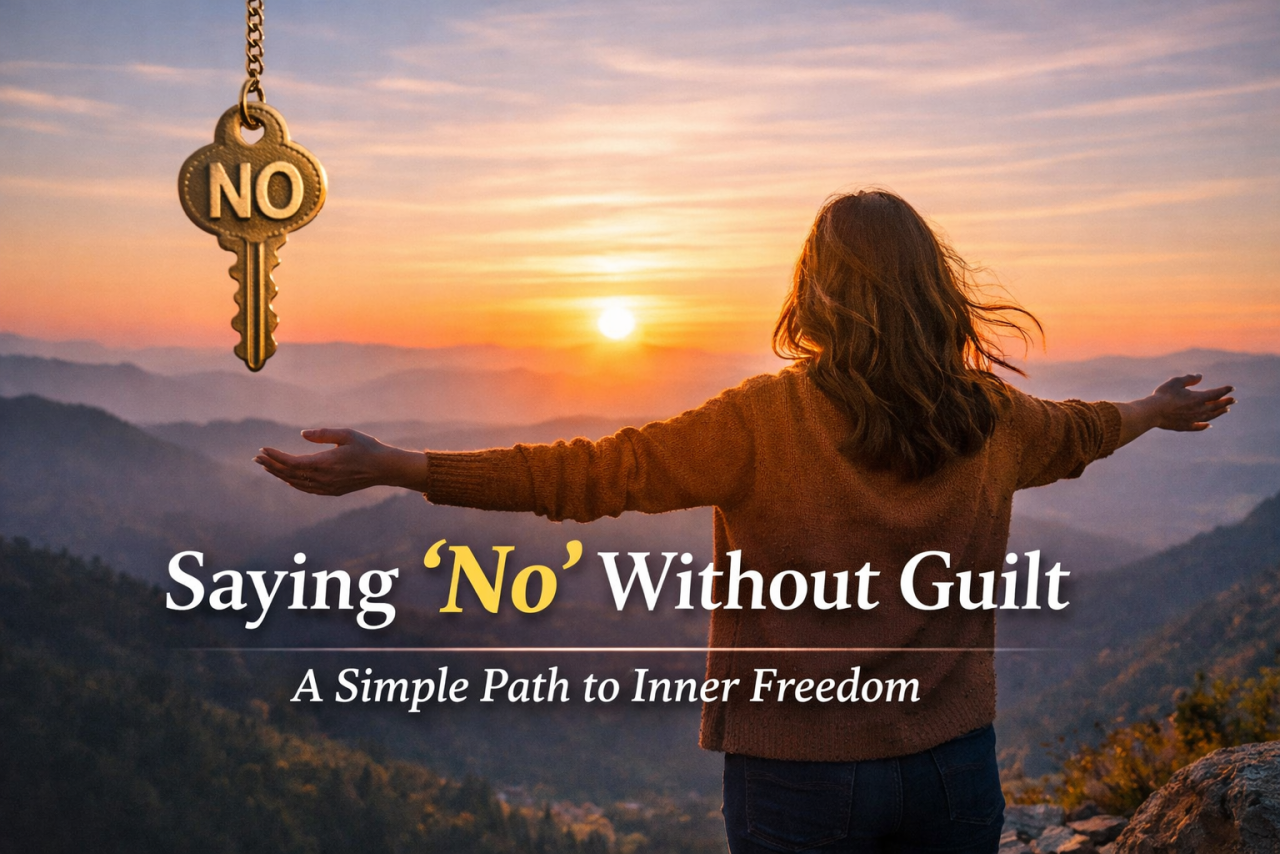
The moment you stop explaining your ‘no’, life begins to feel lighter and more honest.
Most of the burden people carry in life does not come from work, relationships, or responsibilities. It comes from a quiet habit learned very early—to say yes when the heart is saying no. This habit slowly drains energy, clarity, and joy. And because it happens silently, we rarely notice how deeply it shapes our lives.
From childhood, we are taught to please. Obedience is rewarded, agreement is appreciated, and refusal is questioned. Saying no is seen as rude or selfish. So we learn to soften it, decorate it, explain it. We say no with stories, excuses, and apologies. In doing so, we forget that a simple no is not an act of cruelty. It is an act of honesty.
Every time you say ‘yes’ against your inner feeling, something within you closes. A small tension arises. One such moment may seem harmless, but repeated again and again, it becomes a way of living. Over time, this creates fatigue, irritation, and a vague sense of being lost. You may appear functional on the outside, but inside there is resistance, as if life is happening against you.
A ‘no’ spoken from awareness does not need explanation. Truth stands on its own. When you explain your refusal, you are not being kind; you are being uncertain. You are asking to be understood, approved, or forgiven. But a boundary is not something to be forgiven for. It is a sign that you are listening to yourself.
Look at existence. A river flows where it must. A flower blooms when it is time. Nature never explains itself. Only the human mind carries guilt for being authentic. This guilt is not natural. It is taught.
The fear behind saying no is usually the fear of losing love, connection, or approval. But understand this clearly: anyone who truly respects you will respect your no. Those who are disturbed by your refusal were comfortable with your silence, not with your truth. In this way, your no becomes a form of clarity. It reveals the nature of relationships.
Saying no without guilt does not mean becoming hard or insensitive. It means being clear. You can be gentle and firm at the same time. A simple statement such as “I am not comfortable with this” or “I am not available” is complete. The moment you begin to justify, you invite negotiation, and your inner voice is pushed aside once more.
At first, this practice will feel uncomfortable. Old conditioning will surface. Guilt will arise. The mind will warn you of consequences. Stay with the discomfort. It is a sign that something false is dissolving. Freedom is rarely comfortable in the beginning.
When you learn to say no, something else becomes possible—a real yes. A person who cannot say no cannot truly say yes either. Their agreement is mechanical, driven by fear. But when no is available, yes becomes a choice. Then your presence, time, and love carry weight. They are no longer borrowed or forced.
Slowly, life becomes simpler. Relationships become fewer but more honest. The constant inner noise begins to settle. You feel less divided because you are no longer living in contradiction to yourself. Sleep becomes deeper. Decisions become clearer.
To say no without explaining yourself is not rebellion. It is remembrance. You are remembering that your life belongs to you. That your energy is sacred. That your inner voice deserves attention.
The world will continue as it always has. But within you, something will open. A quiet space. A sense of dignity. A freedom that does not depend on approval.
That freedom is not something you achieve. It is something you stop denying.
And it begins with a simple, truthful no.
























Leave a Comment