
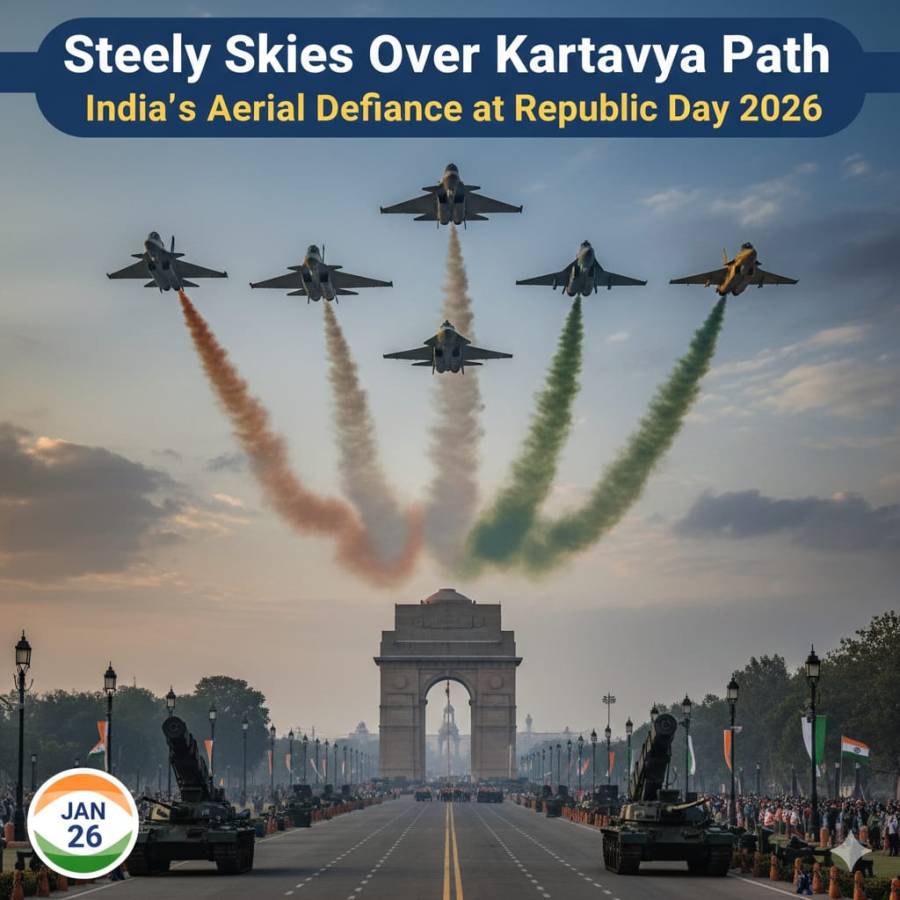
This Republic Day, the skies over Kartavya Path will tell a new story—and it begins with the ‘Sindoor’ formation.
As the morning mist settles over Kartavya Path on January 26, the roar of twenty-nine military aircraft will mark more than the 77th Republic Day of India. It will signal a deliberate shift in how the Indian state communicates power. This year’s flypast is not ornamental. It is operational in intent and unmistakably strategic in message.
At the centre of this transformation is the Indian Air Force’s debut of the ‘Sindoor’ formation, a combat-tested aerial grouping drawn directly from platforms used during Operation Sindoor in May 2025. The formation represents a public articulation of capability, shaped as a response to sustained regional skepticism following India’s retaliatory strikes after the April 2025 Pahalgam massacre.
From Battlefront to Boulevard
The ‘Sindoor’ formation comprises two Rafale fighters, two MiG-29s, two Sukhoi-30 MKIs, and a Jaguar strike aircraft. These are not symbolic selections. Each platform played a role in the precision strikes that targeted terror infrastructure across Pakistan-administered Kashmir and within Pakistan’s mainland.
By placing these aircraft over the national ceremonial axis, the IAF is recreating the architecture of a real combat mission. The display counters narratives that sought to minimise the scale or effectiveness of India’s response in 2025. It also underlines a core doctrinal message: India retains the ability to execute calibrated, high-intensity air operations under contested conditions.
The presence of pilots who flew the original missions adds further credibility to the display. Their participation turns the flypast into a live reaffirmation of operational readiness rather than a retrospective commemoration.
A Phased Battle Array on Display
Republic Day 2026 introduces a Phased Battle Array, moving away from static equipment showcases to a sequential depiction of modern warfare. The array mirrors the logic of an actual military operation.
| Phase | Assets Displayed | Operational Purpose |
|---|---|---|
| Reconnaissance | Drones and signal intelligence units | Target identification and battlefield awareness |
| Air Strike | Sindoor’ formation aircraft | Precision penetration and dominance |
| Firepower | BrahMos, Akash, Pinaka systems | Long-range and layered retaliation |
| Ground Control | Arjun tanks, ATAGS, BMP- II vehicles | Territorial control and consolidation |
This structure is reinforced by a revised flypast format conducted in two segments. The first aligns with marching contingents to highlight inter-service coordination. The second functions as a climactic aerial demonstration. Together, they project the doctrine of accuracy, penetration, and precision as an integrated combat system.
Global Witnesses and Strategic Signalling
The presence of senior European Union leadership, including Ursula von der Leyen, President of the European Commission, and António Costa, President of the European Council, adds diplomatic weight to the proceedings. Their attendance ensures that India’s messaging is not confined to domestic audiences.
At a time when regional adversaries continue to question the legitimacy or impact of India’s military actions, the participation of global political figures signals international acknowledgment of India’s role as a responsible security actor. The display is designed to be seen, recorded, and interpreted beyond South Asia.
Aatmanirbharta in Military Form
The parade also foregrounds indigenous defence capability. Systems such as the BrahMos supersonic cruise missile and the Akash air defence platform, both of which proved operationally effective during the 2025 conflict, form a central part of the display. Their inclusion reinforces India’s emphasis on self-reliance in defence manufacturing and deployment.
The thirty tableaux moving along Kartavya Path, including the Ministry of Defence’s presentation on tri-service integration, extend this narrative. Together, they depict a military ecosystem that is increasingly domestic in origin and joint in execution.
A senior defence official described the flypast as a continuation of strategic messaging rather than a ceremonial exercise. “Operation Sindoor established intent. This display confirms capability. It demonstrates that India can act decisively and precisely when required,” the official said.
As the final Sukhoi-30 performs a vertical climb over the capital, the transformation of Kartavya Path is complete. For one morning, the ceremonial boulevard becomes a visual doctrine of modern Indian warfare, leaving little ambiguity about the country’s preparedness, resolve, and control of its skies.
























Leave a Comment