
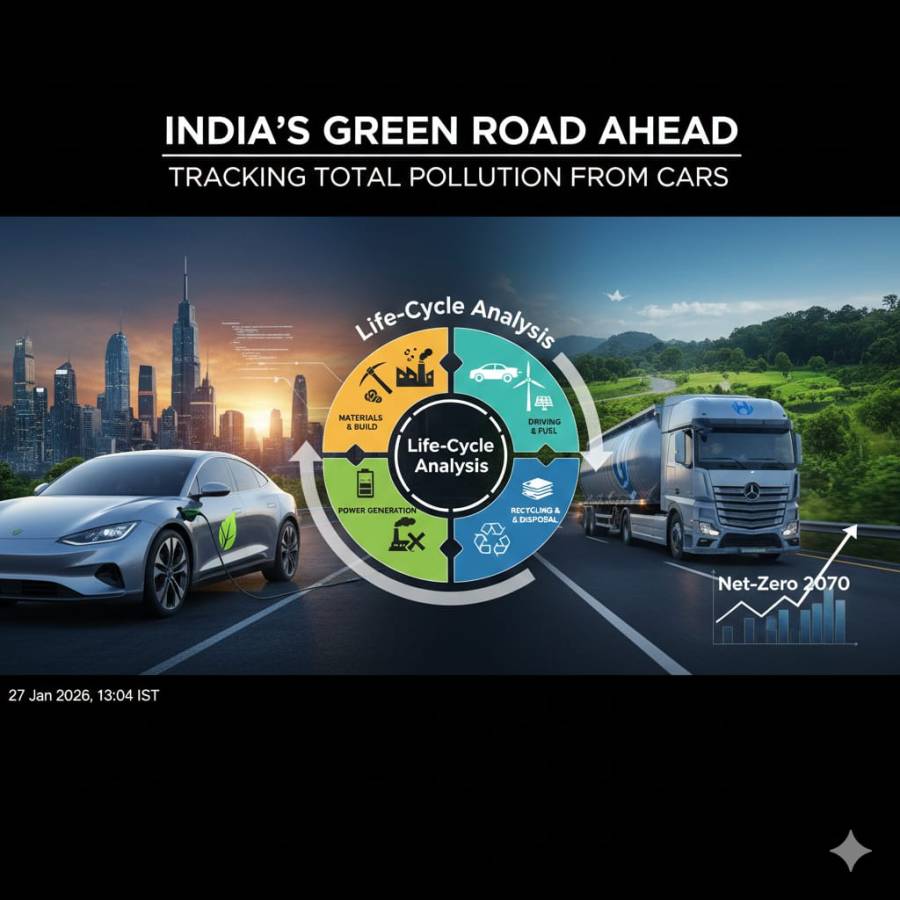
India is preparing to overhaul the way it measures pollution from cars and trucks—an apparently technical shift that could have far-reaching consequences for climate policy, industry strategy, and the future of mobility. Instead of focusing only on tailpipe emissions—the smoke released directly from a vehicle’s exhaust—the government plans to adopt Life-Cycle Analysis (LCA), a method that measures emissions across a vehicle’s entire lifespan.
The proposal is embedded in the Automotive Mission Plan (AMP) 2047, a long-term roadmap aimed at transforming India into a global hub for clean and competitive mobility while supporting the country’s commitment to reach net-zero carbon emissions by 2070.
Looking Beyond the Exhaust Pipe
For decades, vehicle regulations in India and elsewhere have focused narrowly on what comes out of the exhaust. While this approach is easy to measure and enforce, it tells only part of the story. Life-Cycle Analysis attempts to capture the full environmental cost of a vehicle—from the extraction of raw materials to its final disposal.
Under LCA, emissions are counted at every stage: mining lithium, cobalt, and other minerals; manufacturing and assembling vehicles; producing and consuming fuel or electricity during use; and recycling or scrapping vehicles at the end of their lives. This broader lens offers a more realistic assessment of environmental impact.
The shift also forces a reassessment of long-held assumptions about clean mobility, particularly electric vehicles (EVs). EVs produce no tailpipe emissions and are often described as zero-emission vehicles. Yet battery production is energy-intensive, and India’s electricity grid remains heavily dependent on coal. When EVs are charged using coal-based power, their indirect carbon footprint can be significant.
Life-cycle accounting allows policymakers to compare EVs, hybrids, hydrogen-powered vehicles, and internal combustion engine (ICE) vehicles running on petrol, gas, or ethanol on more equal terms.
Implications for the Auto Industry
The automobile sector is a cornerstone of the Indian economy, contributing nearly 7% of GDP and providing employment to millions. The government has signalled that the move to LCA is not intended to slow the industry but to push it toward genuine innovation.
AMP 2047 proposes a mix of incentives for companies developing cleaner technologies and policy nudges to encourage consumers to adopt low-emission vehicles. Electric two-wheelers and three-wheelers are expected to dominate by 2030, while buses, trucks, and passenger cars are projected to increasingly shift to electricity or green fuels over the next two decades.
By adopting life-cycle standards aligned with global norms, India also hopes to make its vehicles more competitive in international markets, where environmental regulations are becoming stricter.
The Challenges Ahead
Despite its appeal, implementing life-cycle analysis will be complex. Calculating emissions across global supply chains—often spanning multiple countries and industries—is technically demanding. Reliable data on mining, manufacturing, and recycling processes is not always available or standardised.
Some industry experts argue that existing fuel-efficiency and emission norms are already delivering measurable benefits and warn that overlapping regulatory frameworks could create confusion for manufacturers and investors.
There is also debate around “well-to-wheel” emissions, which measure pollution from fuel production to final use. Different fuels require different accounting methods. For instance, emissions from plant-based ethanol differ fundamentally from those associated with fossil fuels, raising questions about how comparisons should be made.
A More Mature Climate Strategy
Despite these challenges, the move toward life-cycle emission tracking signals a more nuanced approach to climate policy. Rather than privileging specific technologies, it focuses on outcomes—total environmental impact.
If implemented carefully, LCA could help policymakers design smarter regulations, encourage meaningful innovation, and avoid unintended consequences. More importantly, it could ensure that India’s clean mobility transition is driven by scientific assessment rather than simple labels.
In a country grappling with air pollution, climate vulnerability, and rapid motorisation, measuring what truly matters may prove to be the most important reform of all.

























Leave a Comment