
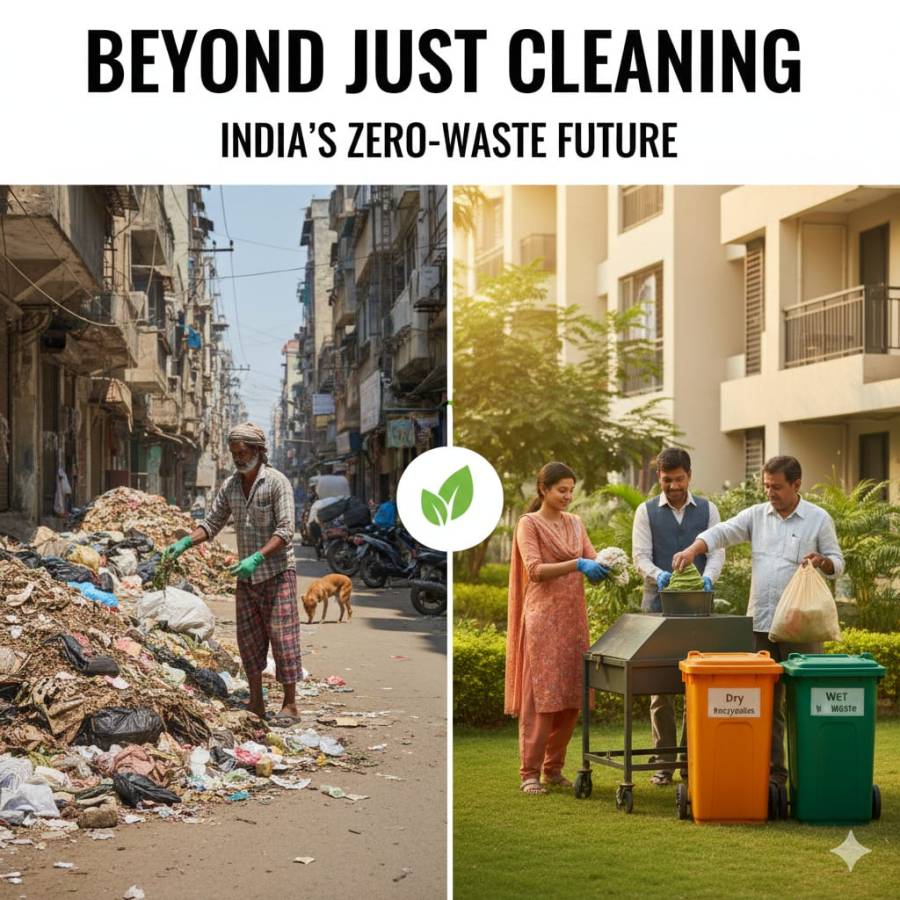
India’s waste crisis won’t be solved by trucks and bins—it starts in your kitchen.
The sight of a garbage-filled street corner or a clogged drain is something most of us are unfortunately used to. While the Swachh Bharat Abhiyan, the flagship program of the Indian government, has undoubtedly brought sanitation into our daily conversations and improved toilet access across the country, but a major challenge remains: what happens to the waste we produce every single day?
A recent initiative by the Greater Noida Authority highlights a shift in strategy that deserves close attention. The authority has extended the deadline for a sanitation ranking competition specifically for bulk waste generators—such as large housing societies, schools, and offices. While it may sound like just another government contest, the core message is clear and crucial: waste management is not just the government’s responsibility; it begins at our doorstep.
The Problem with “Throwing Away”
In India, there is a common belief that once trash is placed in a bin or handed over to a collection vehicle, it is “gone.” In reality, there is no such place as “away.” Most of our waste ends up in overflowing landfills that contaminate soil and groundwater.
Under the Solid Waste Management Rules, large establishments are required to process biodegradable waste—such as kitchen scraps—on-site. Yet many housing societies still struggle to comply. Instead, they hand over mixed waste to municipal bodies, creating a serious logistical challenge. When wet food waste is mixed with dry plastic and paper, recycling becomes nearly impossible, and the waste starts releasing harmful methane gas.
Why Competitions Matter
The Greater Noida initiative, which offers prize money of up to ₹1 lakh along with public recognition, aims to transform waste management from a burden into a source of pride. By rewarding societies that segregate waste at the source and compost within their premises, the authority hopes to create replicable models for others.
As NG Ravi Kumar, CEO of the Greater Noida Authority, has pointed out, the objective is not merely to win prizes. The real aim is behavioral change. India needs to move from a culture of “cleaning” to a culture of “managing” waste responsibly.
How You Can Make a Difference
You do not need to be part of a large housing complex to contribute. Small, consistent actions at home can make a meaningful impact:
- The Two-Bin System: Segregate wet (organic) and dry (recyclable) waste. This simple habit is the foundation of effective waste management. Segregated waste can be processed; mixed waste is just landfill material.
- Say No to Single-Use: The best way to manage waste is to reduce its creation. Carrying a cloth bag or a reusable water bottle can prevent hundreds of plastic items from entering the waste stream.
- Compost at Home: With a balcony or small garden, home composting is easier than ever. Kitchen waste can be converted into nutrient-rich compost for plants.
- Hold Your Community Accountable: If you live in an apartment complex, ask your management what happens to the waste after collection. Encourage participation in local government rankings and waste-management initiatives.
A Collective Responsibility
The Swachh Bharat Abhiyan provided momentum, but the next phase of India’s development depends on how responsibly we handle consumption and waste. Government schemes can supply bins and trucks, but they cannot enter our kitchens to separate plastic wrappers from banana peels.
Waste management reflects our civic sense. When citizens participate—whether through city-wide competitions or personal commitments to segregation and recycling—we do more than clean our surroundings. We help build a healthier, more sustainable India for future generations.
It is time to carry the spirit of these initiatives into every household. Let us stop merely “cleaning up” and start consciously “winding down” our waste.
The sight of a garbage-filled street corner or a clogged drain is something most of us are unfortunately used to. While the Swachh Bharat Abhiyan, the flagship program of the Indian government, has undoubtedly brought sanitation into our daily conversations and improved toilet access across the country, but a major challenge remains: what happens to the waste we produce every single day?
A recent initiative by the Greater Noida Authority highlights a shift in strategy that deserves close attention. The authority has extended the deadline for a sanitation ranking competition specifically for bulk waste generators—such as large housing societies, schools, and offices. While it may sound like just another government contest, the core message is clear and crucial: waste management is not just the government’s responsibility; it begins at our doorstep.
The Problem with “Throwing Away”
In India, there is a common belief that once trash is placed in a bin or handed over to a collection vehicle, it is “gone.” In reality, there is no such place as “away.” Most of our waste ends up in overflowing landfills that contaminate soil and groundwater.
Under the Solid Waste Management Rules, large establishments are required to process biodegradable waste—such as kitchen scraps—on-site. Yet many housing societies still struggle to comply. Instead, they hand over mixed waste to municipal bodies, creating a serious logistical challenge. When wet food waste is mixed with dry plastic and paper, recycling becomes nearly impossible, and the waste starts releasing harmful methane gas.
Why Competitions Matter
The Greater Noida initiative, which offers prize money of up to ₹1 lakh along with public recognition, aims to transform waste management from a burden into a source of pride. By rewarding societies that segregate waste at the source and compost within their premises, the authority hopes to create replicable models for others.
As NG Ravi Kumar, CEO of the Greater Noida Authority, has pointed out, the objective is not merely to win prizes. The real aim is behavioral change. India needs to move from a culture of “cleaning” to a culture of “managing” waste responsibly.
How You Can Make a Difference
You do not need to be part of a large housing complex to contribute. Small, consistent actions at home can make a meaningful impact:
- The Two-Bin System: Segregate wet (organic) and dry (recyclable) waste. This simple habit is the foundation of effective waste management. Segregated waste can be processed; mixed waste is just landfill material.
- Say No to Single-Use: The best way to manage waste is to reduce its creation. Carrying a cloth bag or a reusable water bottle can prevent hundreds of plastic items from entering the waste stream.
- Compost at Home: With a balcony or small garden, home composting is easier than ever. Kitchen waste can be converted into nutrient-rich compost for plants.
- Hold Your Community Accountable: If you live in an apartment complex, ask your management what happens to the waste after collection. Encourage participation in local government rankings and waste-management initiatives.
A Collective Responsibility
The Swachh Bharat Abhiyan provided momentum, but the next phase of India’s development depends on how responsibly we handle consumption and waste. Government schemes can supply bins and trucks, but they cannot enter our kitchens to separate plastic wrappers from banana peels.
Waste management reflects our civic sense. When citizens participate—whether through city-wide competitions or personal commitments to segregation and recycling—we do more than clean our surroundings. We help build a healthier, more sustainable India for future generations.
It is time to carry the spirit of these initiatives into every household. Let us stop merely “cleaning up” and start consciously “winding down” our waste.

























Leave a Comment