
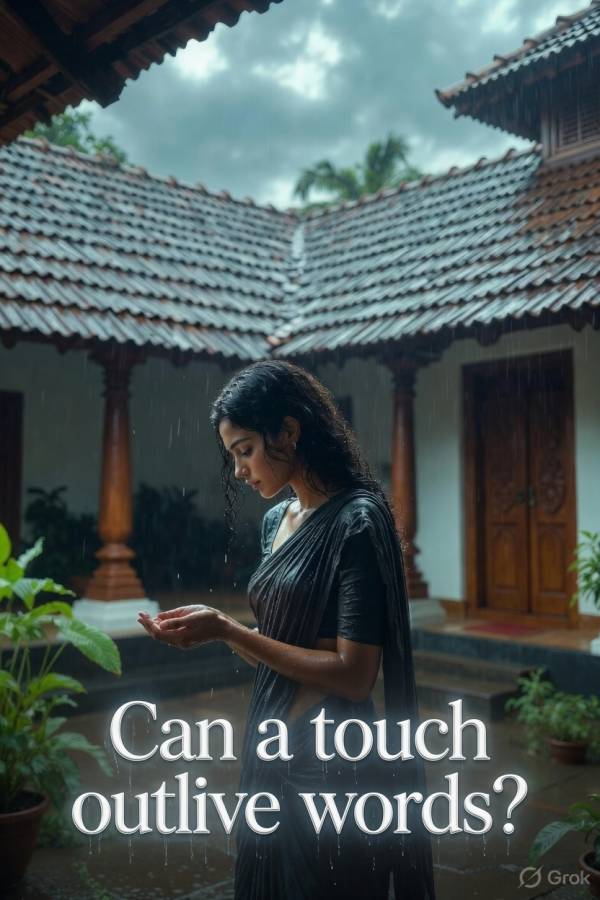
Some memories survive long after faces fade and conversations disappear. Hidden beneath the surface of the skin, they wait quietly for a scent, a season, or a touch.
The evening rain arrived early that year in Malabar.
Clouds gathered over the Arabian Sea like dark bruises spreading across the sky. The scent of wet earth drifted through the village lanes, mixing with jasmine blossoms crushed beneath hurried footsteps. The old tiled houses seemed to exhale with relief as the first drops fell, cooling months of relentless heat.
Meera stood beneath the veranda of her ancestral home and watched the rain descend.
The house had belonged to her family for more than a century. Its wooden pillars were dark with age, polished by generations of hands. Every beam seemed to hold a secret. Every corner carried an echo.
She often wondered whether houses remembered people.
If they did, this one remembered everything.
It remembered her grandmother singing while grinding spices. It remembered her father pacing through sleepless nights. It remembered children running through the courtyard, their laughter bouncing against rain-soaked walls.
And it remembered Arjun.
Even after twelve years.
Meera rested her fingers against one of the ancient pillars. The wood was cool and smooth beneath her skin.
A strange thought crossed her mind.
How many hands had touched this pillar?
How many stories had been written into its grain?
The question stayed with her as thunder rolled in the distance.
Inside the house, the electricity flickered. Shadows danced across the corridor. She lit an oil lamp and carried it to her room.
The room overlooked the courtyard where rainwater collected in silver pools. Beyond the courtyard stood a mango tree that had survived countless monsoons.
Everything seemed unchanged.
Everything except her.
At thirty-eight, Meera had become skilled at living a respectable life. She taught literature at a local college. She attended weddings and funerals. She smiled at neighbors. She paid bills on time.
To the world, she appeared complete.
Yet there were evenings when loneliness settled inside her like a second heartbeat.
Those evenings always brought memories.
And memories always brought Arjun.
They had met during a summer workshop in Kochi when she was twenty-four.
He was a photographer.
Not the ambitious kind chasing fame.
He photographed ordinary things.
Weathered faces.
Fishing nets.
Hands.
Especially hands.
The first photograph he ever took of Meera was not of her face.
It was of her hands resting on a wooden table.
"You look disappointed," she had laughed.
"Why?"
"You didn't photograph my smile."
Arjun had lowered the camera.
"Smiles are easy to fake," he said.
"Hands aren't."
The answer had unsettled her.
Years later, she would realize it was the most truthful thing anyone had ever said to her.
Their friendship grew slowly.
Neither of them rushed toward love.
Love arrived quietly.
It appeared in shared silences.
In long train journeys.
In evenings spent watching the sea.
In the simple comfort of sitting close enough to feel another person's presence.
One night, during a storm much like this one, they found themselves sheltering inside an abandoned fishing shed near the coast.
The rain hammered the roof.
The sea roared beyond the darkness.
Neither spoke.
Arjun reached out and placed his hand over hers.
Nothing more.
No dramatic declarations.
No promises.
No grand gestures.
Yet Meera remembered that moment more vividly than entire years of her life.
Because something had shifted.
The touch lasted only seconds.
The memory lasted forever.
It was then she understood that the body possessed its own language.
A language older than words.
A language impossible to translate.
Years passed.
Their lives moved together like parallel rivers.
Until they didn't.
Arjun received an opportunity to document disappearing communities across several countries.
It was the kind of project he had dreamed about.
The kind of opportunity that appears only once.
He wanted her to come with him.
She wanted to.
But life is rarely shaped by desire alone.
Her father had fallen ill.
Her mother needed help.
The ancestral house demanded attention.
Responsibilities wrapped around her ankles like invisible chains.
They tried to find a solution.
Neither could.
And so they parted.
Not because they stopped loving each other.
Because sometimes love loses to circumstance.
Their final goodbye happened at a railway station.
The platform was crowded.
Announcements echoed overhead.
People rushed in every direction.
Meera remembered very little of what was said.
Words had become meaningless by then.
What she remembered instead was the moment before he boarded the train.
Arjun touched her shoulder.
A simple gesture.
Nothing remarkable.
Yet the warmth of that touch remained with her long after the train disappeared.
The body remembers.
That was the cruel miracle of it.
Years erased conversations.
Years erased details.
Years even blurred faces.
But touch survived.
Like ink refusing to fade.
A sudden clap of thunder pulled Meera back to the present.
Rain lashed against the windows.
She looked down at her hands.
The same hands Arjun had once photographed.
Older now.
Marked by time.
Yet still carrying invisible histories.
An impulse seized her.
She crossed the room and opened an old wooden chest.
Inside lay letters.
Photographs.
Small relics of another life.
Near the bottom, wrapped in yellowing cloth, she found a photograph.
Her hands.
The photograph Arjun had taken all those years ago.
She sat on the floor staring at it.
At first glance, it was ordinary.
Just two hands resting on a table.
But as she studied the image, she noticed something.
The photograph wasn't really about hands.
It was about memory.
The fingers seemed poised between holding on and letting go.
Between presence and absence.
Between beginning and ending.
A folded piece of paper slipped from behind the photograph.
Her breath caught.
She had never seen it before.
The note was written in Arjun's handwriting.
The ink had faded slightly.
She unfolded it carefully.
There was only one sentence.
The body remembers what the mind struggles to keep.
Nothing else.
No signature.
No date.
No explanation.
Just that.
Meera read the sentence again.
And again.
Outside, rain continued to fall.
Inside, something softened.
For years she had treated memory like a wound.
Something to survive.
Something to bury.
But perhaps memory was not punishment.
Perhaps it was evidence.
Evidence that a connection had existed.
Evidence that certain moments mattered.
Evidence that love leaves traces.
The realization settled gently over her.
Like rain settling into thirsty earth.
She rose and walked toward the courtyard.
The storm had begun to weaken.
Drops fell more softly now.
The air smelled of jasmine and wet soil.
Meera stepped into the rain.
Cool water touched her skin.
The sensation awakened countless fragments of the past.
Childhood afternoons.
Her grandmother's embrace.
Her mother's hand guiding hers across a page.
Arjun's fingers intertwined with her own.
Every touch.
Every moment.
Every story.
Still alive somewhere within her.
She looked toward the old wooden pillars surrounding the courtyard.
For the first time, she felt certain they remembered.
Not literally.
But in the way all things remember.
Through marks.
Through impressions.
Through change.
The same was true of people.
Every kindness left a trace.
Every cruelty left a scar.
Every act of love rewrote a small part of who we became.
We were all living archives.
Walking collections of invisible stories.
And our skin was the library.
The rain finally slowed to a mist.
The sky began to brighten.
A pale moon appeared between drifting clouds.
Meera smiled.
Not because she had forgotten.
Because she no longer wished to.
She folded the note and slipped it into her pocket.
Tomorrow would arrive with its routines and obligations.
The world would continue demanding explanations, labels, and carefully arranged lives.
But tonight she understood something profound.
Love had never truly lived inside words.
Words could describe it.
Celebrate it.
Mourn it.
Yet they could never contain it.
Love lived elsewhere.
In remembered warmth.
In lingering comfort.
In the quiet pressure of a hand that once said everything without speaking.
Meera lifted her palms toward the rain-cooled night.
They were ordinary hands.
Lined with years.
Marked by work and time.
Yet they carried entire histories.
And somewhere, written invisibly beneath the surface, remained every story they had ever touched.
Every story that had touched them in return.
The evening rain arrived early that year in Malabar.
Clouds gathered over the Arabian Sea like dark bruises spreading across the sky. The scent of wet earth drifted through the village lanes, mixing with jasmine blossoms crushed beneath hurried footsteps. The old tiled houses seemed to exhale with relief as the first drops fell, cooling months of relentless heat.
Meera stood beneath the veranda of her ancestral home and watched the rain descend.
The house had belonged to her family for more than a century. Its wooden pillars were dark with age, polished by generations of hands. Every beam seemed to hold a secret. Every corner carried an echo.
She often wondered whether houses remembered people.
If they did, this one remembered everything.
It remembered her grandmother singing while grinding spices. It remembered her father pacing through sleepless nights. It remembered children running through the courtyard, their laughter bouncing against rain-soaked walls.
And it remembered Arjun.
Even after twelve years.
Meera rested her fingers against one of the ancient pillars. The wood was cool and smooth beneath her skin.
A strange thought crossed her mind.
How many hands had touched this pillar?
How many stories had been written into its grain?
The question stayed with her as thunder rolled in the distance.
Inside the house, the electricity flickered. Shadows danced across the corridor. She lit an oil lamp and carried it to her room.
The room overlooked the courtyard where rainwater collected in silver pools. Beyond the courtyard stood a mango tree that had survived countless monsoons.
Everything seemed unchanged.
Everything except her.
At thirty-eight, Meera had become skilled at living a respectable life. She taught literature at a local college. She attended weddings and funerals. She smiled at neighbors. She paid bills on time.
To the world, she appeared complete.
Yet there were evenings when loneliness settled inside her like a second heartbeat.
Those evenings always brought memories.
And memories always brought Arjun.
They had met during a summer workshop in Kochi when she was twenty-four.
He was a photographer.
Not the ambitious kind chasing fame.
He photographed ordinary things.
Weathered faces.
Fishing nets.
Hands.
Especially hands.
The first photograph he ever took of Meera was not of her face.
It was of her hands resting on a wooden table.
"You look disappointed," she had laughed.
"Why?"
"You didn't photograph my smile."
Arjun had lowered the camera.
"Smiles are easy to fake," he said.
"Hands aren't."
The answer had unsettled her.
Years later, she would realize it was the most truthful thing anyone had ever said to her.
Their friendship grew slowly.
Neither of them rushed toward love.
Love arrived quietly.
It appeared in shared silences.
In long train journeys.
In evenings spent watching the sea.
In the simple comfort of sitting close enough to feel another person's presence.
One night, during a storm much like this one, they found themselves sheltering inside an abandoned fishing shed near the coast.
The rain hammered the roof.
The sea roared beyond the darkness.
Neither spoke.
Arjun reached out and placed his hand over hers.
Nothing more.
No dramatic declarations.
No promises.
No grand gestures.
Yet Meera remembered that moment more vividly than entire years of her life.
Because something had shifted.
The touch lasted only seconds.
The memory lasted forever.
It was then she understood that the body possessed its own language.
A language older than words.
A language impossible to translate.
Years passed.
Their lives moved together like parallel rivers.
Until they didn't.
Arjun received an opportunity to document disappearing communities across several countries.
It was the kind of project he had dreamed about.
The kind of opportunity that appears only once.
He wanted her to come with him.
She wanted to.
But life is rarely shaped by desire alone.
Her father had fallen ill.
Her mother needed help.
The ancestral house demanded attention.
Responsibilities wrapped around her ankles like invisible chains.
They tried to find a solution.
Neither could.
And so they parted.
Not because they stopped loving each other.
Because sometimes love loses to circumstance.
Their final goodbye happened at a railway station.
The platform was crowded.
Announcements echoed overhead.
People rushed in every direction.
Meera remembered very little of what was said.
Words had become meaningless by then.
What she remembered instead was the moment before he boarded the train.
Arjun touched her shoulder.
A simple gesture.
Nothing remarkable.
Yet the warmth of that touch remained with her long after the train disappeared.
The body remembers.
That was the cruel miracle of it.
Years erased conversations.
Years erased details.
Years even blurred faces.
But touch survived.
Like ink refusing to fade.
A sudden clap of thunder pulled Meera back to the present.
Rain lashed against the windows.
She looked down at her hands.
The same hands Arjun had once photographed.
Older now.
Marked by time.
Yet still carrying invisible histories.
An impulse seized her.
She crossed the room and opened an old wooden chest.
Inside lay letters.
Photographs.
Small relics of another life.
Near the bottom, wrapped in yellowing cloth, she found a photograph.
Her hands.
The photograph Arjun had taken all those years ago.
She sat on the floor staring at it.
At first glance, it was ordinary.
Just two hands resting on a table.
But as she studied the image, she noticed something.
The photograph wasn't really about hands.
It was about memory.
The fingers seemed poised between holding on and letting go.
Between presence and absence.
Between beginning and ending.
A folded piece of paper slipped from behind the photograph.
Her breath caught.
She had never seen it before.
The note was written in Arjun's handwriting.
The ink had faded slightly.
She unfolded it carefully.
There was only one sentence.
The body remembers what the mind struggles to keep.
Nothing else.
No signature.
No date.
No explanation.
Just that.
Meera read the sentence again.
And again.
Outside, rain continued to fall.
Inside, something softened.
For years she had treated memory like a wound.
Something to survive.
Something to bury.
But perhaps memory was not punishment.
Perhaps it was evidence.
Evidence that a connection had existed.
Evidence that certain moments mattered.
Evidence that love leaves traces.
The realization settled gently over her.
Like rain settling into thirsty earth.
She rose and walked toward the courtyard.
The storm had begun to weaken.
Drops fell more softly now.
The air smelled of jasmine and wet soil.
Meera stepped into the rain.
Cool water touched her skin.
The sensation awakened countless fragments of the past.
Childhood afternoons.
Her grandmother's embrace.
Her mother's hand guiding hers across a page.
Arjun's fingers intertwined with her own.
Every touch.
Every moment.
Every story.
Still alive somewhere within her.
She looked toward the old wooden pillars surrounding the courtyard.
For the first time, she felt certain they remembered.
Not literally.
But in the way all things remember.
Through marks.
Through impressions.
Through change.
The same was true of people.
Every kindness left a trace.
Every cruelty left a scar.
Every act of love rewrote a small part of who we became.
We were all living archives.
Walking collections of invisible stories.
And our skin was the library.
The rain finally slowed to a mist.
The sky began to brighten.
A pale moon appeared between drifting clouds.
Meera smiled.
Not because she had forgotten.
Because she no longer wished to.
She folded the note and slipped it into her pocket.
Tomorrow would arrive with its routines and obligations.
The world would continue demanding explanations, labels, and carefully arranged lives.
But tonight she understood something profound.
Love had never truly lived inside words.
Words could describe it.
Celebrate it.
Mourn it.
Yet they could never contain it.
Love lived elsewhere.
In remembered warmth.
In lingering comfort.
In the quiet pressure of a hand that once said everything without speaking.
Meera lifted her palms toward the rain-cooled night.
They were ordinary hands.
Lined with years.
Marked by work and time.
Yet they carried entire histories.
And somewhere, written invisibly beneath the surface, remained every story they had ever touched.
Every story that had touched them in return.

















Leave a Comment