
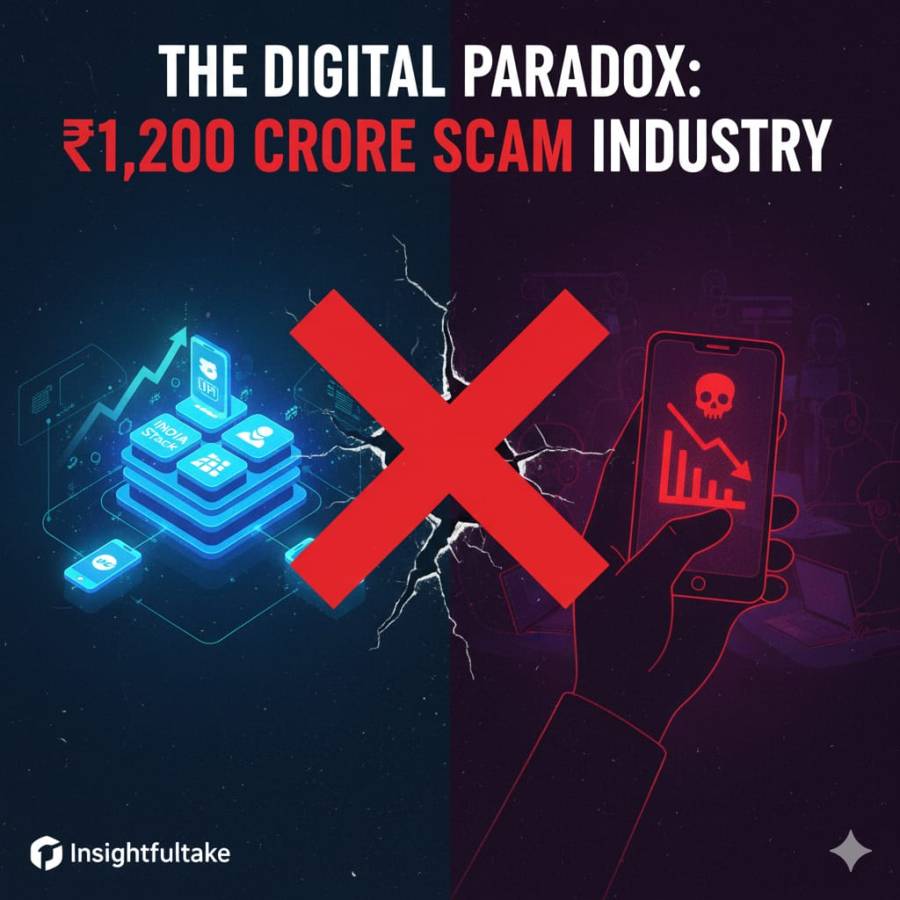
India’s digital narrative is a study in extremes. On one hand, the country is hailed as a global leader in real-time digital payments and public tech infrastructure. On the other, a chilling new reality is emerging from the shadows of this progress. In the national capital alone, cybercrime losses have skyrocketed from a modest ₹6.3 crore in 2015 to a staggering ₹1,271 crore in 2025.
This 190-fold increase in just a decade is more than just a statistic but a systemic alarm bell. While we celebrate the "Digital India" success story, organized syndicates are effectively using that same infrastructure to conduct what can only be described as a high-tech "digital loot."
Rapid Rise of Digital Fraud
The most striking revelation from the recent Delhi Police data isn't just the amount lost, but the efficiency of the criminals. Interestingly, the number of registered cases hasn't exploded at the same rate as the financial damage. In 2023, there were 1,347 cases with a loss of ₹400 crore. By 2025, with only about 1,600 cases, the losses tripled.
This suggests that scammers are moving away from "low-value, high-volume" petty thefts and moving toward high-yield, sophisticated psychological warfare. They are no longer just stealing OTPs; they are stealing life savings through complex schemes.
The New Weapons of Fraud
The surge is driven by three primary "growth sectors" in the cybercrime industry:
- Digital Arrests: Scammers impersonate law enforcement or government agencies, keeping victims under "virtual custody" via video calls for hours—or even days—until they drain their bank accounts.
- Investment & Stock Scams: Leveraging the growing retail investor boom in India, fraudsters use fake trading apps and WhatsApp groups to promise "guaranteed" 100% returns.
- The Mule Account Network: The "spine" of this industry is a massive web of rented bank accounts (mule accounts) that allow stolen money to be layered and moved across borders within minutes.
The Enforcement Catch-Up
To be fair, the police are not standing still. The Intelligence Fusion and Strategic Operations (IFSO) unit has significantly improved its recovery rate. In 2024, only about 10% of cheated money could be frozen; by 2025, that figure rose to 25%.
Large-scale crackdowns like "Operation CyHawk"—which recently saw 5,000 personnel detaining over 7,000 suspects in a single 48-hour window—show that the state is finally treating cybercrime as an organized national security threat rather than just "online cheating."
The Missing Link: Digital Hygiene
Despite the government allocating nearly ₹800 crore for cybersecurity in the latest budget, the human element remains the weakest link. The paradox of India’s digital success is that millions of people have been handed powerful financial tools (smartphones and UPI) without the corresponding "digital literacy" to protect themselves.
As the digital economy is projected to contribute 20% of India's GDP by 2026, the cost of this "trust deficit" could be astronomical. We have built the highway and the cars, but we have yet to teach the drivers how to use the seatbelts.
Until "internet hygiene" becomes as fundamental as basic education, the chest-thumping over our digital infrastructure will continue to be drowned out by the quiet, devastating clicks of a scammer’s mouse.





























Leave a Comment