
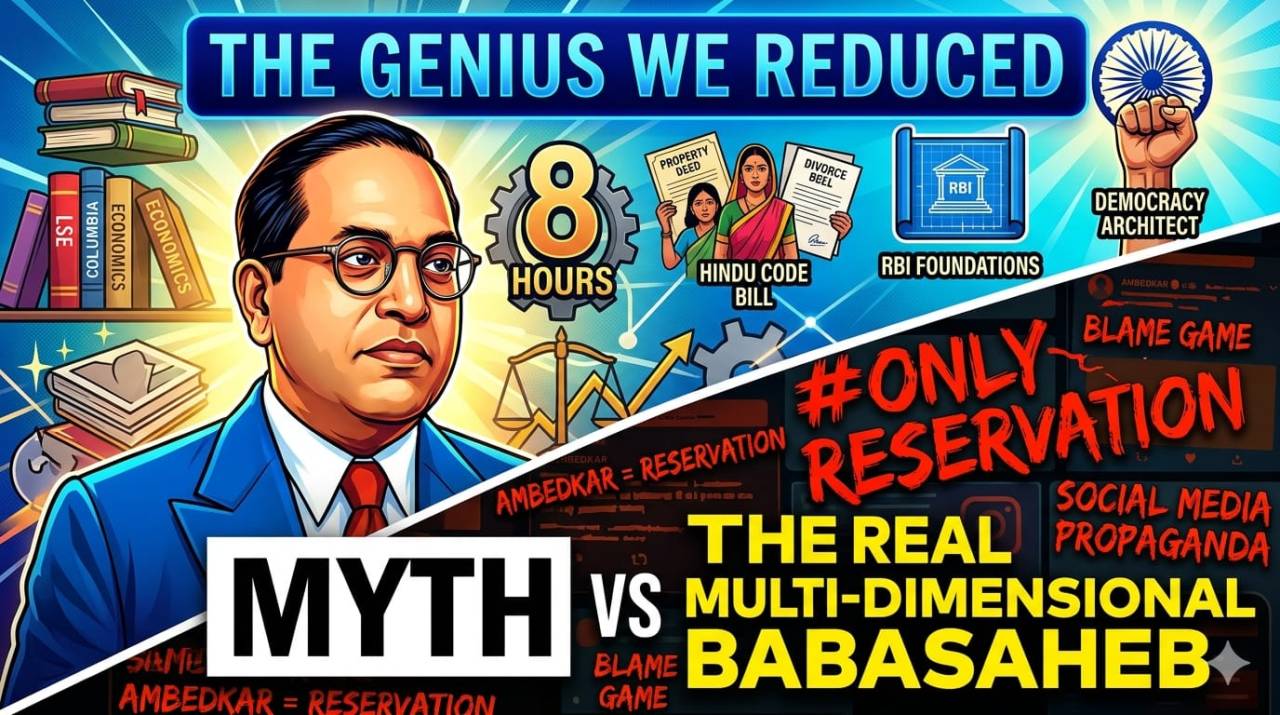
Most Indians know Ambedkar as the man behind reservation. Far fewer realize that many of the freedoms they enjoy today exist because of the constitutional vision he helped build.
Ask a random Indian what comes to mind when they hear the name Dr. B.R. Ambedkar, and there is a good chance the answer will be "reservation." On television debates, in political speeches, and across social media platforms, his legacy is often reduced to a single policy. For many people, especially those who view reservation critically, Ambedkar becomes the face of a system they believe is unfair.
Yet this popular perception overlooks a much larger truth.
To remember Ambedkar only through the lens of reservation is like remembering a great architect for a single brick in a vast building. It ignores the scale of his contribution to India and obscures the role he played in shaping the democratic republic that exists today. The freedoms Indians exercise every day, often without a second thought, are deeply connected to the constitutional framework that Ambedkar helped create.
The irony is hard to miss. Many of the people who criticize Ambedkar do so while exercising rights that he worked tirelessly to protect.
The Freedom We Often Take for Granted
India's younger generations have grown up in a country where speaking openly, criticizing governments, joining political movements, and expressing opinions are considered normal parts of public life. It is easy to forget that such freedoms are neither automatic nor guaranteed.
Before independence, Indians lived under colonial rule. Political dissent was frequently suppressed, and criticism of authority could lead to punishment. The transition from subjects of an empire to citizens of a democratic nation required more than a transfer of power. It required a constitutional framework that protected individual liberty.
As Chairman of the Drafting Committee of the Constituent Assembly, Ambedkar played a central role in creating that framework. The Fundamental Rights enshrined in the Constitution were not merely legal provisions. They were safeguards designed to ensure that future governments could not easily take away the freedoms of ordinary citizens.
Today, when a journalist questions those in power, when a student participates in a protest, or when an individual expresses an opinion online, they are operating within a system of rights that did not emerge by accident. Those protections were carefully debated, drafted, and defended by leaders who understood the dangers of unchecked authority. Ambedkar stood at the heart of that effort.
A Radical Belief in Political Equality
One of Ambedkar's most remarkable contributions is so deeply woven into Indian democracy that it often goes unnoticed.
When India became independent, it adopted universal adult franchise from the very beginning. Every adult citizen, regardless of caste, religion, gender, education, or wealth, received the right to vote.
At the time, this was an extraordinary decision.
Several established democracies had taken decades to extend voting rights to all citizens. Some had restricted participation based on property ownership, literacy, race, or gender. India, despite widespread poverty and low literacy levels, chose a different path.
Ambedkar strongly believed that political equality could not wait for economic development or social reform. Every citizen, he argued, deserved an equal voice in determining the nation's future.
Today, elections are often discussed in terms of parties, campaigns, and political strategies. Yet the simple act of casting a vote remains one of the most powerful expressions of Ambedkar's democratic vision. Every election, from a village panchayat contest to a parliamentary race, reflects his belief that democracy belongs to all citizens, not just a privileged few.
Building Institutions Stronger Than Individuals
History offers countless examples of nations that gained independence but struggled to preserve democratic governance. Ambedkar understood that freedom could not survive on good intentions alone.
Strong institutions were essential.
The Constitution he helped draft established a system of checks and balances designed to prevent the concentration of power. Independent courts, constitutional remedies, federal structures, and legal protections for citizens were all part of a larger effort to ensure that no government could operate without limits.
Ambedkar frequently warned against placing blind faith in leaders. Institutions, he believed, mattered more than individuals because they provided stability during political uncertainty.
That lesson remains relevant today. Governments change, parties rise and fall, and public opinion shifts over time. Yet the constitutional framework continues to provide continuity. Many of the legal and political debates that shape contemporary India are still guided by principles that Ambedkar helped embed in the nation's founding document.
A Vision That Extended Beyond Caste
It would be impossible to discuss Ambedkar without acknowledging his lifelong struggle against caste discrimination. He experienced exclusion and prejudice firsthand and devoted much of his life to challenging a social order that denied dignity to millions.
However, limiting his legacy to caste issues alone creates an incomplete picture.
Ambedkar's vision was broader than social reform. He was deeply concerned with economic justice, labour rights, education, public welfare, and the empowerment of individuals who had long been excluded from opportunities. He argued that political freedom would have little meaning if large sections of society remained trapped in poverty, ignorance, and discrimination.
His writings reveal a thinker who constantly examined how institutions could create a more just society. He was not merely interested in changing laws; he wanted to transform the conditions that prevented people from living with dignity.
That commitment extended far beyond any single community. At its core, his work was about creating a society where citizenship carried equal worth and where opportunity was not determined by birth.
Reservation Was Never the Whole Story
The reservation debate has become so dominant that it often overshadows everything else Ambedkar accomplished.
Whether one supports reservation, opposes it, or believes it should be reformed, it is important to understand its place within the larger constitutional vision. Reservation was conceived as one tool to address historical inequalities. It was not the sum total of Ambedkar's ideas, nor was it the primary measure of his contribution to India.
The Constitution deals with far more than affirmative action. It addresses citizenship, governance, elections, rights, institutions, federal relations, and the rule of law. Ambedkar's role in shaping these foundations has had a profound impact on every Indian, regardless of caste, religion, region, or political belief.
Reducing his legacy to reservation is therefore not simply an oversimplification. It is a misunderstanding of the scale of his contribution.
Remembering the Nation Builder
Historical figures are often remembered through simplified narratives because simplicity is easier than complexity. But when simplification becomes the dominant story, it can distort public understanding.
That is precisely what has happened with Ambedkar.
The public conversation frequently revolves around one policy while overlooking the constitutional vision that helped transform India into the world's largest democracy. As a result, many Indians know his name but remain unfamiliar with the breadth of his work.
Perhaps the greatest tribute to Ambedkar is not to place his portrait on a wall or invoke his name during political debates. It is to understand what he actually built.
Every time Indians vote, speak freely, seek justice in a court of law, or hold their leaders accountable, they participate in a democratic system that bears his imprint.
Reservation may remain a subject of debate, and people will continue to disagree about its future. That is the nature of democracy. But allowing that debate to define Ambedkar's entire legacy means missing the larger story.
And that larger story is extraordinary.
Dr. B.R. Ambedkar was not merely the architect of a policy. He was one of the principal architects of modern India itself. Remembering him only for reservation may well be one of the biggest historical mistakes the nation continues to make.
Ask a random Indian what comes to mind when they hear the name Dr. B.R. Ambedkar, and there is a good chance the answer will be "reservation." On television debates, in political speeches, and across social media platforms, his legacy is often reduced to a single policy. For many people, especially those who view reservation critically, Ambedkar becomes the face of a system they believe is unfair.
Yet this popular perception overlooks a much larger truth.
To remember Ambedkar only through the lens of reservation is like remembering a great architect for a single brick in a vast building. It ignores the scale of his contribution to India and obscures the role he played in shaping the democratic republic that exists today. The freedoms Indians exercise every day, often without a second thought, are deeply connected to the constitutional framework that Ambedkar helped create.
The irony is hard to miss. Many of the people who criticize Ambedkar do so while exercising rights that he worked tirelessly to protect.
The Freedom We Often Take for Granted
India's younger generations have grown up in a country where speaking openly, criticizing governments, joining political movements, and expressing opinions are considered normal parts of public life. It is easy to forget that such freedoms are neither automatic nor guaranteed.
Before independence, Indians lived under colonial rule. Political dissent was frequently suppressed, and criticism of authority could lead to punishment. The transition from subjects of an empire to citizens of a democratic nation required more than a transfer of power. It required a constitutional framework that protected individual liberty.
As Chairman of the Drafting Committee of the Constituent Assembly, Ambedkar played a central role in creating that framework. The Fundamental Rights enshrined in the Constitution were not merely legal provisions. They were safeguards designed to ensure that future governments could not easily take away the freedoms of ordinary citizens.
Today, when a journalist questions those in power, when a student participates in a protest, or when an individual expresses an opinion online, they are operating within a system of rights that did not emerge by accident. Those protections were carefully debated, drafted, and defended by leaders who understood the dangers of unchecked authority. Ambedkar stood at the heart of that effort.
A Radical Belief in Political Equality
One of Ambedkar's most remarkable contributions is so deeply woven into Indian democracy that it often goes unnoticed.
When India became independent, it adopted universal adult franchise from the very beginning. Every adult citizen, regardless of caste, religion, gender, education, or wealth, received the right to vote.
At the time, this was an extraordinary decision.
Several established democracies had taken decades to extend voting rights to all citizens. Some had restricted participation based on property ownership, literacy, race, or gender. India, despite widespread poverty and low literacy levels, chose a different path.
Ambedkar strongly believed that political equality could not wait for economic development or social reform. Every citizen, he argued, deserved an equal voice in determining the nation's future.
Today, elections are often discussed in terms of parties, campaigns, and political strategies. Yet the simple act of casting a vote remains one of the most powerful expressions of Ambedkar's democratic vision. Every election, from a village panchayat contest to a parliamentary race, reflects his belief that democracy belongs to all citizens, not just a privileged few.
Building Institutions Stronger Than Individuals
History offers countless examples of nations that gained independence but struggled to preserve democratic governance. Ambedkar understood that freedom could not survive on good intentions alone.
Strong institutions were essential.
The Constitution he helped draft established a system of checks and balances designed to prevent the concentration of power. Independent courts, constitutional remedies, federal structures, and legal protections for citizens were all part of a larger effort to ensure that no government could operate without limits.
Ambedkar frequently warned against placing blind faith in leaders. Institutions, he believed, mattered more than individuals because they provided stability during political uncertainty.
That lesson remains relevant today. Governments change, parties rise and fall, and public opinion shifts over time. Yet the constitutional framework continues to provide continuity. Many of the legal and political debates that shape contemporary India are still guided by principles that Ambedkar helped embed in the nation's founding document.
A Vision That Extended Beyond Caste
It would be impossible to discuss Ambedkar without acknowledging his lifelong struggle against caste discrimination. He experienced exclusion and prejudice firsthand and devoted much of his life to challenging a social order that denied dignity to millions.
However, limiting his legacy to caste issues alone creates an incomplete picture.
Ambedkar's vision was broader than social reform. He was deeply concerned with economic justice, labour rights, education, public welfare, and the empowerment of individuals who had long been excluded from opportunities. He argued that political freedom would have little meaning if large sections of society remained trapped in poverty, ignorance, and discrimination.
His writings reveal a thinker who constantly examined how institutions could create a more just society. He was not merely interested in changing laws; he wanted to transform the conditions that prevented people from living with dignity.
That commitment extended far beyond any single community. At its core, his work was about creating a society where citizenship carried equal worth and where opportunity was not determined by birth.
Reservation Was Never the Whole Story
The reservation debate has become so dominant that it often overshadows everything else Ambedkar accomplished.
Whether one supports reservation, opposes it, or believes it should be reformed, it is important to understand its place within the larger constitutional vision. Reservation was conceived as one tool to address historical inequalities. It was not the sum total of Ambedkar's ideas, nor was it the primary measure of his contribution to India.
The Constitution deals with far more than affirmative action. It addresses citizenship, governance, elections, rights, institutions, federal relations, and the rule of law. Ambedkar's role in shaping these foundations has had a profound impact on every Indian, regardless of caste, religion, region, or political belief.
Reducing his legacy to reservation is therefore not simply an oversimplification. It is a misunderstanding of the scale of his contribution.
Remembering the Nation Builder
Historical figures are often remembered through simplified narratives because simplicity is easier than complexity. But when simplification becomes the dominant story, it can distort public understanding.
That is precisely what has happened with Ambedkar.
The public conversation frequently revolves around one policy while overlooking the constitutional vision that helped transform India into the world's largest democracy. As a result, many Indians know his name but remain unfamiliar with the breadth of his work.
Perhaps the greatest tribute to Ambedkar is not to place his portrait on a wall or invoke his name during political debates. It is to understand what he actually built.
Every time Indians vote, speak freely, seek justice in a court of law, or hold their leaders accountable, they participate in a democratic system that bears his imprint.
Reservation may remain a subject of debate, and people will continue to disagree about its future. That is the nature of democracy. But allowing that debate to define Ambedkar's entire legacy means missing the larger story.
And that larger story is extraordinary.
Dr. B.R. Ambedkar was not merely the architect of a policy. He was one of the principal architects of modern India itself. Remembering him only for reservation may well be one of the biggest historical mistakes the nation continues to make.


















Leave a Comment