
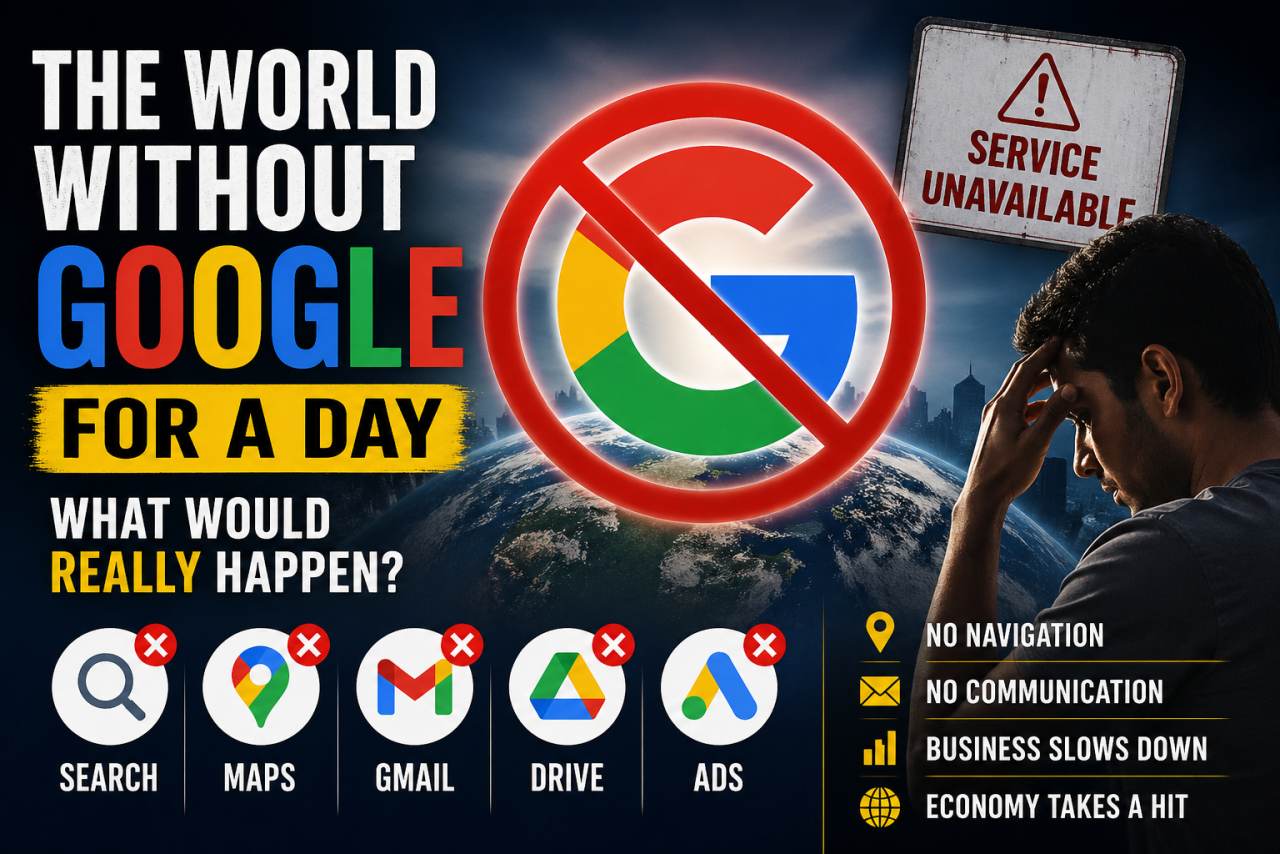
Can the world function—even for a day—without Google?
The idea of a world without Google, even for a single day, feels almost unthinkable. Over the past two decades, Google has quietly embedded itself into the fabric of our daily lives. From searching information and navigating roads to running businesses and storing memories, it has become less of a tool and more of an invisible infrastructure. Its absence, even temporarily, would not just be inconvenient—it would be deeply disruptive.
This thought experiment also serves as a subtle warning. It pushes us to reflect on our growing dependence on “free” digital services. While these tools offer efficiency and accessibility, they also create habits that are difficult to break. When convenience becomes dependency, even a brief disruption can feel like a crisis.
Interestingly, not every part of the world relies on Google in the same way. Countries like China, Iran, Cuba, and regions such as Crimea have restrictions on Google services. However, this does not mean they function without search engines or digital ecosystems. Instead, they have developed alternative platforms that cater to similar needs. This highlights an important truth: the absence of Google is manageable, but only when substitutes are in place.
For much of the world, however, Google has become synonymous with information itself. In today’s digital age, access to information defines productivity, learning, and decision-making. Google simplifies this process to an extraordinary degree. Instead of memorizing facts or maintaining physical records, we rely on instant access. A single click connects us to a universe of knowledge available 24/7. Remove that access, and the gap becomes immediately visible.
A day without Google Search alone would leave millions struggling to perform routine tasks. Students researching assignments, professionals verifying data, and individuals solving everyday problems would find themselves slowed down. It is not that information would disappear—it would simply become harder to reach.
The disruption would be even more visible in navigation. Google Maps has revolutionized how we move through the world. Real-time traffic updates, route optimization, and location-based services have made travel faster and more predictable. Businesses, from delivery services to ride-hailing platforms, depend heavily on this system. Without it, cities could experience confusion, delays, and inefficiencies. People would revert to older methods—asking for directions, using static maps, or relying on guesswork.
Beyond individuals, the economic impact would be significant. The digital economy, which forms a substantial portion of global GDP, is closely tied to platforms like Google. Businesses depend on tools such as Gmail, Google Drive, and Google Ads for communication, collaboration, and marketing. A sudden outage would slow down workflows, delay transactions, and interrupt revenue streams. Advertising campaigns would pause, customer engagement would drop, and productivity would decline.
Communication, too, would feel the strain. Emails might be delayed, shared documents inaccessible, and virtual collaborations disrupted. For companies operating across time zones, even a short interruption could create confusion and misalignment. Clients and consumers alike would experience delays, leading to frustration and uncertainty.
And yet, despite all this, humanity would endure. A day without Google would not bring the world to a halt—but it would certainly make it feel less efficient, less connected, and less predictable. It would remind us that while technology enhances our lives, it also reshapes our ability to function independently.
Perhaps the most important takeaway is not fear, but awareness. The modern world is building an expansive digital ecosystem designed for convenience and cost-effectiveness. Alternatives exist, and innovation continues to evolve. However, the dominance of a single platform like Google highlights the risks of over-centralization.
In the end, a day without Google would be a lesson—a brief glimpse into a slower, less streamlined world. It would challenge our habits, test our adaptability, and remind us of the value of balance. Google may feel like a solution to many of modern life’s problems, but true resilience lies in our ability to function even without it.
The idea of a world without Google, even for a single day, feels almost unthinkable. Over the past two decades, Google has quietly embedded itself into the fabric of our daily lives. From searching information and navigating roads to running businesses and storing memories, it has become less of a tool and more of an invisible infrastructure. Its absence, even temporarily, would not just be inconvenient—it would be deeply disruptive.
This thought experiment also serves as a subtle warning. It pushes us to reflect on our growing dependence on “free” digital services. While these tools offer efficiency and accessibility, they also create habits that are difficult to break. When convenience becomes dependency, even a brief disruption can feel like a crisis.
Interestingly, not every part of the world relies on Google in the same way. Countries like China, Iran, Cuba, and regions such as Crimea have restrictions on Google services. However, this does not mean they function without search engines or digital ecosystems. Instead, they have developed alternative platforms that cater to similar needs. This highlights an important truth: the absence of Google is manageable, but only when substitutes are in place.
For much of the world, however, Google has become synonymous with information itself. In today’s digital age, access to information defines productivity, learning, and decision-making. Google simplifies this process to an extraordinary degree. Instead of memorizing facts or maintaining physical records, we rely on instant access. A single click connects us to a universe of knowledge available 24/7. Remove that access, and the gap becomes immediately visible.
A day without Google Search alone would leave millions struggling to perform routine tasks. Students researching assignments, professionals verifying data, and individuals solving everyday problems would find themselves slowed down. It is not that information would disappear—it would simply become harder to reach.
The disruption would be even more visible in navigation. Google Maps has revolutionized how we move through the world. Real-time traffic updates, route optimization, and location-based services have made travel faster and more predictable. Businesses, from delivery services to ride-hailing platforms, depend heavily on this system. Without it, cities could experience confusion, delays, and inefficiencies. People would revert to older methods—asking for directions, using static maps, or relying on guesswork.
Beyond individuals, the economic impact would be significant. The digital economy, which forms a substantial portion of global GDP, is closely tied to platforms like Google. Businesses depend on tools such as Gmail, Google Drive, and Google Ads for communication, collaboration, and marketing. A sudden outage would slow down workflows, delay transactions, and interrupt revenue streams. Advertising campaigns would pause, customer engagement would drop, and productivity would decline.
Communication, too, would feel the strain. Emails might be delayed, shared documents inaccessible, and virtual collaborations disrupted. For companies operating across time zones, even a short interruption could create confusion and misalignment. Clients and consumers alike would experience delays, leading to frustration and uncertainty.
And yet, despite all this, humanity would endure. A day without Google would not bring the world to a halt—but it would certainly make it feel less efficient, less connected, and less predictable. It would remind us that while technology enhances our lives, it also reshapes our ability to function independently.
Perhaps the most important takeaway is not fear, but awareness. The modern world is building an expansive digital ecosystem designed for convenience and cost-effectiveness. Alternatives exist, and innovation continues to evolve. However, the dominance of a single platform like Google highlights the risks of over-centralization.
In the end, a day without Google would be a lesson—a brief glimpse into a slower, less streamlined world. It would challenge our habits, test our adaptability, and remind us of the value of balance. Google may feel like a solution to many of modern life’s problems, but true resilience lies in our ability to function even without it.



















Leave a Comment