
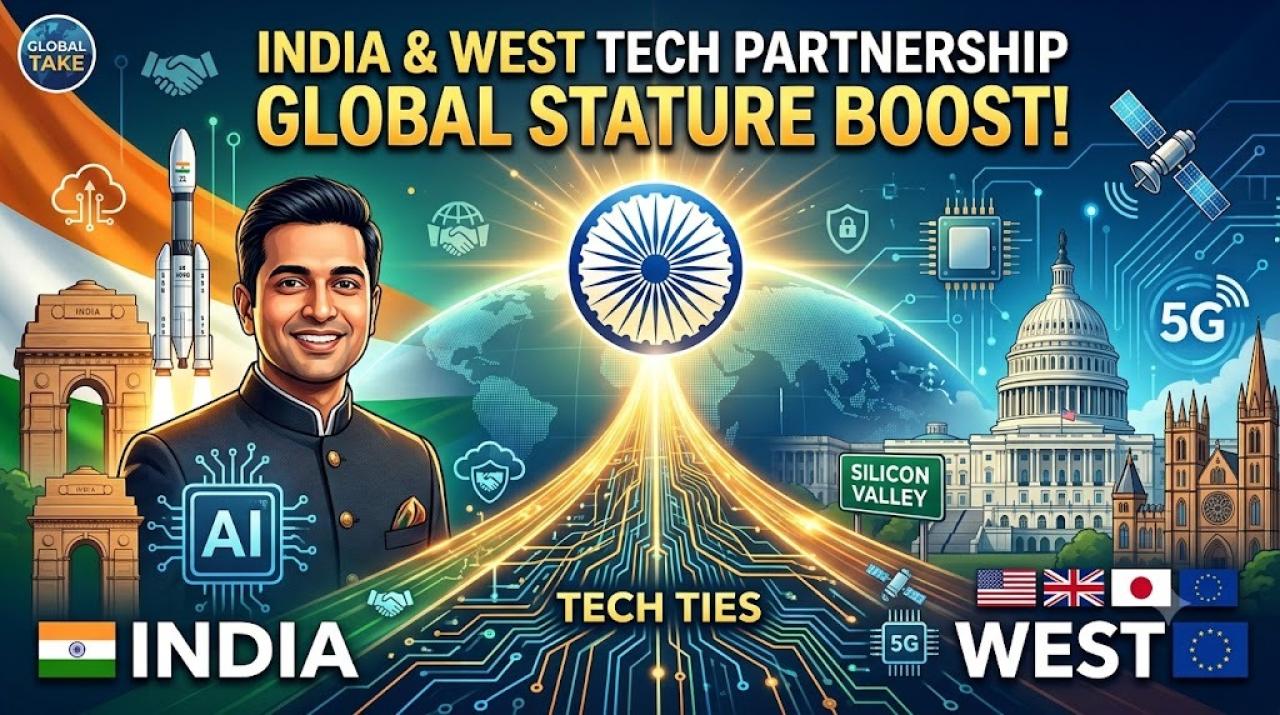
India’s technology partnerships with the West could help reduce dependence on China, strengthen domestic innovation and support its ambition to become the world’s third-largest economy.
India’s technology partnerships with the United Kingdom and other Western countries could play an important role in strengthening its economy, improving national security and raising its standing in the global order. As India aims to become the world’s third-largest economy, investment in advanced technology, research and innovation will be essential. Stronger international partnerships can help the country build these capabilities, reduce dependence on foreign suppliers and create opportunities for Indian businesses and skilled professionals.
The India-UK Technology Security Initiative (TSI) is an important step in this direction. The initiative focuses on emerging technologies that are likely to shape the global economy and influence relations between major powers. These include artificial intelligence (AI), telecommunications, semiconductors, quantum computing, biotechnology and space technology. Cooperation in these fields can help both countries address shared challenges while creating new opportunities for research, investment and industrial development.
India has pursued similar partnerships with several European countries and other advanced economies. Such agreements reflect a growing recognition that technological progress cannot depend on domestic efforts alone. Countries need access to research, expertise, investment and reliable supply chains to remain competitive. For India, closer ties with technologically advanced nations could accelerate this process and support its long-term economic ambitions.
Technology Is Central to India’s Economic Ambitions
India’s ambition to become the world’s third-largest economy will require more than an increase in production and consumption. It will also depend on the country’s ability to develop new technologies, improve productivity and move towards higher-value industries.
Artificial intelligence offers significant opportunities in this regard. Its applications in agriculture, healthcare, education, manufacturing, financial services and public administration could help improve efficiency and reduce costs. Farmers could benefit from better weather forecasts and crop management tools. Healthcare providers could use AI-assisted systems to support diagnosis and patient care. Manufacturers could improve production processes, while public institutions could use digital tools to deliver services more efficiently.
However, the benefits of AI will depend on how effectively India develops and deploys these technologies. The country needs skilled professionals, reliable digital infrastructure, strong data protection, affordable access and adequate support for research. International cooperation can help India acquire expertise, build technical capabilities and encourage the development of solutions suited to its own needs.
Semiconductors are equally important. These chips are essential to smartphones, computers, vehicles, telecommunications equipment, defence systems and a wide range of industrial products. Dependence on a limited number of overseas suppliers can leave Indian industries vulnerable to supply disruptions and geopolitical tensions. Partnerships with countries that have advanced semiconductor capabilities could help India develop its domestic manufacturing ecosystem and strengthen its position in global supply chains.
Cooperation in quantum computing, biotechnology and space technology could open further opportunities. These sectors require substantial investment, specialised knowledge and long-term research. Working with established technology partners can help India share costs, learn from international experience and build its own capacity.
Reducing Dependence on China
China’s technological progress presents both a challenge and a lesson for India. Over the years, China has built considerable strength in manufacturing, telecommunications, electronics, electric vehicles and several emerging technologies. Its industrial capacity and investment in research have given it a strong position in global supply chains.
India cannot ignore this reality as it seeks to expand its economic and strategic influence. Dependence on Chinese technology, components and industrial supplies can create vulnerabilities, particularly when commercial relationships are affected by political or security concerns.
Closer cooperation with the UK, the United States and European partners can help India diversify its sources of technology and reduce these risks. Such partnerships could provide access to advanced research, alternative supply chains and specialised expertise. They may also encourage international companies to invest in India and consider it a more reliable base for manufacturing and technological development.
However, reducing dependence on China should not be the only objective. India must also strengthen its ability to develop, manufacture and improve technologies within the country. Replacing one foreign supplier with another would offer only limited long-term security. The real goal should be to build domestic capabilities while maintaining productive relationships with international partners.
This will require consistent policies, easier conditions for research and investment, stronger links between universities and industry, and greater support for Indian start-ups. Technology partnerships can provide an important foundation, but their success will depend on how effectively India converts international cooperation into domestic capacity.
The Importance of India-UK and India-US Cooperation
Bilateral technology agreements can have an impact beyond the two countries directly involved. Cooperation between India and the UK, for example, can connect Indian researchers, businesses and institutions with established British expertise. Similar cooperation with the United States can create opportunities in advanced computing, aerospace, semiconductors and other strategic sectors.
The combined benefits could extend to education, employment, industrial development and national security. Indian companies may gain access to new markets, while foreign companies could find opportunities to invest in India’s expanding economy. Joint research programmes can also help scientists and engineers develop solutions to common problems.
For a country with a population of around 1.4 billion, the challenge is not merely to expand the economy but to ensure that economic progress reaches a wider section of society. Technology can help improve access to education, healthcare, financial services and government schemes, particularly in underserved regions. It can also create new employment opportunities, provided workers receive the training needed to adapt to changing industries.
At the same time, technological progress carries risks. Automation may disrupt some jobs, AI systems can produce unreliable results, and digital services can deepen existing inequalities if access remains uneven. Cooperation must therefore include attention to cybersecurity, privacy, responsible AI use and the development of skills. Economic growth should not come at the cost of public trust or individual rights.
From Agreements to Results
The real value of technology partnerships will be measured by what they deliver on the ground. Signing agreements and announcing new initiatives are important first steps, but they must lead to research projects, investment, knowledge-sharing, new products and stronger industrial capacity.
India needs clear implementation plans, measurable targets and regular assessments of progress. Universities, research institutions, start-ups and established companies should have opportunities to participate. Small businesses, too, should be able to benefit from new technologies rather than being left behind by large corporations.
India’s engagement with the UK and other Western countries offers an opportunity to strengthen its technological foundation and expand its role in the global economy. These partnerships can help the country address critical gaps, diversify supply chains and develop expertise in industries that will shape the future.
India’s rise as a major economic power will ultimately depend on its ability to combine international cooperation with domestic innovation. Strong technology ties can provide access to knowledge, investment and markets, but sustained progress will require effective policies, skilled people and the capacity to turn ideas into practical solutions.
If India can achieve this balance, its technology partnerships will do more than improve diplomatic relations. They can help build a stronger economy, create wider opportunities for its people and establish India as a more influential force in the global technological landscape.



























Leave a Comment