
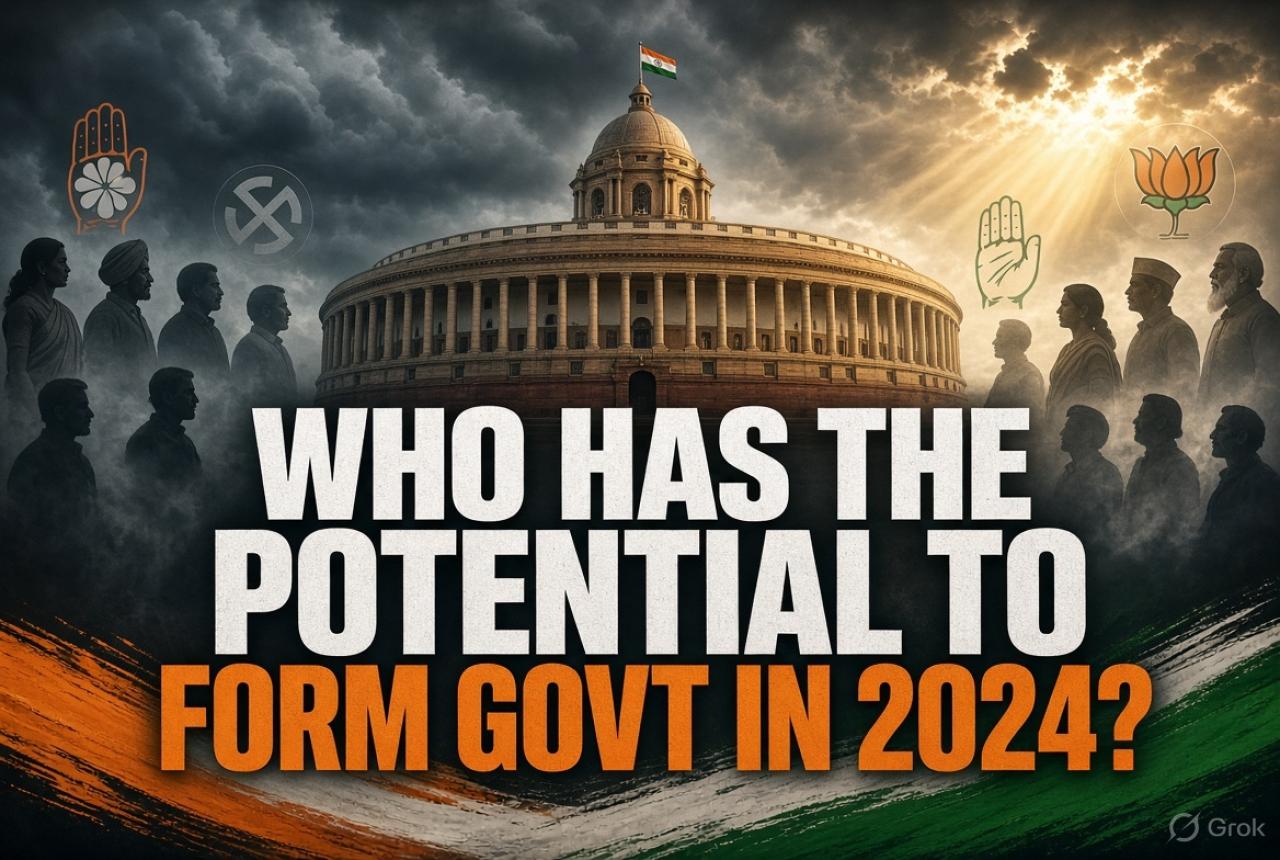
Congress entered 2024 with decades of governing experience behind it and the difficult task of rebuilding its political strength at the Centre.
The 2024 Lok Sabha election was a contest in which the Congress sought to regain national political space after a decade of electoral decline. Its long record in government, role in India's freedom movement and experience in running the Union government remained important parts of its case before voters.
The Congress was part of the INDIA alliance, a coalition of opposition parties formed to challenge the BJP-led National Democratic Alliance. The alliance brought together parties with different regional bases, political ideologies and leadership structures. Congress, as the principal national opposition party in the grouping, had the largest historical footprint but also carried the burden of its recent electoral record.
The party's claim to national relevance rests partly on its history. The Indian National Congress was founded in 1885 and became one of the principal political organisations of India's freedom movement. Mahatma Gandhi, Jawaharlal Nehru, Sardar Vallabhbhai Patel and several other leaders associated with the Congress played important roles in the struggle against British rule.
After independence, Congress became the dominant political force in the country and governed India for much of the first several decades. Its governments were involved in creating many of the institutions and policies that shaped the early republic.
Building a New India
India inherited a difficult economic situation in 1947. Poverty was widespread, literacy was low, industrial production was limited and the country lacked much of the infrastructure required for rapid economic development.
The Congress governments under Jawaharlal Nehru adopted planned economic development as the principal approach. Large public-sector industries were established in areas such as steel, power, mining and heavy machinery. Major dams and irrigation projects were also built.
The thinking behind this model was that the state had to take the lead in creating the industrial base required for a developing country. Private industry did not have the financial capacity to undertake many of these projects at the time.
The system produced a substantial public sector and helped create industrial capacity. It also developed several weaknesses. Excessive regulation and the licence-permit system restricted private enterprise, while India's economic growth remained relatively slow for several decades.
These shortcomings eventually contributed to a major change in economic policy.
Agriculture and Food Security
Food security was one of independent India's most urgent problems. The country depended on food imports during periods of shortage, making agricultural production a major national priority.
The Green Revolution changed that situation. The introduction of high-yielding varieties of seeds, expanded irrigation, fertilisers and modern farming methods sharply increased wheat and rice production, particularly in Punjab, Haryana and western Uttar Pradesh.
India gradually moved towards greater food self-sufficiency.
The White Revolution brought another major change. Operation Flood, launched in the 1970s, expanded dairy cooperatives and connected rural milk producers with larger markets. The programme helped increase milk production and created additional sources of income for millions of rural households.
Both developments became important parts of India's economic transformation, although their benefits were not equally distributed across all regions.
Education, Science and Technology
The Congress governments also placed considerable emphasis on higher education and scientific research.
Institutions such as the Indian Institutes of Technology, national research laboratories and the Indian Space Research Organisation became important parts of India's scientific infrastructure. The foundations of India's nuclear and space programmes were laid during the early decades after independence.
The results became more visible over time. India developed nuclear capabilities, built a successful space programme and produced a large pool of engineers and scientists.
The growth of the information technology sector in later decades also benefited from the country's investment in technical education.
These achievements cannot be credited to one political party alone. Successive governments continued and expanded many of these programmes. But the institutional foundations were established during the early years of the republic.
Social Justice and Welfare
Social inequality remained one of India's most difficult problems after independence. Congress governments introduced several measures intended to address historical discrimination and economic disadvantage.
The Constitution provided reservations for Scheduled Castes and Scheduled Tribes in education, employment and political representation. Land reforms were introduced in several states, including the abolition of the Zamindari system.
The implementation of land reforms varied widely. In some states they significantly weakened traditional landlord structures, while elsewhere their impact was limited.
The Congress-led government under Prime Minister P. V. Narasimha Rao also implemented the Mandal Commission recommendations in 1990, extending reservations in central government employment to Other Backward Classes.
Later Congress-led governments introduced programmes such as the Mahatma Gandhi National Rural Employment Guarantee Act, the Right to Information Act and the Right to Education Act.
These laws expanded citizens' access to employment support, government information and education.
The 1991 Economic Reforms
The economic crisis of 1991 forced India to reconsider its development model.
India faced a severe balance-of-payments crisis and had limited foreign exchange reserves. The government led by Prime Minister P. V. Narasimha Rao, with Manmohan Singh as Finance Minister, introduced a series of reforms.
Industrial licensing was reduced, trade barriers were lowered and foreign investment rules were changed. The reforms marked a major shift away from the heavily regulated economic system that had developed after independence.
The changes contributed to the expansion of private enterprise, foreign investment and service-sector industries. Information technology, telecommunications, banking and several other sectors grew rapidly in the following decades.
The reforms also generated debates over inequality, employment and the distribution of economic gains. Nevertheless, 1991 remains one of the most important turning points in India's economic history.
The Other Side of the Record
Congress's political history also contains serious controversies and failures.
The Emergency imposed by the Indira Gandhi government from 1975 to 1977 remains one of the most controversial periods in India's democratic history. Civil liberties were restricted, opposition leaders were arrested and press freedoms were curtailed.
The party also faced repeated allegations of corruption, internal factionalism and administrative failures at different points in its history.
Its electoral decline after 2014 became another major challenge. Congress won only 44 seats in the 2014 Lok Sabha election and 52 in 2019. Rahul Gandhi's defeat in Amethi in 2019 further highlighted the difficulties facing the party.
By 2024, therefore, Congress was trying to combine its historical record with a political campaign focused on contemporary issues.
The INDIA Alliance
The formation of the INDIA alliance changed the opposition's strategy before the 2024 election.
Congress joined hands with several regional parties, including the Samajwadi Party, Trinamool Congress, DMK, RJD, Shiv Sena and others. The alliance was not a single political organisation. Each party had its own leadership, electoral base and priorities.
That created both strength and difficulty.
Regional parties brought strong support in individual states, while Congress provided a national political presence. At the same time, differences over seat-sharing, leadership and political strategy created challenges for the alliance.
The Congress therefore entered the election with a difficult task. It had to rebuild its own organisation while also maintaining coordination with parties that were competing against it in some states.
What 2024 Changed
The 2024 election produced a significant change in Parliament.
Congress increased its Lok Sabha tally from 52 seats in 2019 to 99 in 2024. The BJP remained the single largest party but fell short of a majority on its own and formed the government with its NDA allies.
Rahul Gandhi won from both Rae Bareli and Wayanad and subsequently retained Rae Bareli. He was appointed Leader of the Opposition in the Lok Sabha in June 2024.
The result did not bring Congress back to power at the Centre, but it gave the party a larger parliamentary presence and a stronger institutional position than it had after the 2019 election.
For Rahul Gandhi, the role of Leader of the Opposition also provided a formal constitutional platform from which to challenge the government and present an alternative political argument.
Experience Versus Present-Day Expectations
Congress's long record remains an important part of any discussion about its ability to govern. It has experience of managing the Union government through periods of war, economic crisis, political instability and major social change.
At the same time, past experience cannot by itself determine a party's suitability for future governance.
India in 2024 was dealing with a different set of challenges: employment, inflation, economic inequality, manufacturing, technology, national security, climate change, federal relations and the changing nature of global politics.
A political party seeking power has to address these issues with policies that can be implemented rather than relying only on its historical record.
Congress entered the 2024 election with considerable political history behind it, but also with the need to convince voters that it could translate that experience into a contemporary programme of governance.
The party's record, therefore, contains achievements as well as failures. Its role in the freedom movement, institution-building, agriculture, education, science, social welfare and economic reforms forms an important part of India's political history. The Emergency, periods of weak governance, corruption controversies and its prolonged electoral decline form another part of that history.
A democratic electorate has to consider the entire record.
The 2024 Lok Sabha election ultimately showed that Congress had recovered some of the parliamentary ground it had lost in the previous two general elections, but it remained in opposition.
Its performance also demonstrated that India's national politics had become more competitive and increasingly dependent on alliances between national and regional parties.
For Congress, the challenge after 2024 was not simply to recall what it had achieved in the past. It was to rebuild its organisation, develop a convincing programme for the present and persuade voters that it could govern India in the future.
The judgment belongs to the electorate.
The 2024 Lok Sabha election was a contest in which the Congress sought to regain national political space after a decade of electoral decline. Its long record in government, role in India's freedom movement and experience in running the Union government remained important parts of its case before voters.
The Congress was part of the INDIA alliance, a coalition of opposition parties formed to challenge the BJP-led National Democratic Alliance. The alliance brought together parties with different regional bases, political ideologies and leadership structures. Congress, as the principal national opposition party in the grouping, had the largest historical footprint but also carried the burden of its recent electoral record.
The party's claim to national relevance rests partly on its history. The Indian National Congress was founded in 1885 and became one of the principal political organisations of India's freedom movement. Mahatma Gandhi, Jawaharlal Nehru, Sardar Vallabhbhai Patel and several other leaders associated with the Congress played important roles in the struggle against British rule.
After independence, Congress became the dominant political force in the country and governed India for much of the first several decades. Its governments were involved in creating many of the institutions and policies that shaped the early republic.
Building a New India
India inherited a difficult economic situation in 1947. Poverty was widespread, literacy was low, industrial production was limited and the country lacked much of the infrastructure required for rapid economic development.
The Congress governments under Jawaharlal Nehru adopted planned economic development as the principal approach. Large public-sector industries were established in areas such as steel, power, mining and heavy machinery. Major dams and irrigation projects were also built.
The thinking behind this model was that the state had to take the lead in creating the industrial base required for a developing country. Private industry did not have the financial capacity to undertake many of these projects at the time.
The system produced a substantial public sector and helped create industrial capacity. It also developed several weaknesses. Excessive regulation and the licence-permit system restricted private enterprise, while India's economic growth remained relatively slow for several decades.
These shortcomings eventually contributed to a major change in economic policy.
Agriculture and Food Security
Food security was one of independent India's most urgent problems. The country depended on food imports during periods of shortage, making agricultural production a major national priority.
The Green Revolution changed that situation. The introduction of high-yielding varieties of seeds, expanded irrigation, fertilisers and modern farming methods sharply increased wheat and rice production, particularly in Punjab, Haryana and western Uttar Pradesh.
India gradually moved towards greater food self-sufficiency.
The White Revolution brought another major change. Operation Flood, launched in the 1970s, expanded dairy cooperatives and connected rural milk producers with larger markets. The programme helped increase milk production and created additional sources of income for millions of rural households.
Both developments became important parts of India's economic transformation, although their benefits were not equally distributed across all regions.
Education, Science and Technology
The Congress governments also placed considerable emphasis on higher education and scientific research.
Institutions such as the Indian Institutes of Technology, national research laboratories and the Indian Space Research Organisation became important parts of India's scientific infrastructure. The foundations of India's nuclear and space programmes were laid during the early decades after independence.
The results became more visible over time. India developed nuclear capabilities, built a successful space programme and produced a large pool of engineers and scientists.
The growth of the information technology sector in later decades also benefited from the country's investment in technical education.
These achievements cannot be credited to one political party alone. Successive governments continued and expanded many of these programmes. But the institutional foundations were established during the early years of the republic.
Social Justice and Welfare
Social inequality remained one of India's most difficult problems after independence. Congress governments introduced several measures intended to address historical discrimination and economic disadvantage.
The Constitution provided reservations for Scheduled Castes and Scheduled Tribes in education, employment and political representation. Land reforms were introduced in several states, including the abolition of the Zamindari system.
The implementation of land reforms varied widely. In some states they significantly weakened traditional landlord structures, while elsewhere their impact was limited.
The Congress-led government under Prime Minister P. V. Narasimha Rao also implemented the Mandal Commission recommendations in 1990, extending reservations in central government employment to Other Backward Classes.
Later Congress-led governments introduced programmes such as the Mahatma Gandhi National Rural Employment Guarantee Act, the Right to Information Act and the Right to Education Act.
These laws expanded citizens' access to employment support, government information and education.
The 1991 Economic Reforms
The economic crisis of 1991 forced India to reconsider its development model.
India faced a severe balance-of-payments crisis and had limited foreign exchange reserves. The government led by Prime Minister P. V. Narasimha Rao, with Manmohan Singh as Finance Minister, introduced a series of reforms.
Industrial licensing was reduced, trade barriers were lowered and foreign investment rules were changed. The reforms marked a major shift away from the heavily regulated economic system that had developed after independence.
The changes contributed to the expansion of private enterprise, foreign investment and service-sector industries. Information technology, telecommunications, banking and several other sectors grew rapidly in the following decades.
The reforms also generated debates over inequality, employment and the distribution of economic gains. Nevertheless, 1991 remains one of the most important turning points in India's economic history.
The Other Side of the Record
Congress's political history also contains serious controversies and failures.
The Emergency imposed by the Indira Gandhi government from 1975 to 1977 remains one of the most controversial periods in India's democratic history. Civil liberties were restricted, opposition leaders were arrested and press freedoms were curtailed.
The party also faced repeated allegations of corruption, internal factionalism and administrative failures at different points in its history.
Its electoral decline after 2014 became another major challenge. Congress won only 44 seats in the 2014 Lok Sabha election and 52 in 2019. Rahul Gandhi's defeat in Amethi in 2019 further highlighted the difficulties facing the party.
By 2024, therefore, Congress was trying to combine its historical record with a political campaign focused on contemporary issues.
The INDIA Alliance
The formation of the INDIA alliance changed the opposition's strategy before the 2024 election.
Congress joined hands with several regional parties, including the Samajwadi Party, Trinamool Congress, DMK, RJD, Shiv Sena and others. The alliance was not a single political organisation. Each party had its own leadership, electoral base and priorities.
That created both strength and difficulty.
Regional parties brought strong support in individual states, while Congress provided a national political presence. At the same time, differences over seat-sharing, leadership and political strategy created challenges for the alliance.
The Congress therefore entered the election with a difficult task. It had to rebuild its own organisation while also maintaining coordination with parties that were competing against it in some states.
What 2024 Changed
The 2024 election produced a significant change in Parliament.
Congress increased its Lok Sabha tally from 52 seats in 2019 to 99 in 2024. The BJP remained the single largest party but fell short of a majority on its own and formed the government with its NDA allies.
Rahul Gandhi won from both Rae Bareli and Wayanad and subsequently retained Rae Bareli. He was appointed Leader of the Opposition in the Lok Sabha in June 2024.
The result did not bring Congress back to power at the Centre, but it gave the party a larger parliamentary presence and a stronger institutional position than it had after the 2019 election.
For Rahul Gandhi, the role of Leader of the Opposition also provided a formal constitutional platform from which to challenge the government and present an alternative political argument.
Experience Versus Present-Day Expectations
Congress's long record remains an important part of any discussion about its ability to govern. It has experience of managing the Union government through periods of war, economic crisis, political instability and major social change.
At the same time, past experience cannot by itself determine a party's suitability for future governance.
India in 2024 was dealing with a different set of challenges: employment, inflation, economic inequality, manufacturing, technology, national security, climate change, federal relations and the changing nature of global politics.
A political party seeking power has to address these issues with policies that can be implemented rather than relying only on its historical record.
Congress entered the 2024 election with considerable political history behind it, but also with the need to convince voters that it could translate that experience into a contemporary programme of governance.
The party's record, therefore, contains achievements as well as failures. Its role in the freedom movement, institution-building, agriculture, education, science, social welfare and economic reforms forms an important part of India's political history. The Emergency, periods of weak governance, corruption controversies and its prolonged electoral decline form another part of that history.
A democratic electorate has to consider the entire record.
The 2024 Lok Sabha election ultimately showed that Congress had recovered some of the parliamentary ground it had lost in the previous two general elections, but it remained in opposition.
Its performance also demonstrated that India's national politics had become more competitive and increasingly dependent on alliances between national and regional parties.
For Congress, the challenge after 2024 was not simply to recall what it had achieved in the past. It was to rebuild its organisation, develop a convincing programme for the present and persuade voters that it could govern India in the future.
The judgment belongs to the electorate.
























Leave a Comment