
Can innovation really lift an entire nation? India’s rise in global rankings and startup boom suggests inclusive growth is no longer a theory—it’s reality
Innovation is no longer a luxury—it has become the backbone of economic growth in the 21st century. For a country like India, innovation is not just about technological advancement rather than it is about ensuring growth that reaches every layer of society. Over the past decade, India has consciously shifted toward an innovation-driven economic model, combining policy reforms, digital transformation, and grassroots participation.
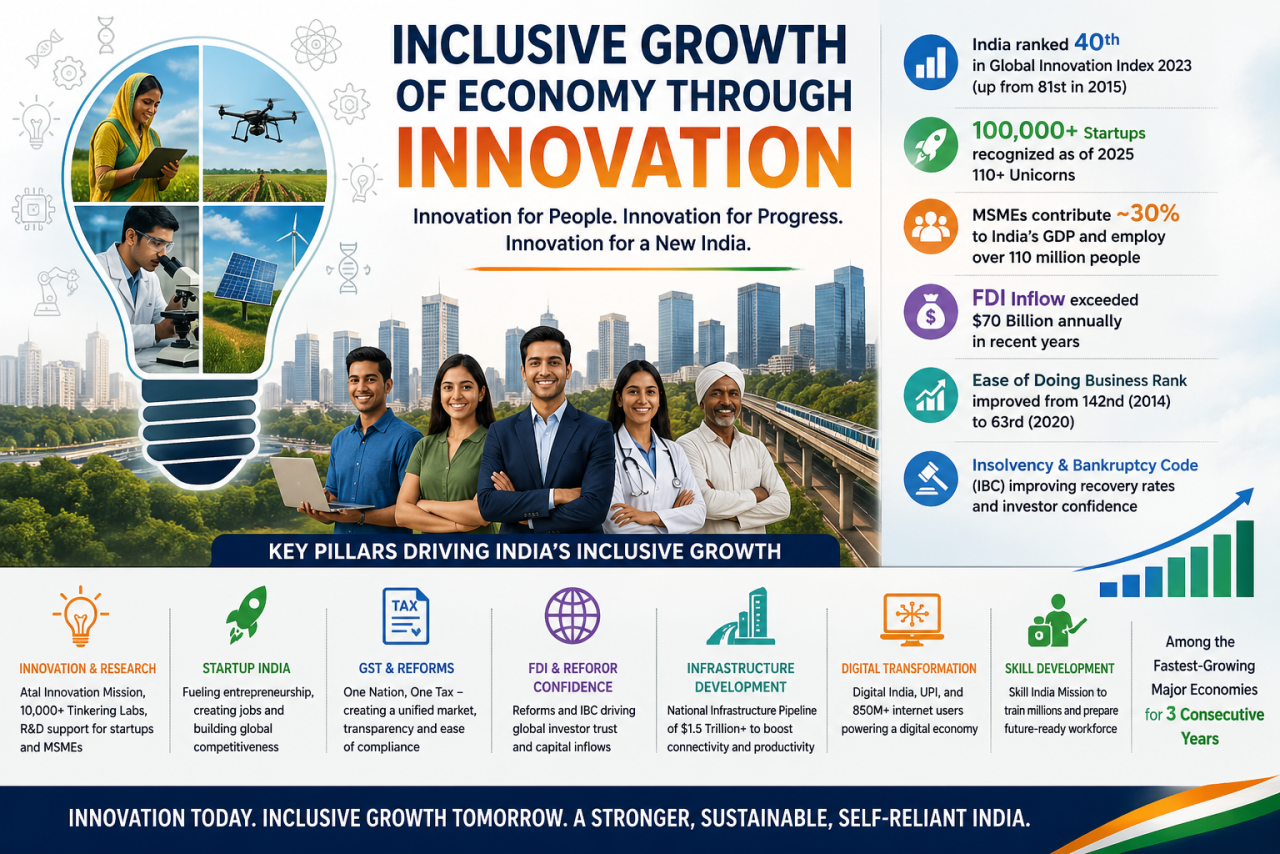
The results are visible. According to the latest Global Innovation Index 2025, India now ranks 38th globally, a significant jump from 81st in 2015. More importantly, India continues to be ranked 1st among lower-middle-income economies, reinforcing its position as an “innovation overperformer.” This steady rise reflects not just improved rankings but a deeper structural transformation in how the economy functions.
Innovation for Inclusive Development
At the centre of India’s innovation push lies inclusivity. The goal is not limited to creating unicorn startups or high-end technologies, but to ensure that innovation solves real-world problems—especially for those at the bottom of the economic pyramid.
Institutions like NITI Aayog have been instrumental in driving this agenda through programs such as the Atal Innovation Mission. With over 10,000+ Atal Tinkering Labs established in schools, the initiative is nurturing a culture of problem-solving and creativity among young Indians.
The focus on Micro, Small, and Medium Enterprises (MSMEs) further strengthens inclusive growth. MSMEs contribute nearly 30% to India’s GDP and employ over 110 million people. By enabling access to credit, digital tools, and innovation support, the government is ensuring that small businesses are not left behind in the growth story. This model effectively bridges grassroots challenges with scalable technological solutions.
Startup Ecosystem, GST & Structural Reforms
India’s startup ecosystem has witnessed exponential growth, largely driven by policy support and regulatory ease. The Startup India initiative has transformed the entrepreneurial landscape. As of 2026, India has over 110,000 recognized startups and more than 115 unicorns, making it the third-largest startup ecosystem in the world.
Tax and regulatory reforms have played a crucial role in enabling this growth. The implementation of the Goods and Services Tax (GST) unified the country into a single market, reducing logistical inefficiencies and improving compliance transparency.
These reforms contributed to India’s sharp rise in the World Bank Ease of Doing Business rankings—from 142nd in 2014 to 63rd in 2020—a leap that significantly improved global investor perception.
FDI Surge and Investor Confidence
India’s reform-oriented approach has translated into strong investor confidence. The country has consistently attracted $70–85 billion in annual Foreign Direct Investment (FDI) in recent years, placing it among the top global destinations for capital inflows.
A major structural reform supporting this trend is the Insolvency and Bankruptcy Code (IBC), which has improved recovery rates and introduced time-bound resolution mechanisms for distressed assets. This has made the business environment more predictable and investor-friendly—an essential factor for long-term economic growth.
Digital Transformation, Infrastructure & Skills
India’s digital revolution has been a game changer in making growth inclusive. Under the Digital India initiative, internet users have crossed 900 million, dramatically expanding access to services, education, and financial systems.
The Unified Payments Interface (UPI) has transformed the payments ecosystem, processing billions of transactions every month, and enabling even small vendors and rural users to participate in the formal economy. This level of financial inclusion is unprecedented for a country of India’s size.
Parallel investments in infrastructure are further accelerating growth. Programs like the National Infrastructure Pipeline (NIP), with planned investments exceeding $1.5 trillion, aim to enhance connectivity, logistics, and productivity.
Skill development remains another critical pillar. Initiatives under Skill India have trained millions of youth, preparing them for emerging sectors such as AI, renewable energy, and advanced manufacturing.
Final Take
India’s journey toward inclusive economic growth through innovation is not just a policy experiment—it is becoming a global model. By integrating technology with social objectives, the country is ensuring that growth is both broad-based and sustainable.
The real strength of India’s approach lies in its balance: fostering world-class startups while empowering small enterprises, driving digital transformation while investing in human capital, and attracting global capital while addressing local challenges.
If this momentum continues, India is well on track to emerge not only as an innovation powerhouse but also as a nation where economic progress genuinely includes everyone.
Innovation is no longer a luxury—it has become the backbone of economic growth in the 21st century. For a country like India, innovation is not just about technological advancement rather than it is about ensuring growth that reaches every layer of society. Over the past decade, India has consciously shifted toward an innovation-driven economic model, combining policy reforms, digital transformation, and grassroots participation.
The results are visible. According to the latest Global Innovation Index 2025, India now ranks 38th globally, a significant jump from 81st in 2015. More importantly, India continues to be ranked 1st among lower-middle-income economies, reinforcing its position as an “innovation overperformer.” This steady rise reflects not just improved rankings but a deeper structural transformation in how the economy functions.
Innovation for Inclusive Development
At the centre of India’s innovation push lies inclusivity. The goal is not limited to creating unicorn startups or high-end technologies, but to ensure that innovation solves real-world problems—especially for those at the bottom of the economic pyramid.
Institutions like NITI Aayog have been instrumental in driving this agenda through programs such as the Atal Innovation Mission. With over 10,000+ Atal Tinkering Labs established in schools, the initiative is nurturing a culture of problem-solving and creativity among young Indians.
The focus on Micro, Small, and Medium Enterprises (MSMEs) further strengthens inclusive growth. MSMEs contribute nearly 30% to India’s GDP and employ over 110 million people. By enabling access to credit, digital tools, and innovation support, the government is ensuring that small businesses are not left behind in the growth story. This model effectively bridges grassroots challenges with scalable technological solutions.
Startup Ecosystem, GST & Structural Reforms
India’s startup ecosystem has witnessed exponential growth, largely driven by policy support and regulatory ease. The Startup India initiative has transformed the entrepreneurial landscape. As of 2026, India has over 110,000 recognized startups and more than 115 unicorns, making it the third-largest startup ecosystem in the world.
Tax and regulatory reforms have played a crucial role in enabling this growth. The implementation of the Goods and Services Tax (GST) unified the country into a single market, reducing logistical inefficiencies and improving compliance transparency.
These reforms contributed to India’s sharp rise in the World Bank Ease of Doing Business rankings—from 142nd in 2014 to 63rd in 2020—a leap that significantly improved global investor perception.
FDI Surge and Investor Confidence
India’s reform-oriented approach has translated into strong investor confidence. The country has consistently attracted $70–85 billion in annual Foreign Direct Investment (FDI) in recent years, placing it among the top global destinations for capital inflows.
A major structural reform supporting this trend is the Insolvency and Bankruptcy Code (IBC), which has improved recovery rates and introduced time-bound resolution mechanisms for distressed assets. This has made the business environment more predictable and investor-friendly—an essential factor for long-term economic growth.
Digital Transformation, Infrastructure & Skills
India’s digital revolution has been a game changer in making growth inclusive. Under the Digital India initiative, internet users have crossed 900 million, dramatically expanding access to services, education, and financial systems.
The Unified Payments Interface (UPI) has transformed the payments ecosystem, processing billions of transactions every month, and enabling even small vendors and rural users to participate in the formal economy. This level of financial inclusion is unprecedented for a country of India’s size.
Parallel investments in infrastructure are further accelerating growth. Programs like the National Infrastructure Pipeline (NIP), with planned investments exceeding $1.5 trillion, aim to enhance connectivity, logistics, and productivity.
Skill development remains another critical pillar. Initiatives under Skill India have trained millions of youth, preparing them for emerging sectors such as AI, renewable energy, and advanced manufacturing.
Final Take
India’s journey toward inclusive economic growth through innovation is not just a policy experiment—it is becoming a global model. By integrating technology with social objectives, the country is ensuring that growth is both broad-based and sustainable.
The real strength of India’s approach lies in its balance: fostering world-class startups while empowering small enterprises, driving digital transformation while investing in human capital, and attracting global capital while addressing local challenges.
If this momentum continues, India is well on track to emerge not only as an innovation powerhouse but also as a nation where economic progress genuinely includes everyone.





















Leave a Comment