
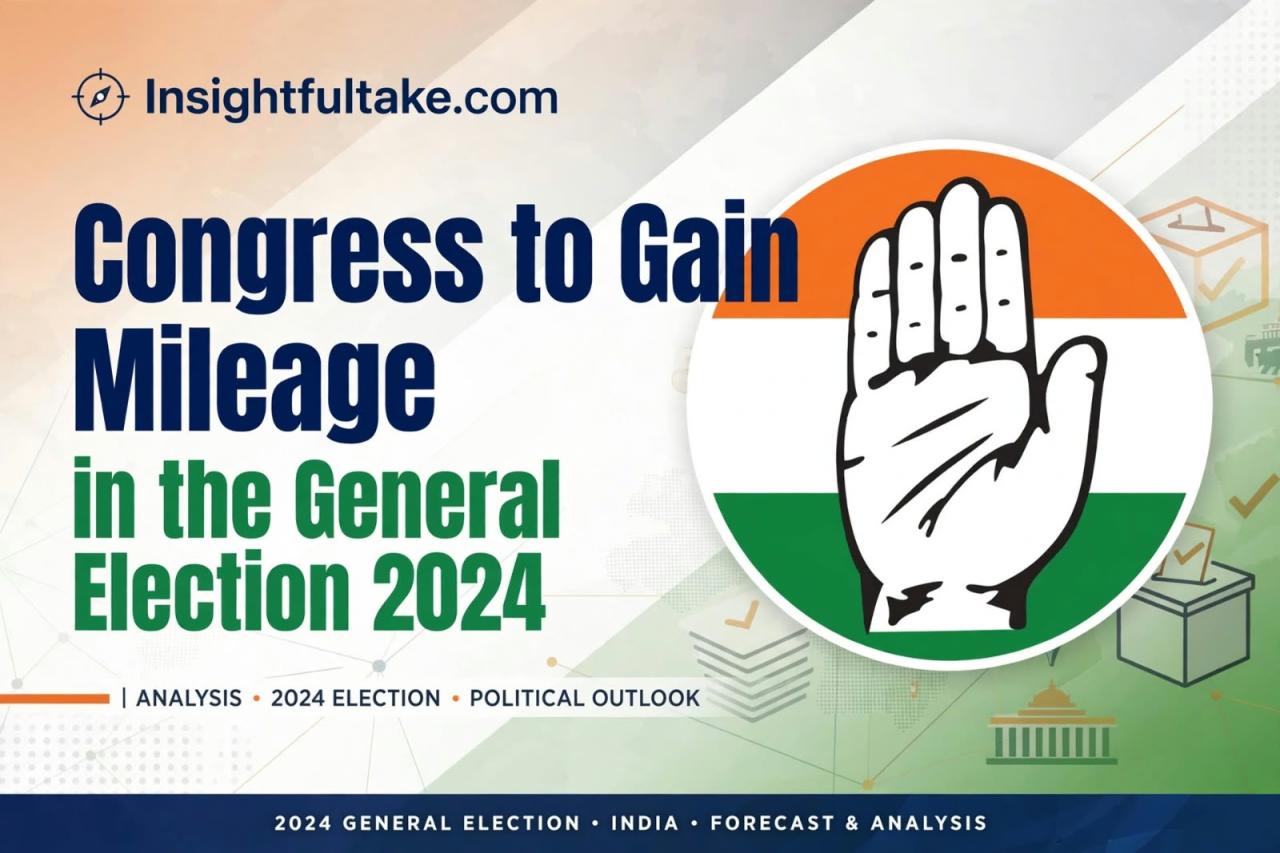
Congress hoped to regain political ground in 2024, but Rahul Gandhi, AAP and opposition unity presented both opportunities and challenges.
The Congress entered the 2024 general election facing a difficult task of rebuilding its organisation, regaining voter confidence and presenting itself as a credible alternative to the BJP. Rahul Gandhi remained at the centre of that effort as the party increasingly relied on him to lead its campaign and connect with voters.
The question of whether Rahul Gandhi should be projected as the Congress’s prime ministerial candidate had remained a subject of debate within the party. Some senior leaders had earlier been cautious about making such a commitment, but the demand for stronger and younger leadership was becoming more visible among party workers.
Rahul Gandhi had indicated that he was prepared to accept greater responsibility if the party believed he was the right person to lead it. For the Congress, this was important because the party needed a recognisable national face who could take on Narendra Modi and present a different political vision.
The party also knew that its traditional style of functioning had to change if it wanted to attract younger voters. India had a large young population that was increasingly connected through smartphones, social media and digital platforms. Jobs, education, economic opportunities, welfare and governance were among the issues shaping the political choices of this generation.
A generational shift inside Congress
The Congress needed to give younger leaders greater responsibility and a larger role in state politics. Its organisational decisions in states such as Bihar, Madhya Pradesh and Rajasthan indicated an effort to bring younger faces into positions of greater importance.
For the party, youth leadership was not simply about replacing older leaders with younger ones. It also required a change in political communication and organisation. Younger voters were less likely to respond to traditional political messaging and more likely to judge parties through their record, visibility and ability to communicate directly with them.
Rahul Gandhi’s growing visibility among Congress workers reflected this changing mood. His supporters believed that the party needed a national leader who could directly challenge Narendra Modi. His critics, however, continued to point to his electoral record and questioned whether he had the political experience required to take on the BJP’s formidable election machinery.
Those concerns could not be ignored. Narendra Modi had built considerable political experience over several years and had demonstrated an ability to run large election campaigns. The Congress therefore needed more than a change of leadership if it wanted to seriously challenge the BJP.
AAP adds another challenge
The Congress was also dealing with the growing influence of the Aam Aadmi Party.
Arvind Kejriwal and the AAP had expanded their political presence beyond Delhi and Punjab. The party had built its campaign around issues such as government schools, healthcare, electricity, welfare schemes and everyday governance. This gave AAP a political identity that was different from both the Congress and BJP.
The expansion of AAP created another complication for the Congress because the opposition vote could become divided in several constituencies. At the same time, the BJP could also face a changed electoral contest if AAP succeeded in expanding its support among urban and middle-class voters.
The Congress therefore had to consider two separate strategies. It needed to strengthen its own organisation while also finding areas where cooperation with other opposition parties could work.
The opposition alliance question
The possibility of a broader opposition understanding was likely to remain important during the election campaign.
Rahul Gandhi, Priyanka Gandhi Vadra and Arvind Kejriwal represented different political organisations and had different electoral strengths. Their parties also had competing interests in several states. Any attempt to build a common front would therefore require difficult negotiations over seats, leadership and campaign strategy.
The fact that Rahul Gandhi, Priyanka Gandhi Vadra and Arvind Kejriwal have all practised Vipassana meditation was an interesting personal connection, but it had little direct relevance to electoral politics. Their political relationship would depend on practical considerations rather than personal similarities.
For Congress, cooperation with regional parties could be useful in states where the BJP had a strong presence. But alliances could also create problems if local parties demanded more seats or refused to accept Congress leadership.
Congress has an opportunity
The Congress had reasons to believe that it could improve its position in 2024 if it managed to combine Rahul Gandhi’s national presence with stronger state leadership and better grassroots organisation.
But political mileage alone would not be enough. The BJP had the advantage of a powerful organisational network, an established national leadership and Narendra Modi’s strong appeal among a substantial section of voters.
The Congress therefore needed to convince voters that it had changed. That meant improving its organisation, giving younger leaders genuine responsibility, communicating more effectively and presenting clear positions on employment, education, economic growth, welfare and governance.
Rahul Gandhi could play an important role in that effort. A wider opposition understanding could also improve the party’s prospects in several constituencies.
The 2024 election was therefore going to test more than Rahul Gandhi’s leadership or Narendra Modi’s popularity. It would also test whether the Congress could recover from years of electoral setbacks and rebuild itself as a serious national political force.
The party had an opportunity to gain ground, but converting that opportunity into votes required organisation, a clear political message and a sustained campaign at the grassroots level.












Leave a Comment